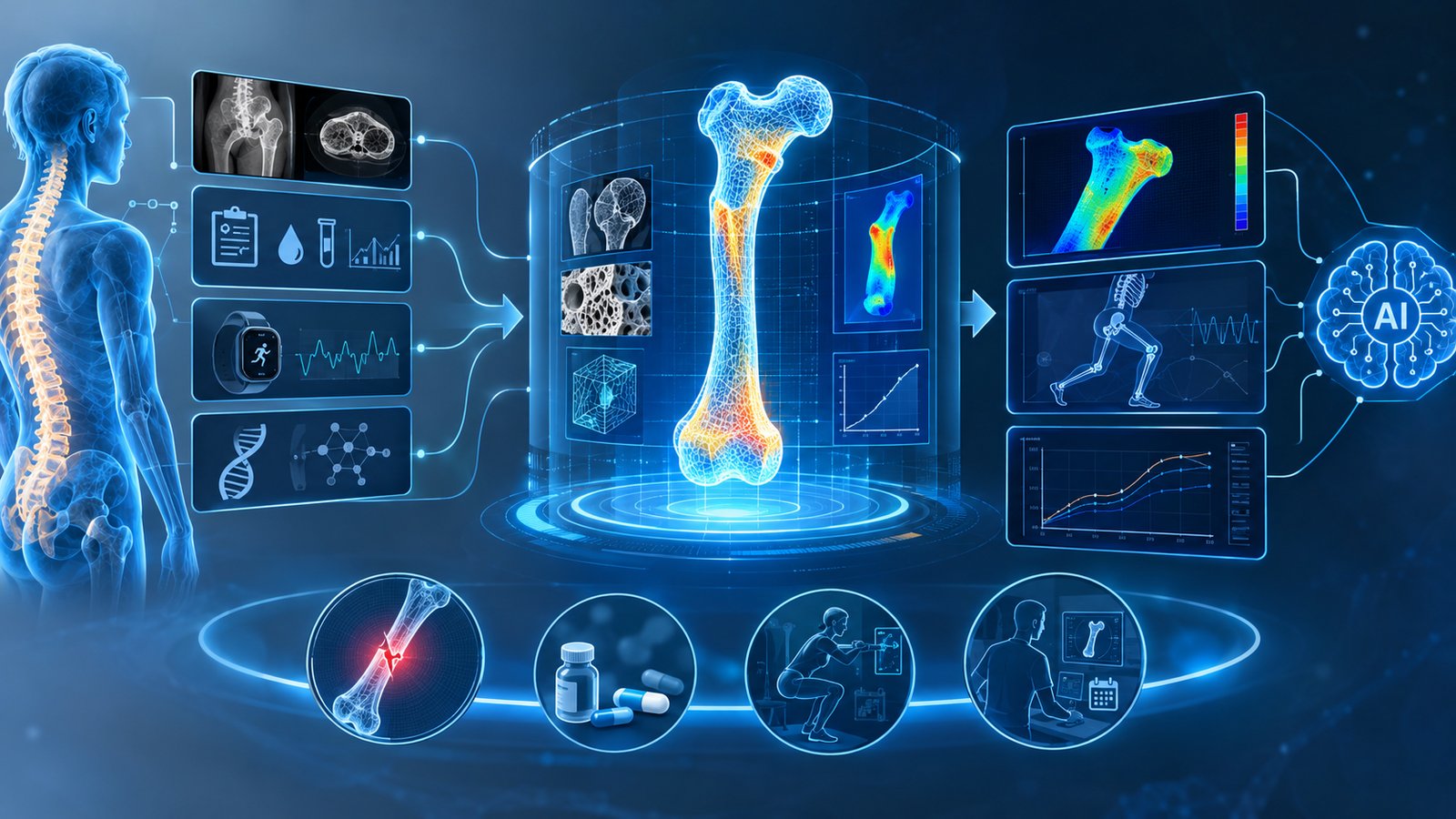
数字孪生技术为骨健康领域的精准评估与个体化管理提供了新的研究方向。通过整合医学影像、临床指标、生物力学建模、人工智能及连续监测数据,骨健康数字孪生有望构建动态更新的个体化骨骼模型,用于骨折风险评估、治疗效果模拟、骨折愈合监测及长期健康管理。本文综述了骨健康数字孪生的基本概念、技术架构、潜在临床应用及主要挑战,重点探讨数据整合、有限元分析、模型验证、预测不确定性与数据隐私等关键问题。当前,该技术仍处于探索与发展阶段,其临床价值尚需通过标准化研究、外部验证及前瞻性临床研究进一步证实。未来应优先围绕明确的临床需求开展研究,推动数字孪生从计算模型向可靠、可解释且具有临床实用价值的决策支持工具转化。
Digital twin technology offers a promising research direction for precision assessment and personalized management of bone health. By integrating medical imaging, clinical parameters, biomechanical modeling, artificial intelligence, and longitudinal monitoring data, bone-health digital twins may enable dynamic, patient-specific skeletal models for fracture-risk assessment, treatment-response simulation, fracture-healing monitoring, and long-term health management. This article reviews the fundamental concepts, technical architecture, potential clinical applications, and major challenges of bone-health digital twins, with particular attention to data integration, finite element analysis, model validation, predictive uncertainty, and data privacy. The technology remains at an exploratory stage, and its clinical value requires further confirmation through standardized research, external validation, and prospective clinical studies. Future efforts should prioritize clearly defined clinical needs and facilitate the translation of digital twins from computational models into reliable, interpretable, and clinically useful decision-support tools.
一、概念界定:从数字模型到数字孪生
骨健康数字孪生(digital twin)是指利用医学影像、临床指标、生物力学模型及连续监测数据,在数字空间构建与真实个体骨骼状态相对应、可随新数据更新的虚拟模型。其目标不只是重建骨骼的三维形态,更是模拟骨骼结构、力学性能、骨重建过程及治疗反应,辅助评估疾病进展和骨折风险。
A digital twin for bone health is a patient-specific virtual model constructed from medical imaging, clinical measurements, biomechanical models, and longitudinal monitoring data. Unlike a static three-dimensional reconstruction, it aims to represent and simulate skeletal structure, mechanical behavior, bone remodeling, and treatment response, thereby supporting assessment of disease progression and fracture risk.
需要强调的是,数字模型、人工智能预测工具与真正的数字孪生并不完全等同。数字孪生通常强调个体化建模、持续的数据更新、模拟能力,以及虚拟模型与真实个体之间的反馈关系。当前肌肉骨骼领域的相关研究仍处于发展阶段,不同研究对“数字孪生”的定义和实现程度并不一致,临床应用成熟度也存在差异。
It is important to distinguish a digital twin from a static digital model or a standalone artificial intelligence prediction tool. A digital twin generally implies patient-specific modeling, ongoing data updates, simulation capability, and a feedback relationship between the virtual model and the real individual. Research in musculoskeletal medicine remains developmental, with substantial variation in definitions, implementation, and clinical maturity.
二、技术架构:构建个体化骨骼虚拟模型
骨健康数字孪生可以整合多层次数据。第一层是结构数据,包括双能X线吸收法(DXA)、定量CT(QCT)、临床CT及必要时的高分辨率外周定量CT(HR-pQCT),用于描述骨密度、几何结构和骨微结构。第二层是临床与生物学数据,包括年龄、既往脆性骨折、用药史、肾功能、钙磷代谢指标及骨转换标志物。第三层是功能数据,例如步态、平衡、肌力、活动水平和可穿戴设备记录的运动负荷。
A bone-health digital twin can integrate several layers of information. Structural data from dual-energy X-ray absorptiometry (DXA), quantitative CT (QCT), clinical CT, and, where appropriate, high-resolution peripheral QCT (HR-pQCT) characterize bone density, geometry, and microarchitecture. Clinical and biological data include age, prior fragility fractures, medication exposure, renal function, calcium–phosphate metabolism, and bone-turnover markers. Functional data may include gait, balance, muscle strength, physical activity, and loading patterns captured by wearable devices.
在建模层面,有限元分析(finite element analysis, FEA)可将骨骼几何结构与材料属性转化为计算模型,模拟不同载荷下的应力、应变及潜在失效位置;生物力学模型可进一步纳入肌肉力量、关节运动和个体活动模式。机器学习则可用于影像分割、参数估计、数据融合和风险预测。理想系统还应量化预测不确定性,明确模型在何种患者群体和临床场景下可靠。
At the modeling level, finite element analysis (FEA) converts skeletal geometry and material properties into computational representations of stress, strain, and potential failure locations under different loading conditions. Biomechanical models can incorporate muscle forces, joint motion, and individual activity patterns. Machine learning may support image segmentation, parameter estimation, data fusion, and risk prediction. A clinically credible system should also quantify uncertainty and specify the populations and settings in which its predictions are reliable.
已有研究为这一技术路线提供了初步依据。例如,研究者已探索利用人工智能重建椎体数字模型,并结合有限元方法预测椎体骨折响应;2025年的肌肉骨骼数字孪生综述也归纳了生物力学模拟、可穿戴监测及个体化康复等应用方向。此类成果证明了技术可行性,但不能直接等同于已验证的骨质疏松诊疗工具。
Early studies support the feasibility of this approach. Researchers have explored AI-assisted vertebral reconstruction combined with finite element modeling to predict vertebral fracture responses. A 2025 review of musculoskeletal digital twins also described applications in biomechanical simulation, wearable monitoring, and personalized rehabilitation. These findings demonstrate technical promise, but they do not establish that digital twins are already validated tools for routine osteoporosis diagnosis or management.
三、潜在临床应用:从骨折风险评估到治疗模拟
1. 骨折风险的个体化评估。 传统骨折风险评估通常整合临床危险因素与骨密度,但难以全面呈现特定骨骼部位的结构差异及复杂载荷条件。数字孪生有望将骨密度、骨几何结构、局部力学特征、跌倒风险和活动模式结合起来,探索更具个体针对性的骨折风险表征。其价值在于补充而非简单替代现有工具,例如FRAX及DXA相关评估。
1. Personalized fracture-risk assessment. Conventional fracture-risk assessment integrates clinical risk factors and bone density but may not fully represent site-specific structural variation or complex loading conditions. Digital twins could combine bone density, geometry, local mechanical characteristics, fall risk, and activity patterns to develop more individualized representations of fracture risk. Their potential role is to complement—not simply replace—established tools such as FRAX and DXA-based assessment.
2. 治疗方案的虚拟模拟。 数字孪生可以探索不同干预策略下可能出现的变化,例如抗骨质疏松药物治疗后骨转换指标与骨密度的变化、不同运动负荷对骨骼力学环境的影响,以及脊柱手术或椎体强化术对局部稳定性的影响。对于骨折患者,还可以将骨折形态、固定方式、骨质量与康复负荷结合,用于研究骨折愈合和延迟愈合风险。2026年发表的骨折愈合建模综述进一步讨论了个体化建模与康复方案之间的联系。
2. Virtual treatment simulation. Digital twins may enable exploration of potential responses to different interventions, including changes in bone-turnover markers and bone density during osteoporosis treatment, the effects of exercise loading on skeletal mechanics, and changes in local stability after spinal surgery or vertebral augmentation. In fracture care, models may integrate fracture morphology, fixation strategy, bone quality, and rehabilitation loading to investigate healing trajectories and delayed-union risk. A 2026 review of fracture-healing models further examined the relationship between patient-specific modeling and individualized rehabilitation.
3. 长期随访与动态管理。 将复查影像、实验室检查、治疗依从性、跌倒事件及可穿戴设备数据持续纳入模型,理论上可以追踪患者骨健康状态的变化,并在风险趋势发生变化时提示临床团队重新评估。对于骨折联络服务(FLS),数字孪生可作为探索性研究框架,帮助整合骨折后评估、二级预防、治疗监测与康复随访,形成更连续的管理链条。
3. Longitudinal monitoring and adaptive care. Repeated imaging, laboratory results, treatment adherence, falls, and wearable-device data could be incorporated over time to track changes in skeletal health and flag trends that warrant clinical reassessment. In fracture liaison services (FLS), digital twins could serve as an exploratory framework for integrating post-fracture assessment, secondary prevention, treatment monitoring, and rehabilitation follow-up into a more continuous care pathway.
四、关键挑战:技术准确不等于临床有效
骨健康数字孪生面临的首要挑战是数据质量与标准化。DXA、CT及不同影像设备的测量结果存在差异;骨组织材料属性难以通过常规影像直接、准确地获得;真实载荷又受到姿势、肌肉力量和日常活动的影响。模型输入中的偏差可能在复杂计算过程中被放大,因此需要明确数据来源、校准方法和适用边界。
The first major challenge is data quality and standardization. Measurements differ across DXA, CT, and imaging platforms; bone material properties cannot always be inferred accurately from routine imaging; and real-world loading depends on posture, muscle strength, and daily activity. Bias in model inputs may propagate through complex simulations, making transparent data provenance, calibration methods, and clearly defined applicability limits essential.
第二个挑战是模型验证。计算模型与实验测量一致,只能说明其在特定条件下具有一定技术可信度,不能证明其能够改善患者结局。研究应逐步开展外部验证、前瞻性队列研究及适当的临床试验,评价模型对骨折预测、治疗选择和患者结局是否具有增量价值,并与现有临床工具进行直接比较。现阶段,骨健康数字孪生更适合作为研究与临床决策支持的探索方向,而不应被描述为已普遍成熟的临床标准。
The second challenge is model validation. Agreement between computational outputs and experimental measurements demonstrates technical credibility under specific conditions, but does not prove improved patient outcomes. Research should progress through external validation, prospective cohorts, and appropriate clinical trials to determine whether digital twins add value for fracture prediction, treatment selection, and patient outcomes compared with existing tools. At present, bone-health digital twins are best regarded as an emerging research and decision-support approach, rather than an established standard of care.
第三个挑战涉及可解释性、隐私和公平性。数字孪生可能融合影像、病历、基因或连续生理数据,必须建立明确的数据授权、访问控制和安全治理机制。模型还应说明关键预测因素及不确定性,并评估不同年龄、性别、族群和合并症人群中的性能差异,避免技术进步扩大医疗资源与算法偏差带来的不平等。
Further challenges concern interpretability, privacy, and equity. Digital twins may combine imaging, medical records, genetic information, or continuous physiological data, requiring explicit consent, access controls, and robust data governance. Models should communicate important predictive factors and uncertainty, while performance should be evaluated across age groups, sexes, populations, and comorbidity profiles to avoid worsening inequalities through algorithmic bias or unequal access.
五、未来研究方向
未来研究可优先选择临床问题明确、数据相对可得的应用场景,例如椎体骨折力学模拟、骨折愈合监测或高危患者的动态风险评估,而非一开始就构建覆盖全身骨骼、全部疾病过程的复杂模型。研究设计应预先规定目标人群、预测终点、更新频率、模型性能指标及临床行动阈值,并评估成本效益和工作流程可行性。
Future research should prioritize clinically defined applications with accessible data, such as vertebral fracture mechanics, fracture-healing monitoring, or dynamic risk assessment in high-risk patients, rather than attempting to model the entire skeleton and all disease processes from the outset. Studies should prespecify target populations, prediction endpoints, update frequency, performance metrics, and clinical action thresholds, while evaluating cost-effectiveness and workflow feasibility.
从长远来看,骨健康数字孪生的意义不在于制造一个看似完整的虚拟骨骼,而在于建立能够持续更新、经过严格验证,并能回答具体临床问题的个体化模型。只有当其预测结果可以转化为更合理的决策,并在前瞻性研究中证实能够改善患者结局时,数字孪生才可能真正推动骨健康管理走向精准化和动态化。
Ultimately, the value of a bone-health digital twin lies not in producing a visually complete virtual skeleton, but in building an individualized model that can be updated, rigorously validated, and used to address specific clinical questions. Only when its predictions inform better decisions and demonstrate improved patient outcomes in prospective studies can digital twins meaningfully advance precision and adaptive bone-health management.
参考文献
1. Diniz P, Grimm B, Garcia F, et al. Digital twin systems for musculoskeletal applications: a current concepts review. Knee Surg Sports Traumatol Arthrosc. 2025;33:1892–1910.
2. Wang et al. The Digital Twin: A Potential Solution for the Personalized Diagnosis and Treatment of Musculoskeletal System Diseases. Front Bioeng Biotechnol. 2023.
3. Ahmadian H, Mageswaran P, Walter BA, et al. Toward an artificial intelligence-assisted framework for reconstructing the digital twin of vertebra and predicting its fracture response. Int J Numer Method Biomed Eng. 2022;38(6):e3601.
4. Li L, Patel M, Zhang L. A review of bone fracture healing modelling: from mechanobiological theory to personalized rehabilitation protocols. Bone. 2026;202:117688.
5. Glinkowski WM, Gieroba T, Śliwczyński A. Digital Twins in Orthopedics and Trauma: Concepts, Emerging Evidence, and Barriers to Clinical Translation. J Clin Med. 2026;15(11):4127.