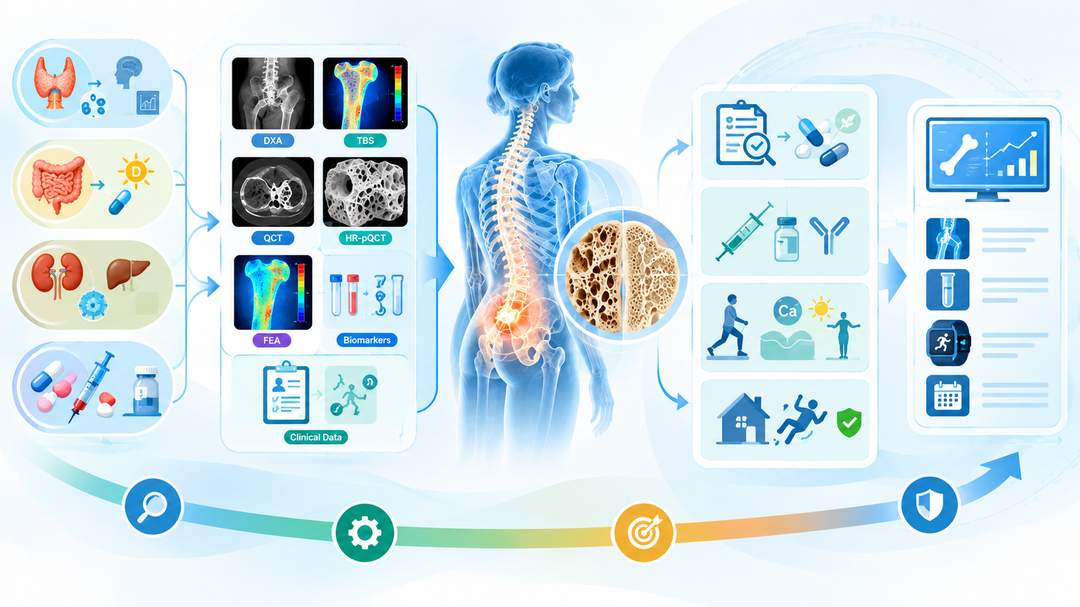
继发性骨质疏松症是由基础疾病、药物暴露或营养与代谢异常引起或加重的骨量减少及骨脆弱性增加。与原发性骨质疏松相比,其临床管理更强调系统性病因筛查、可逆因素识别及针对性干预。本文综述继发性骨质疏松的主要病因、临床线索、实验室筛查策略与精准管理路径,重点讨论内分泌异常、慢性疾病、营养缺乏及药物相关骨丢失的识别与处理,并探讨骨折风险分层、个体化药物选择和长期疗效监测的临床价值。通过整合基础疾病治疗、骨折预防、生活方式干预及持续随访,有望改善治疗反应并降低后续脆性骨折风险。
Secondary osteoporosis refers to reduced bone mass and increased skeletal fragility caused or aggravated by underlying diseases, medication exposure, or nutritional and metabolic abnormalities. Compared with primary osteoporosis, its management places greater emphasis on systematic etiological investigation, identification of reversible factors, and targeted interventions. This article reviews the major causes, clinical indicators, laboratory screening strategies, and precision management pathways for secondary osteoporosis. Particular attention is given to endocrine disorders, chronic diseases, nutritional deficiencies, and medication-related bone loss, alongside the clinical value of fracture-risk stratification, individualized pharmacotherapy, and long-term treatment monitoring. Integrating management of underlying conditions with fracture prevention, lifestyle interventions, and longitudinal follow-up may improve treatment response and reduce subsequent fragility fractures.
一、病因识别:继发性骨质疏松不应被忽视
继发性骨质疏松症是由基础疾病、药物暴露或营养与代谢异常引起或加重的骨量减少及骨脆弱性增加。相关综述指出,继发性病因在绝经前女性和男性骨质疏松患者中尤其值得关注;若仅依据DXA结果进行治疗,而未识别潜在病因,可能导致骨丢失持续、治疗反应不佳或继发性骨病漏诊。
Secondary osteoporosis refers to reduced bone mass and increased skeletal fragility caused or aggravated by underlying diseases, medication exposure, or nutritional and metabolic abnormalities. Reviews highlight the importance of investigating secondary causes, particularly in premenopausal women and men with osteoporosis. Treating BMD abnormalities without identifying the underlying cause may allow continued bone loss, contribute to a suboptimal treatment response, or delay the diagnosis of another metabolic bone disorder.
常见病因可归纳为几类:内分泌异常,包括甲状旁腺功能亢进、甲状腺功能亢进、库欣综合征和性腺功能减退;营养及消化系统疾病,包括维生素D缺乏、钙摄入不足、乳糜泻和其他吸收不良;慢性疾病,包括慢性肾病、慢性肝病、炎症性疾病及部分血液系统肿瘤;以及药物相关因素,尤其是长期糖皮质激素、芳香化酶抑制剂、雄激素剥夺治疗和部分抗癫痫药物。
Common causes can be grouped into several categories: endocrine disorders, including hyperparathyroidism, hyperthyroidism, Cushing syndrome, and hypogonadism; nutritional and gastrointestinal conditions, including vitamin D deficiency, inadequate calcium intake, celiac disease, and other malabsorptive disorders; chronic diseases, including chronic kidney or liver disease, inflammatory disorders, and selected hematological malignancies; and medication-related factors, particularly prolonged glucocorticoid exposure, aromatase inhibitors, androgen-deprivation therapy, and certain antiseizure medications.
二、从临床线索到分层检查
病因筛查应从病史、体格检查和骨折特征开始。较年轻时发生脆性骨折、骨密度显著低于年龄预期、反复骨折、身高进行性下降、长期使用影响骨代谢的药物,或骨密度与临床表现不相称,均应提高对继发性病因的警惕。男性、绝经前女性以及治疗过程中出现非预期骨丢失的患者,通常尤其需要进一步评估。
Evaluation should begin with the clinical history, physical examination, and fracture characteristics. Fragility fractures at a relatively young age, BMD substantially below that expected for age, recurrent fractures, progressive height loss, prolonged exposure to bone-affecting medications, or a mismatch between BMD and the clinical presentation should raise suspicion of a secondary cause. Men, premenopausal women, and patients with unexpected bone loss during treatment often warrant particular attention.
初始实验室评估可根据临床情况包括血常规、血钙(必要时校正白蛋白)、磷、肌酐及估算肾小球滤过率、碱性磷酸酶和25-羟维生素D。甲状腺功能、甲状旁腺激素、肝功能、性激素、尿钙、乳糜泻相关抗体以及血清蛋白电泳等,应依据症状、体征和初筛结果选择,而非对所有患者机械地进行全套检查。
Depending on the clinical context, initial laboratory investigations may include a complete blood count, serum calcium with albumin correction when appropriate, phosphate, creatinine and estimated glomerular filtration rate, alkaline phosphatase, and 25-hydroxyvitamin D. Thyroid function, parathyroid hormone, liver function, sex hormones, urinary calcium, celiac serology, and serum protein electrophoresis should be selected according to clinical findings and initial results rather than ordered indiscriminately in every patient.
检查结果还需结合鉴别诊断解释。例如,低磷血症、碱性磷酸酶异常或骨痛可能提示骨软化症等矿化障碍;高钙血症可能提示甲状旁腺功能亢进或恶性肿瘤;贫血、肾功能异常及骨痛并存时,应考虑浆细胞疾病等可能。此时,单纯将低骨密度归类为原发性骨质疏松,可能延误针对病因的治疗。
Laboratory findings must also be interpreted in the context of differential diagnosis. Hypophosphatemia, abnormal alkaline phosphatase, or bone pain may suggest osteomalacia or another mineralization disorder. Hypercalcemia may indicate hyperparathyroidism or malignancy. The combination of anemia, renal dysfunction, and bone pain warrants consideration of plasma-cell disorders. Misclassifying low BMD as primary osteoporosis may delay essential cause-directed treatment.
三、精准管理:从纠正病因到骨折风险控制
继发性骨质疏松的治疗应采用双轨策略:一方面尽可能控制基础疾病、调整可替代的致病药物并纠正营养或代谢异常;另一方面,根据患者的骨折风险决定是否需要抗骨质疏松药物。病因治疗不能自动替代骨折预防,例如,纠正维生素D缺乏并不意味着已经发生椎体或髋部脆性骨折的患者不再需要进一步的骨质疏松治疗。
Management should follow a dual-track strategy: address the underlying disease, modify causative medications when feasible, and correct nutritional or metabolic abnormalities, while independently assessing whether osteoporosis medication is required according to fracture risk. Treating the underlying cause does not automatically eliminate the need for fracture prevention. For example, correcting vitamin D deficiency does not remove the potential indication for osteoporosis treatment in a patient who has already sustained a vertebral or hip fragility fracture.
对于糖皮质激素相关骨质疏松,应综合评估药物剂量、疗程、既往骨折、年龄及DXA结果,并尽早采取与风险水平相匹配的干预。对于性腺功能减退,应明确激素异常的原因及治疗适应证;对于慢性肾病患者,则需鉴别慢性肾病相关矿物质和骨异常(CKD-MBD),避免仅依据BMD套用一般骨质疏松治疗路径。对肿瘤治疗相关骨丢失患者,应将抗骨质疏松治疗与肿瘤治疗计划、肾功能及其他安全性因素统筹考虑。
For glucocorticoid-induced osteoporosis, assessment should integrate drug dose and duration, prior fractures, age, and DXA findings, with early intervention tailored to risk. In hypogonadism, the cause of hormonal abnormalities and the indications for replacement therapy should be established. In chronic kidney disease, clinicians should distinguish osteoporosis from chronic kidney disease–mineral and bone disorder (CKD-MBD), rather than automatically applying standard osteoporosis treatment pathways based on BMD alone. For cancer treatment-related bone loss, osteoporosis management should be coordinated with the oncological treatment plan, renal function, and other safety considerations.
药物选择应基于骨折风险、病因、肾功能、禁忌证及患者偏好。双膦酸盐和地舒单抗可用于适宜患者,但肾功能、低钙血症风险及停药后的序贯治疗安排需要充分考虑;极高骨折风险患者可在符合适应证时考虑促骨形成治疗,并根据药物特性安排后续抗骨吸收治疗。无论采用何种药物,都应同时落实适当的钙与维生素D摄入、抗阻和负重运动、跌倒预防以及用药依从性管理。
Drug selection should reflect fracture risk, underlying etiology, renal function, contraindications, and patient preferences. Bisphosphonates and denosumab are options for appropriate patients, but renal considerations, hypocalcemia risk, and sequential treatment planning after discontinuation require attention. For patients at very high fracture risk, bone-forming therapy may be considered when indicated, followed by antiresorptive treatment as appropriate. Regardless of medication choice, management should include adequate calcium and vitamin D intake, resistance and weight-bearing exercise, fall prevention, and support for treatment adherence.
四、疗效监测与未来探索
精准管理不应以骨密度变化作为唯一终点。随访应综合新发脆性骨折、身高变化、疼痛与功能状态、药物不良反应、依从性及基础疾病控制情况。DXA复查间隔应根据初始风险、治疗方案及临床变化决定;骨转换标志物,如P1NP和CTX,可在适当情境下辅助评估治疗反应与依从性,但必须考虑采样条件、检测平台及生物学变异。
Precision management should not rely on BMD change as the sole endpoint. Follow-up should integrate incident fragility fractures, changes in height, pain and functional status, adverse effects, adherence, and control of the underlying disease. DXA intervals should be determined by baseline risk, treatment strategy, and clinical changes. Bone turnover markers, including P1NP and CTX, may help assess treatment response and adherence in selected settings, provided that sampling conditions, assay platforms, and biological variability are considered.
未来研究应重点探索基于病因分型的风险预测模型、不同继发性骨质疏松亚型的药物疗效差异,以及将电子病历、影像学、实验室指标与临床风险算法整合的决策支持工具。真正的精准管理不仅是选择更强效的药物,更是识别可逆病因、避免错误诊断、合理安排治疗顺序,并通过长期随访降低再次骨折风险。
Future research should prioritize etiology-specific fracture prediction, differences in treatment response across secondary osteoporosis subtypes, and decision-support tools integrating electronic health records, imaging, laboratory biomarkers, and clinical risk algorithms. Precision management is not simply about selecting more potent medication; it requires identifying reversible causes, avoiding diagnostic errors, sequencing treatment appropriately, and reducing subsequent fracture risk through long-term follow-up.
结论
继发性骨质疏松症要求临床医生从单纯识别低骨密度转向系统性病因调查和个体化骨折预防。将基础疾病治疗、药物风险管理、骨折风险分层及持续监测有机结合,是改善治疗反应和降低再骨折风险的关键。
Secondary osteoporosis requires a shift from simply identifying low BMD to systematic etiological investigation and individualized fracture prevention. Integrating treatment of underlying diseases, medication-risk management, fracture-risk stratification, and ongoing monitoring is essential to improving treatment response and reducing subsequent fractures.
参考文献
1. Ebeling PR, Nguyen HH, Aleksova J, et al. Secondary Osteoporosis. Endocrine Reviews. 2022;43(2):240–313.
2. LeBoff MS, Greenspan SL, Insogna KL, et al. The clinician’s guide to prevention and treatment of osteoporosis. Osteoporosis International. 2022;33:2049–2102.
3. Shoback D, Rosen CJ, Black DM, et al. Pharmacological Management of Osteoporosis in Postmenopausal Women: An Endocrine Society Clinical Practice Guideline. The Journal of Clinical Endocrinology & Metabolism. 2020;105(3):587–594.
4. Fuggle NR, Curtis EM, Ward KA, et al. Evidence-Based Guideline for the management of osteoporosis in men. Nature Reviews Rheumatology. 2024;20:241–251.
5. Agency for Care Effectiveness, Singapore. Osteoporosis: diagnosis and management.