背景|Background
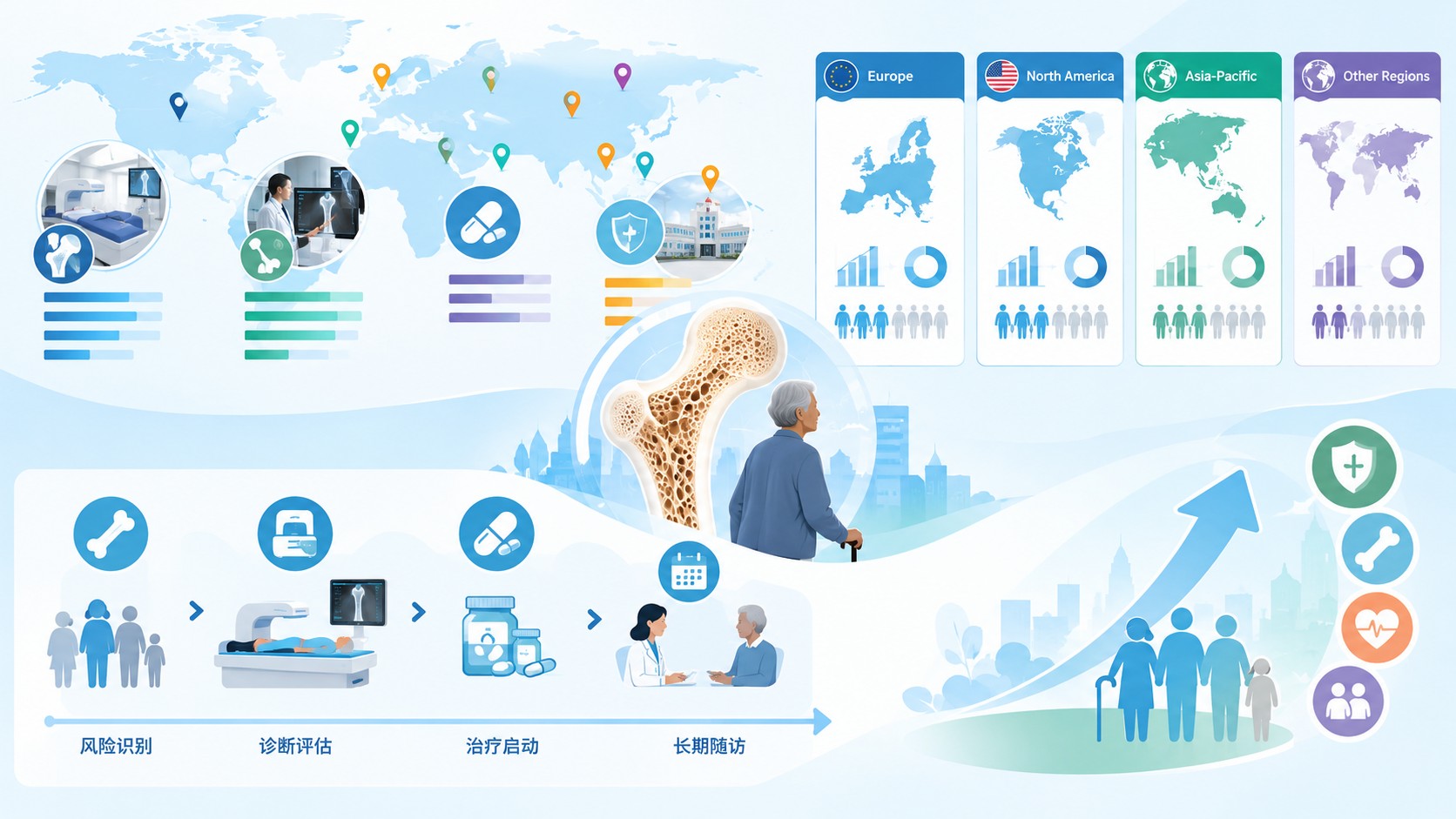
随着全球人口老龄化加速,骨质疏松症及脆性骨折已成为影响老年人生活质量、独立生活能力和医疗卫生资源配置的重要公共卫生问题。尽管骨密度检测、骨折风险预测和抗骨质疏松药物不断发展,临床实践中的筛查不足、治疗延迟、骨折后二级预防不充分及长期随访中断等问题仍普遍存在。不同国家和地区在经济发展水平、医疗保障制度、诊断资源分布、临床指南实施及患者健康认知方面的差异,进一步造成骨健康服务的可及性与质量不均衡。因此,从全球视角比较不同地区的诊疗模式及其实施障碍,不仅有助于理解循证证据与临床现实之间的差距,也有助于识别可推广的实践经验,为构建更加公平、连续且以骨折预防为导向的骨健康管理体系提供依据。
With global population aging accelerating, osteoporosis and fragility fractures have become major public health concerns affecting quality of life, independent living, and healthcare resource allocation among older adults. Despite advances in bone mineral density testing, fracture-risk prediction, and anti-osteoporosis therapies, inadequate screening, delayed treatment, insufficient secondary fracture prevention, and interrupted long-term follow-up remain common challenges. Differences in economic development, healthcare financing, diagnostic infrastructure, implementation of clinical guidelines, and public awareness further contribute to inequalities in access to and quality of bone health care. Comparing clinical practices and implementation barriers across regions can therefore help clarify the gap between evidence and real-world care, identify transferable best practices, and inform the development of a more equitable, coordinated, and fracture-prevention-oriented model of bone health management.
一、全球共同挑战:循证证据并未转化为均等的临床获益 | A Global Challenge: Evidence Has Not Translated into Equitable Clinical Benefits
骨质疏松症的诊断工具、骨折风险评估方法及抗骨质疏松药物已取得显著进展,但不同国家和地区的临床实践仍存在明显差异。差异不仅体现在药物是否可及,还体现在筛查策略、骨密度检测能力、治疗启动时机、医保支付、骨折后二级预防和长期随访等环节。全球骨健康领域的核心问题,已不仅是“是否拥有有效治疗”,更是“哪些患者能够及时获得适当治疗,并从中持续获益”。
Osteoporosis diagnostics, fracture-risk assessment, and pharmacological treatments have advanced considerably, yet clinical practice continues to vary substantially across countries and regions. Differences extend beyond drug availability to screening strategies, access to bone mineral density testing, treatment initiation, reimbursement, secondary fracture prevention, and long-term follow-up. The central global challenge is no longer simply whether effective treatments exist, but whether patients can access appropriate care in time and benefit from it over the long term.
国际骨质疏松基金会(IOF)发布的欧洲骨质疏松症评估报告SCOPE 2021显示,2019年欧盟27国及相关欧洲国家中,达到干预阈值的女性平均治疗缺口约为71%,国家间差异显著,约从32%到86%不等。换言之,即使在诊疗体系相对完善的欧洲,高骨折风险女性仍有相当一部分未接受适当治疗。研究团队指出,治疗缺口并非单纯由疾病负担决定,医疗服务组织、风险识别能力和治疗可及性同样重要。[1]
The International Osteoporosis Foundation’s SCOPE 2021 report estimated that the treatment gap among women eligible for intervention across the EU27 and associated European countries averaged approximately 71% in 2019, ranging from around 32% to 86% between countries. In other words, a substantial proportion of women at high fracture risk remained untreated even in comparatively well-resourced healthcare systems. These findings indicate that treatment gaps reflect not only disease burden but also differences in service organization, risk identification, and access to therapy.[1]
二、欧洲与北美:指南较成熟,但治疗缺口仍然存在 | Europe and North America: Established Guidelines, Persistent Treatment Gaps
欧洲的临床实践通常强调基于骨折风险的分层管理。FRAX等风险评估工具、双能X线吸收法(DXA)及各国干预阈值共同参与治疗决策。然而,2024年对法国、德国、意大利、西班牙和英国等五个欧洲国家的10部指南进行比较发现,尽管主要治疗原则大体一致,各国在风险评估方法和治疗决策方面仍存在差异,部分差异与本国医保报销和卫生政策密切相关。[2]
European clinical practice commonly emphasizes fracture-risk stratification. Tools such as FRAX, dual-energy X-ray absorptiometry (DXA), and country-specific intervention thresholds inform treatment decisions. However, a 2024 comparison of 10 guidelines from five European countries—France, Germany, Italy, Spain, and the United Kingdom—found broad agreement on major treatment principles alongside differences in risk-assessment methods and clinical decision pathways. National reimbursement arrangements and healthcare policies were important contributors to these variations.[2]
北美的经验则提示,诊断能力和药物选择丰富,并不必然意味着骨折后二级预防落实充分。临床路径仍需要将骨科、老年医学、内分泌科、基层医疗和药学服务连接起来。对于发生髋部或椎体脆性骨折的患者,若治疗责任仅停留在急性骨折处置阶段,而缺少后续风险评估、药物启动及复诊安排,患者就可能错失预防再骨折的关键窗口。因此,临床质量不应仅以手术成功率或出院时的诊疗完成度衡量,还应关注出院后的治疗启动率与持续性。
Experience in North America similarly illustrates that sophisticated diagnostic services and a broad range of treatment options do not automatically ensure comprehensive secondary fracture prevention. Care pathways must connect orthopaedics, geriatrics, endocrinology, primary care, and pharmacy services. For patients with fragility fractures of the hip or vertebrae, focusing exclusively on acute fracture management without arranging subsequent risk assessment, medication initiation, and follow-up can leave a critical opportunity to prevent further fractures unused. Clinical quality should therefore be assessed not only by surgical outcomes or discharge readiness, but also by post-discharge treatment initiation and persistence.
三、亚太地区:诊疗资源、支付能力与服务体系差异叠加 | Asia-Pacific: Interacting Gaps in Resources, Reimbursement, and Care Delivery
2026年发布的APCO–IOF亚太地区审计,对22个国家和地区的骨质疏松及脆性骨折负担、医疗资源、政策环境和诊疗模式进行了系统评估。结果显示,仅10个国家和地区建立了集中式骨折数据库;仅6个将骨质疏松明确列为国家卫生优先事项。骨折联络服务(FLS)的覆盖也不均衡:四分之一的国家和地区尚无此类服务,超过一半的国家和地区中,开展FLS的医院比例不足25%。DXA检查等待时间从当天即可完成到接近一年不等,检查费用约为15—175美元。[3]
The APCO–IOF Asia-Pacific Regional Audit, published in 2026, systematically assessed osteoporosis and fragility fracture burden, healthcare resources, policy environments, and clinical care models across 22 countries and regions. Only 10 had centralized fracture databases, and just six explicitly recognized osteoporosis as a national health priority. Fracture liaison service (FLS) coverage was also uneven: one-quarter had no such service, while in more than half, fewer than 25% of hospitals provided FLS. Waiting times for DXA scans ranged from same-day access to nearly one year, with reported costs ranging from approximately US$15 to US$175.[3]
这些数据揭示了亚太地区诊疗差异的结构性特征:同样的临床指南,在不同卫生体系中可能产生截然不同的实际效果。城市与农村之间的设备分布差异、医保支付限制、专科医生不足,以及骨科与内分泌科、基层医疗之间的协作程度,都会影响患者从风险识别到治疗落实的全过程。该审计的专家团队强调,当前主要障碍并非缺乏有效的诊断技术或药物,而是证据向常规临床实践转化不足。需要注意的是,审计数据结合了官方统计、登记数据和专家估算,各国数据完整性并不完全一致,因此更适合用于识别体系性问题,而非简单排列国家诊疗水平。
These findings reveal a structural feature of regional disparities: the same clinical guideline can produce very different real-world outcomes across healthcare systems. Urban–rural differences in diagnostic infrastructure, reimbursement restrictions, shortages of specialists, and coordination between orthopaedics, endocrinology, and primary care all influence the pathway from risk identification to treatment delivery. The audit’s expert authors emphasize that the main obstacle is not the absence of effective diagnostic technologies or medicines, but the failure to translate evidence consistently into routine practice. Because the audit combines official statistics, registry data, and expert estimates, with varying levels of data completeness across countries, it is best used to identify systemic problems rather than to construct a simplistic ranking of national care quality.
四、从诊断到二级预防:临床路径决定真实世界结局 | From Diagnosis to Secondary Prevention: Care Pathways Shape Real-World Outcomes
骨折联络服务是缩小诊疗差距的重要实践模式。其核心并非单纯增加检查或开具处方,而是通过病例识别、骨折风险评估、继发性骨质疏松筛查、治疗建议、患者教育和持续随访,形成跨科室、跨医疗阶段的闭环管理。亚太地区相关系统综述纳入37项研究,发现FLS实施仍受到公共教育不足、资金与人员配置不充分、科室协作薄弱和随访不足等因素制约。[4]
Fracture liaison services offer an important model for narrowing care gaps. Their purpose is not merely to increase testing or prescriptions, but to establish a coordinated pathway encompassing case identification, fracture-risk assessment, evaluation for osteoporosis, treatment recommendations, patient education, and continued follow-up. A systematic review of FLS in the Asia-Pacific region identified 37 studies and found that implementation remained constrained by inadequate public education, insufficient funding and staffing, weak interdepartmental collaboration, and limited follow-up.[4]
从临床实践角度看,最值得优先关注的是髋部、椎体等脆性骨折患者,因为既往骨折提示后续骨折风险升高。医疗机构应将骨折患者自动纳入评估流程,明确出院前后的治疗责任,并记录治疗启动率、复诊率、再骨折率及患者失访情况。对于资源有限的地区,可先通过标准化风险筛查、电子病历提醒、基层医生培训和远程随访建立基础路径,再逐步扩展至完整FLS体系。
From a clinical perspective, patients with fragility fractures of the hip or vertebrae deserve particular attention because a previous fracture signals elevated future risk. Hospitals should integrate fracture patients into standardized assessment pathways, assign clear responsibility for treatment before and after discharge, and monitor treatment initiation, follow-up attendance, refracture rates, and loss to follow-up. In resource-constrained settings, a basic pathway can begin with standardized risk screening, electronic medical record alerts, primary care training, and remote follow-up before expanding toward a comprehensive FLS model.
五、临床实践的启示:统一循证原则,实施区域化路径 | Implications for Clinical Practice: Common Evidence, Locally Adapted Pathways
全球骨健康诊疗差异的应对策略,不应是机械复制某个国家的指南,而应在循证原则基础上进行本地化实施。第一,建立适合本地人群的骨折风险评估路径,结合既往脆性骨折、临床危险因素和DXA结果,避免过度依赖单一指标。第二,将治疗选择与患者骨折风险、合并症、药物安全性、支付能力及长期依从性综合考虑。第三,将骨折后二级预防纳入医院质量管理,推动骨科、内分泌科、老年医学、全科和药学团队协同工作。第四,利用区域登记系统和真实世界数据持续评价诊疗质量,识别服务覆盖不足和患者失访的具体环节。
The appropriate response to global disparities in bone health care is not to copy another country’s guidelines mechanically, but to implement evidence-based principles through locally adapted pathways. First, establish locally appropriate fracture-risk assessment strategies that integrate prior fragility fractures, clinical risk factors, and DXA findings rather than relying on a single measure. Second, individualize treatment according to fracture risk, comorbidities, safety, affordability, and the likelihood of long-term adherence. Third, incorporate secondary fracture prevention into hospital quality management through collaboration among orthopaedics, endocrinology, geriatrics, primary care, and pharmacy teams. Fourth, use regional registries and real-world data to evaluate care quality continuously and identify specific gaps in service coverage and patient follow-up.
从全球视角看,骨健康诊疗的下一阶段竞争力,将更多取决于医疗体系能否把指南转化为可执行、可监测、可持续的临床服务。对中国而言,既要提升基层风险识别和规范治疗能力,也要借鉴成熟地区的骨折联络服务与质量评价经验;对其他资源受限地区,则应优先改善基础诊断可及性、药物支付保障和转诊协同。只有将循证医学、医疗资源配置和患者全周期管理结合起来,才能真正缩小地区间的骨折预防差距。
Globally, the next stage of progress in bone health care will depend increasingly on whether healthcare systems can translate guidelines into actionable, measurable, and sustainable clinical services. China can strengthen primary care capacity for risk identification and evidence-based treatment while learning from established FLS models and quality assessment systems. Other resource-constrained settings may need to prioritize access to basic diagnostics, affordable treatment, and coordinated referral pathways. Only by integrating evidence-based medicine, healthcare resource allocation, and longitudinal patient management can health systems meaningfully narrow regional disparities in fracture prevention.
参考文献 | References
1. Kanis JA, Norton N, Harvey NC, et al. SCOPE 2021: a new scorecard for osteoporosis in Europe. Archives of Osteoporosis. 2021;16:82.
2. Cortet B, Guañabens N, Brandi ML, et al. Similarities and differences between European guidelines for the management of postmenopausal osteoporosis. Archives of Osteoporosis. 2024;19:84.
3. Choo HMC, Chandran M, Mitchell P, et al. Osteoporosis and fragility fracture burden in Asia Pacific: Key findings from the APCO-IOF Asia Pacific Regional Audit. 2026.
4. Wu CH, et al. Fracture liaison services for osteoporosis in the Asia-Pacific region: current unmet needs and systematic literature review. Osteoporosis International. 2018.