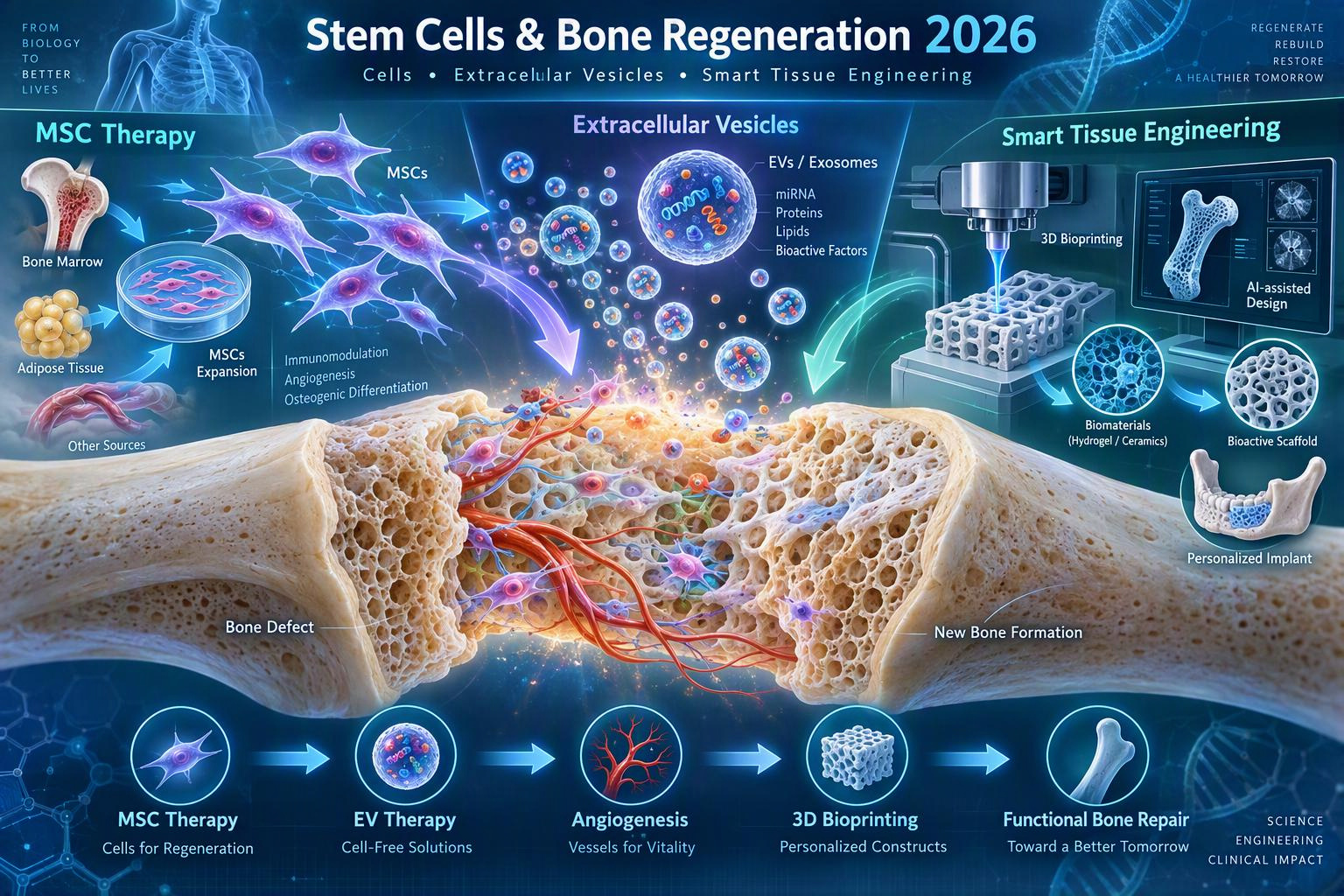
骨再生医学正从传统骨移植和单一生长因子应用,向细胞治疗、生物材料、基因调控及多模态组织工程协同发展的方向演进。2026年,相关研究的突出特点包括间充质基质细胞(mesenchymal stromal cells,MSCs)的临床转化与异体细胞策略、细胞外囊泡介导的无细胞再生、血管生成与成骨耦联调控,以及三维打印和个体化骨修复支架的持续发展。尽管部分技术在临床前研究中展现出良好的骨形成潜力,其临床应用仍受到疗效异质性、制备标准化、长期安全性及监管要求等因素制约。本文综述上述进展,并讨论其在骨缺损、骨不连及骨组织工程中的应用前景。
Bone regenerative medicine is moving beyond conventional bone grafting and isolated growth-factor delivery toward integrated strategies involving cell therapy, biomaterials, gene regulation, and tissue engineering. In 2026, key developments include clinical translation of mesenchymal stromal cells (MSCs), allogeneic cell therapies, extracellular vesicle-based cell-free approaches, coordinated angiogenesis and osteogenesis, and personalized three-dimensional (3D)-printed scaffolds. Although several approaches show encouraging osteogenic potential in preclinical studies, clinical translation remains constrained by heterogeneous efficacy, manufacturing standardization, long-term safety, and regulatory requirements. This review summarizes these developments and their implications for critical bone defects, nonunion, and bone tissue engineering.
一、间充质基质细胞:从自体移植走向标准化细胞治疗
MSCs是当前骨组织再生研究的核心细胞类型之一,可来源于骨髓、脂肪组织及其他组织。其治疗潜力不仅在于向成骨细胞谱系分化,还在于通过旁分泌信号调节炎症、促进血管生成和重塑局部再生微环境。2026年发表于 Bone Research 的综述进一步系统梳理了细胞、蛋白质、基因及mRNA治疗在骨再生中的发展,体现出骨修复研究由单一细胞移植向多层次生物治疗整合的趋势。[1]
MSCs are central to contemporary bone-regeneration research. Their therapeutic effects extend beyond osteogenic differentiation to paracrine signaling, immunomodulation, angiogenesis, and remodeling of the local regenerative microenvironment. A 2026 review in Bone Research provides an integrated overview of cellular, protein, gene, and mRNA-based approaches, highlighting the shift from isolated cell transplantation toward multimodal biological therapies.[1]
自体MSCs可降低异体免疫反应方面的顾虑,但细胞采集具有侵入性,且年龄、基础疾病和细胞扩增过程均可能影响细胞质量。异体MSCs则具有供者筛选、批次化生产和现货供应的潜在优势。2026年发表的一项系统综述与荟萃分析比较了自体与异体MSCs用于骨再生的研究,结果提示两者总体再生表现可能相近,但纳入证据主要来自动物实验,仅有极少量人体研究,尚不足以证明其临床等效性。[2]
Autologous MSCs avoid some concerns associated with donor-derived cells, but harvesting is invasive and cell quality may vary with age, comorbidities, and expansion procedures. Allogeneic MSCs offer potential advantages in donor screening, batch manufacturing, and off-the-shelf availability. A 2026 systematic review and meta-analysis suggested broadly comparable regenerative outcomes between autologous and allogeneic MSCs; however, the evidence was predominantly preclinical, with very limited human data, and does not establish clinical equivalence.[2]
二、细胞外囊泡:从细胞移植转向无细胞再生
MSCs来源的细胞外囊泡(extracellular vesicles,EVs)是2026年骨再生领域的重要研究方向。EVs可携带miRNA、蛋白质及脂质等生物活性物质,参与成骨分化、免疫调节和内皮细胞活化。与完整细胞相比,无细胞策略有望降低活细胞存活、异常分化和细胞制备方面的部分障碍,但其实际优势仍需通过规范化比较研究验证。2026年发表于 Acta Biomaterialia 的系统综述与网络荟萃分析显示,在动物骨缺损模型中,MSC及其分泌组与支架联合应用可促进骨再生,其中EV联合支架或水凝胶的部分结局表现突出。[3]
MSC-derived extracellular vesicles (EVs) represent an important cell-free strategy in 2026. These vesicles carry bioactive molecules, including microRNAs, proteins, and lipids, that regulate osteogenic differentiation, immune responses, and endothelial activation. Compared with whole-cell transplantation, EV-based approaches may avoid some challenges involving cell viability, unwanted differentiation, and cellular manufacturing, although these advantages require standardized comparative validation. A 2026 systematic review and network meta-analysis in Acta Biomaterialia found that MSCs and their secretome, combined with regenerative scaffolds, promoted bone formation in animal models; EV–scaffold and EV–hydrogel combinations performed particularly well for selected outcomes.[3]
当前技术重点正由证明EV具有生物学活性,转向提高递送效率与产品可重复性。通过细胞预处理、囊泡载荷调控、表面功能化以及可注射水凝胶缓释,可望改善EV在骨缺损部位的滞留与作用时间。值得关注的是,软骨内成骨(endochondral ossification)模拟策略试图重建骨折修复中的软骨痂形成、矿化和骨重塑过程,EV可能成为调节这一连续过程的生物活性介质。[4] 然而,EV来源、分离纯化方法、剂量计量、效力检测及储存条件尚未完全统一,目前不宜将其视为已确立的常规临床治疗。
Research is shifting from demonstrating EV bioactivity toward improving delivery and product reproducibility. Cell preconditioning, cargo engineering, surface functionalization, and sustained release from injectable hydrogels may improve local retention and therapeutic activity. Developmentally inspired endochondral ossification strategies are also attracting attention: by reproducing cartilage-callus formation, mineralization, and remodeling, EVs may help coordinate successive stages of fracture repair.[4] Nevertheless, EV source selection, purification, dose measurement, potency assays, and storage remain insufficiently standardized, and EV-based therapies should not yet be regarded as established routine clinical treatments.
三、血管生成与成骨耦联:从单一成骨走向微环境重建
大型骨缺损修复的瓶颈不仅在于成骨细胞不足,还包括局部血供、免疫反应与基质重塑失衡。血管生成与成骨之间存在紧密的时空联系:新生血管为再生组织提供氧和营养,同时参与成骨细胞募集及骨形成信号调控。2026年有关干细胞来源EV的研究综述强调,通过调节囊泡载荷、靶向递送和生物材料储库,有望同步调控内皮细胞活化、炎症微环境及骨形成。[5]
Successful repair of large bone defects depends not only on osteogenic activity but also on vascular supply, immune regulation, and matrix remodeling. Angiogenesis and osteogenesis are closely coordinated in space and time: newly formed vessels deliver oxygen and nutrients while contributing to osteoprogenitor recruitment and osteogenic signaling. A 2026 review of stem cell-derived EVs highlights the potential of engineered vesicle cargo, targeted delivery, and biomaterial depots to coordinate endothelial activation, inflammatory responses, and bone formation.[5]
未来更具转化潜力的方案可能不是单独增加某一种细胞或生长因子,而是通过时序化递送,先改善炎症与血管环境,再促进成骨和矿化,最后支持骨组织成熟与重塑。对于糖尿病、骨质疏松或慢性炎症等修复不良背景,如何验证这些策略在病理微环境中的有效性,尤其值得关注。现阶段,这一方向仍以机制研究和临床前验证为主,尚需高质量人体试验明确其对骨愈合时间、骨不连发生率及功能结局的实际影响。
Future translational strategies may therefore prioritize sequential delivery rather than simply increasing the dose of a single cell population or growth factor. The proposed sequence is to stabilize the inflammatory and vascular environment, promote osteogenesis and mineralization, and subsequently support tissue maturation and remodeling. Validation in diabetes, osteoporosis, and chronic inflammatory conditions is particularly important. At present, these approaches remain largely preclinical, and robust human trials are needed to determine their effects on healing time, nonunion rates, and functional outcomes.
四、三维生物打印与智能支架:构建个体化再生骨组织
三维打印技术正推动骨组织工程由传统多孔支架向具有空间结构、可控降解和生物活性的复合构建体发展。通过整合羟基磷灰石、磷酸钙陶瓷、生物活性水凝胶及细胞或EVs,可针对缺损形态设计支架孔隙、力学性能和生物信号释放特征。2026年发表的EV增强三维生物打印系统综述纳入35项研究,绝大多数报告了成骨分化或骨形成改善,但研究体系仍以临床前实验为主。[6]
Three-dimensional printing is advancing bone tissue engineering from conventional porous scaffolds toward constructs with defined architecture, controlled degradation, and biological activity. Combining hydroxyapatite, calcium phosphate ceramics, bioactive hydrogels, and cells or EVs allows defect-specific control of scaffold porosity, mechanical properties, and bioactive signal release. A 2026 systematic review of EV-enhanced 3D bioprinting included 35 studies, most reporting improvements in osteogenic differentiation or bone formation; however, the evidence remains predominantly preclinical.[6]
后续发展重点包括多细胞协同打印、血管化骨组织构建、可注射原位成型材料,以及结合影像学和计算设计实现缺损个体化重建。支架不仅需要提供机械支撑,还应与新骨形成和材料降解速度相匹配,并避免局部应力集中或血管长入不足。人工智能有望辅助结构优化、材料组合筛选和影像驱动的个体化设计,但其临床价值仍须通过可重复的实验验证和长期随访确认。
Emerging priorities include multicellular bioprinting, vascularized bone constructs, injectable in situ-forming materials, and image-guided personalized reconstruction. Scaffolds must provide adequate mechanical support while matching degradation to new bone formation, avoiding stress concentration and inadequate vascular ingrowth. Artificial intelligence may assist structural optimization, biomaterial selection, and imaging-based design, but its clinical value requires reproducible experimental validation and long-term follow-up.
五、临床转化挑战与展望
2026年骨再生技术的主要进展,是逐渐形成“细胞或细胞分泌物+生物材料+血管与免疫微环境调控”的综合技术框架,而不是某一种干细胞疗法取得了全面突破。临床转化应重点解决细胞身份与效力评价、异体免疫风险、基因修饰安全性、EV制备一致性、支架降解及长期组织整合等问题。临床研究还需采用统一的骨缺损分型、影像学评价标准和患者重要结局指标,区分影像学骨形成与真正的力学稳定、功能恢复。
The major advance in 2026 is the emergence of an integrated framework combining cells or their secretome, biomaterials, and regulation of vascular and immune microenvironments—not a universal breakthrough by any single stem cell therapy. Translation requires rigorous assessment of cell identity and potency, allogeneic immune risks, genetic-modification safety, EV manufacturing consistency, scaffold degradation, and long-term tissue integration. Clinical trials also need standardized defect classifications, imaging endpoints, and patient-important outcomes to distinguish radiographic bone formation from genuine mechanical stability and functional recovery.
总体而言,MSCs、EVs及智能生物材料为复杂骨缺损和骨不连提供了值得持续研究的新路径,但目前证据强度和临床成熟度存在明显差异。近期更可行的方向,是优先推进质量可控、机制明确、能够与现有骨科手术结合的再生方案,并通过规范化临床试验逐步建立适应证与获益人群。对医学专业人员而言,应区分临床前有效性、早期临床可行性和已获证实的临床疗效,避免将技术前景直接等同于治疗标准。
In summary, MSCs, EVs, and advanced biomaterials offer promising avenues for complex bone defects and nonunion, but evidence quality and clinical maturity vary substantially. Near-term priorities include developing reproducible, mechanism-informed regenerative products compatible with established orthopedic procedures and validating their indications through rigorous clinical trials. Clinicians should distinguish preclinical efficacy, early clinical feasibility, and demonstrated clinical benefit rather than equating technological promise with established treatment standards.
参考文献
1. Del Toro Runzer C, Balmayor ER, van Griensven M. Biologics for bone regeneration: advances in cell, protein, gene, and mRNA therapies. Bone Research. 2026;14:5.
2. Vågen PÅ, Loro LL, Mohamed-Ahmed S, et al. Allogeneic stem cell strategies in bone regeneration: A systematic review and meta-analysis. Stem Cell Research & Therapy. 2026.
3. Lu Z, Chen H, Chang H, et al. Therapeutic effects of mesenchymal stem cells and their secretomes (extracellular vesicles) with bone-implant scaffolds for bone regeneration: A systematic review and network meta-analysis of preclinical studies. Acta Biomaterialia. 2026;213:88–102.
4. Staubli F, Zhou Y, Vader P, et al. Harnessing extracellular vesicles for endochondral bone regeneration: Mechanisms and applications. Acta Biomaterialia. 2026;212:168–186.
5. Shu Y, Luo Z, Tang Z, et al. Stem cell-derived extracellular vesicles-mediated bone regeneration: mechanisms, targeted delivery, and clinical perspectives in promoting angiogenesis. Frontiers in Bioengineering and Biotechnology. 2026;14.
6. Medojevic M, Mitic D, Jacimovic J, et al. Extracellular Vesicles-Enhanced 3D (Bio)Printing for Bone Regeneration: A Systematic Review. Tissue Engineering Part B: Reviews. 2026.
注:本文基于截至2026年10月可检索的代表性文献进行叙述性综述,并非系统评价或临床指南。文中所述新兴策略的临床成熟度不一,具体应用应以经验证的证据及法律监管要求为准。