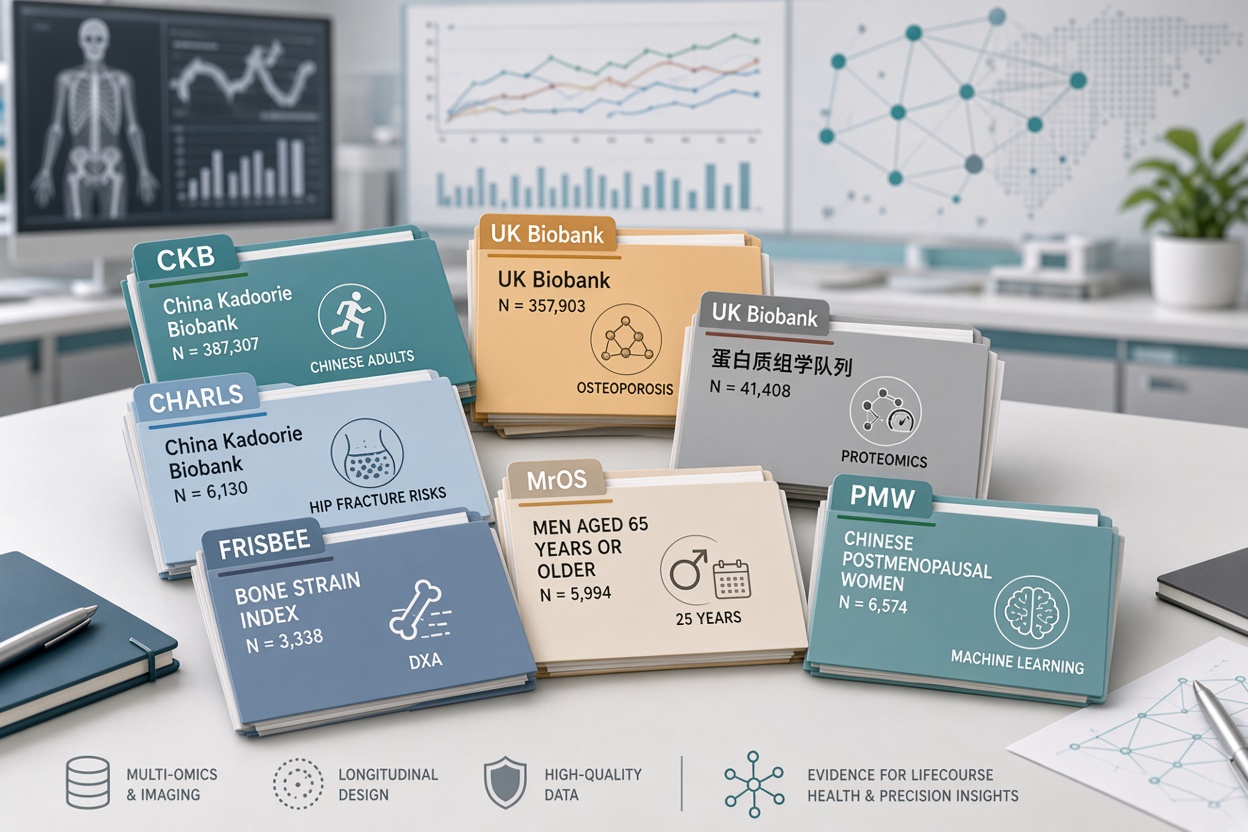
一、2026年值得关注的大规模骨健康队列研究
以下按研究规模、随访价值及临床转化意义选取代表性研究。纳入标准为2026年发表或正式更新、具有明确队列设计及骨健康相关结局的研究;这不是对全球所有队列研究的穷尽性盘点。
The following studies were selected for their cohort size, longitudinal value, and potential clinical relevance. Inclusion was based on publication or formal update in 2026, a defined cohort design, and bone-health-related outcomes. This is a representative selection rather than an exhaustive inventory of all global cohort research.
1. 中国慢性病前瞻性研究(China Kadoorie Biobank,CKB):体力活动与骨折风险
研究规模:387,307名中国成年人;中位随访10.1年。
2026年发表于 Osteoporosis International 的研究将体力活动区分为职业性活动和非职业性活动,并通过医保数据库识别新发骨折,共观察到8,964例骨折。较高总活动量与总体骨折风险增加相关,其中主要由职业性体力活动驱动;中等体力活动水平则与较低髋部骨折风险相关(HR 0.82,95% CI 0.71–0.94)。该研究的亮点是揭示“活动越多越护骨”并非适用于所有情境,职业负荷、运动类型及强度可能具有不同的骨骼效应。
Published in Osteoporosis International in 2026, this study distinguished occupational from non-occupational physical activity and identified incident fractures through health insurance databases. Over a median 10.1 years, 8,964 fractures occurred. Higher total activity was associated with greater overall fracture risk, largely driven by occupational activity, whereas moderate activity was associated with a lower risk of hip fracture (HR 0.82, 95% CI 0.71–0.94). The findings challenge the assumption that more activity is invariably better for skeletal health.
2. 英国生物样本库(UK Biobank):生命历程脂肪量与骨质疏松
研究规模:357,903人;中位随访15.7年。
2026年8月发表于 Frontiers in Endocrinology 的前瞻性队列研究分析出生体重、儿童期体型及成年BMI与新发骨质疏松的关系。随访期间11,905人发生骨质疏松,其中女性占82%。成年低体重与骨质疏松风险明显升高相关(HR 2.41);超重和肥胖则分别与较低风险相关(HR 0.63和0.50)。蛋白质组学分析进一步发现95种蛋白可能介导BMI与骨质疏松的关联。研究提示,骨健康风险可能由早期发育与成年体成分共同塑造,但观察性关联不能直接证明因果关系。
Published in Frontiers in Endocrinology in August 2026, this prospective study examined birth weight, childhood body size, and adult BMI in relation to incident osteoporosis. Among 357,903 participants, 11,905 developed osteoporosis during follow-up, 82% of whom were women. Adult underweight was associated with substantially higher risk (HR 2.41), whereas overweight and obesity were associated with lower risk estimates (HR 0.63 and 0.50). Proteomic analyses identified 95 potential mediators, providing hypotheses about the metabolic and biological pathways linking adiposity to skeletal health.
3. UK Biobank蛋白质组学队列:寻找骨质疏松的早期预警窗口
研究规模:41,408名健康成年人。
2026年6月发表于 Bone 的研究利用血浆蛋白质组学数据,探索骨质疏松临床诊断前的分子变化。研究识别出122种与骨质疏松风险相关的蛋白,并发现诊断前约10年和6年出现两个重要变化峰。研究还识别出同时具有衰弱与肥胖特征的高风险亚型,并建立包含10种蛋白的预测模型,其AUC为0.743,高于传统危险因素模型的0.680。该研究的创新在于从“诊断时识别”转向“发病前多年识别”,但模型仍需独立队列验证后才能用于常规筛查。
Published in Bone in June 2026, this study used plasma proteomics to investigate molecular changes preceding clinical osteoporosis. It identified 122 osteoporosis-associated proteins and two major change peaks approximately 10 and 6 years before diagnosis. A high-risk subtype characterized by frailty and obesity was also identified. A 10-protein model achieved an AUC of 0.743, compared with 0.680 for a conventional risk-factor model. These findings suggest opportunities for earlier risk stratification, although independent validation is required before clinical adoption.
4. 中国健康与养老追踪调查(CHARLS):代谢异常、衰弱与髋部骨折
研究规模:6,130名45岁及以上成年人。
2026年发表于 Archives of Osteoporosis 的研究将甘油三酯-葡萄糖指数与衰弱指数结合,构建TyGFI,并分析其2012—2015年的变化轨迹与后续髋部骨折风险。研究识别出低且稳定、中度上升和高水平上升三种轨迹。与低且稳定组相比,中度上升组及高水平上升组的髋部骨折风险分别约为1.97倍和3.79倍。该结果强调,代谢异常与衰弱的长期累积可能补充传统骨密度及临床危险因素的风险评估,但仍需在其他人群中验证。
Published in Archives of Osteoporosis in May 2026, this CHARLS-based study combined the triglyceride–glucose index with a frailty index to construct TyGFI and examined its longitudinal trajectories. Compared with participants with low, stable values, those with moderate-increasing and high-increasing trajectories had approximately 1.97-fold and 3.79-fold higher hip fracture risks, respectively. The findings support further investigation of cumulative metabolic dysfunction and frailty as complementary markers of skeletal vulnerability.
5. FRISBEE队列:骨应变指数能否改善长期骨折预测?
研究规模:3,338名64—77岁社区女性;随访5年及10年。
2026年发表于 Bone 的研究评估了基于DXA有限元分析计算的骨应变指数(Bone Strain Index,BSI)。10年随访期间,803名女性发生至少一次脆性骨折,其中525人发生主要骨质疏松性骨折。髋部BSI与骨折风险的关联强于腰椎BSI;髋部BSI每升高1个标准差,10年骨折风险仍显著升高,即使在FRAX调整后关联依然存在(HR 1.24,95% CI 1.14–1.35)。这提示骨力学参数可能补充传统骨密度和FRAX评估,但其增量预测价值及成本效益仍需进一步研究。
Published in Bone in 2026, this FRISBEE cohort study evaluated the Bone Strain Index (BSI), derived from DXA-based finite element analysis. During 10 years, 803 women sustained fragility fractures, including 525 major osteoporotic fractures. Total hip BSI was more strongly associated with fracture risk than lumbar spine BSI. Its association remained significant after FRAX adjustment (HR 1.24 per standard-deviation increase; 95% CI 1.14–1.35), suggesting potential incremental value beyond conventional risk assessment.
6. 美国男性骨质疏松研究(MrOS):25年长期随访的阶段性总结
研究规模:5,994名65岁及以上男性;随访延续至2024年。
2026年发表于 Journal of Bone and Mineral Research 的里程碑论文总结了MrOS队列25年的研究成果。该队列整合DXA、定量CT、骨结构、激素、生物标志物、神经肌肉功能、跌倒及合并症等信息,系统研究男性髋部、椎体、腕部及其他部位骨折的危险因素。研究提示,男性骨折风险与骨量、骨几何结构及临床因素密切相关,现有风险预测工具仍有改进空间。其突出价值在于补充女性研究相对丰富、男性长期骨健康证据不足的研究格局。
Published in Journal of Bone and Mineral Research in April 2026, this landmark report summarizes 25 years of the MrOS study, which enrolled 5,994 community-dwelling men aged 65 years or older and followed participants through 2024. The cohort integrates DXA, quantitative CT, skeletal geometry, hormones, biomarkers, neuromuscular function, falls, and comorbidities. Its findings have advanced understanding of fracture determinants in men and highlighted the need for improved absolute-risk prediction tools.
7. 中国绝经后女性全国队列:机器学习筛查与5年骨折验证
研究规模:训练队列6,574人;两个外部验证队列共3,197人;前瞻性骨折验证795人。
2026年8月发表于 Osteoporosis International 的研究建立了基于常规临床变量的机器学习骨质疏松筛查模型,并在独立中国队列中验证。外部验证AUC为0.750和0.744;在5年随访队列中,高风险组临床骨折发生风险较高(HR 1.78,95% CI 1.06–2.99)。该研究将全国性筛查模型与真实后续骨折结局联系起来,体现了从诊断预测迈向预后验证的方向。
Published in Osteoporosis International in August 2026, this study developed a machine-learning screening model for Chinese postmenopausal women. It used a training cohort of 6,574 participants, two external validation cohorts totaling 3,197, and a prospective fracture-validation cohort of 795. External-validation AUCs were 0.750 and 0.744. Over five years, the high-risk group had a higher incidence of clinical fractures (HR 1.78; 95% CI 1.06–2.99), linking screening performance to subsequent clinical outcomes.
二、总结与研究展望
2026年大规模骨健康队列研究呈现出三个方向:一是由单次测量转向长期轨迹与累积暴露分析;二是由骨密度扩展至蛋白质组学、骨力学、代谢和衰弱指标;三是更重视外部验证及未来骨折结局。上述研究仍以观察性证据为主,不能将统计关联直接解释为因果关系,也不能将模型性能等同于临床获益。
Major directions in 2026 include longitudinal trajectory analysis, integration of proteomics and biomechanical measures with metabolic and frailty indicators, and greater emphasis on external validation and future fracture outcomes. Most findings remain observational; associations do not establish causality, and predictive performance does not automatically translate into clinical benefit.
未来研究应进一步整合多民族、多地区队列,统一骨折结局定义,验证模型在不同医疗体系中的适用性,并通过前瞻性实施研究确定其能否改善筛查效率、治疗决策及骨折结局。
Future work should integrate more diverse populations, harmonize fracture definitions, validate models across healthcare systems, and use prospective implementation studies to determine whether these approaches improve screening efficiency, treatment decisions, and fracture outcomes.
参考文献
1. Yang Q, Zeng B, Zheng J, et al. Association of physical activity with fracture: a prospective cohort study of 387,307 Chinese participants. Osteoporosis International. 2026.
2. Liu H, Zhu J, Zhang Q, et al. Life course adiposity and risk of incident osteoporosis: a prospective cohort study from the UK Biobank. Frontiers in Endocrinology. 2026;17:1839419.
3. Zheng Y, Li J, Li Y, et al. Proteomics-driven discovery of intervention windows and risk subtypes in osteoporosis: a prospective cohort study. Bone. 2026.
4. Su H, Fu C, Wang P, et al. Long-term trajectories and cumulative exposure of the triglyceride–glucose–frailty index in relation to hip fracture risk: evidence from a large-scale population-based cohort. Archives of Osteoporosis. 2026;21:80.
5. de Filette J, Bellanger A, Rinaudo L, et al. Bone strain index improves 10-year fracture risk prediction beyond bone mineral density and FRAX® in community-dwelling older women: a study of the FRISBEE cohort. Bone. 2026;207:117858.
6. The Osteoporotic Fractures in Men Study Research Group. The Osteoporotic Fractures in Men Study (MrOS): a 25-year landmark study of skeletal health in older men. Journal of Bone and Mineral Research. 2026;41(5):474–491.
7. Sun Q, Yin X, Yu W, et al. Machine learning-based screening model for osteoporosis in Chinese postmenopausal women: a nationwide study with prospective fracture validation. Osteoporosis International. 2026.
说明: 本文所述“2026年研究”指研究成果在2026年发表,并不意味着所有队列均于2026年开始或完成随访。各研究人群、骨折定义及统计方法存在差异,跨研究比较应保持谨慎。