2026年,一项发表于 npj Science of Food 的研究提出骨健康优化膳食模式(Bone Health Optimized Diet,BHOD),旨在针对骨质疏松预防构建比传统健康膳食评分更具针对性的饮食模式。研究整合大规模人群膳食数据、全食物关联分析、机器学习及多组学证据,发现较高的BHOD依从性与较低的骨质疏松风险相关,并在独立人群中进行验证。这一研究推动骨健康营养从单一营养素补充转向整体膳食模式优化,但目前证据主要支持关联性,仍需随机对照试验验证因果关系和临床效益。[1]
In 2026, a study published in npj Science of Food introduced the Bone Health Optimized Diet (BHOD), a dietary pattern specifically designed to support osteoporosis prevention. By integrating large-scale dietary data, food-wide association analysis, machine learning, and multi-omics evidence, the investigators found that greater adherence to BHOD was associated with a lower risk of osteoporosis, with validation in independent populations. This work advances bone-health nutrition from isolated nutrient supplementation toward optimization of the overall diet. However, the current evidence is primarily associative, and randomized controlled trials are needed to establish causality and clinical benefit.[1]
一、BHOD的提出及研究设计
传统地中海饮食、DASH饮食和健康饮食指数主要围绕心血管代谢健康或整体膳食质量建立,未必能够精准识别与骨质疏松风险相关的食物组合。BHOD研究利用英国生物样本库(UK Biobank)183,092名参与者的膳食数据,通过全食物关联分析和机器学习筛选与骨质疏松相关的重要食物组,并据此构建优化膳食模式;随后在UK Biobank验证集及美国国家健康与营养调查(NHANES)人群中验证相关性。[1]
Conventional dietary patterns, including the Mediterranean diet, DASH diet, and Healthy Eating Index, were primarily developed around cardiometabolic health or overall dietary quality and may not optimally capture food combinations associated with osteoporosis. The BHOD investigators analyzed dietary data from 183,092 UK Biobank participants, using food-wide association analysis and machine learning to identify food groups associated with osteoporosis and construct a targeted dietary pattern. Associations were subsequently evaluated in a UK Biobank validation set and the US National Health and Nutrition Examination Survey (NHANES).[1]
这一设计的关键创新在于以疾病相关结局为导向,而非简单地将既有健康饮食评分直接应用于骨骼健康。其方法学框架能够探索食物之间的组合关系,并为未来建立骨健康专属膳食评价工具提供思路。不过,食物摄入数据的测量误差、生活方式混杂因素、反向因果以及不同人群的饮食文化差异,仍可能影响结果的解释与推广。
The principal methodological innovation is the development of a dietary pattern oriented toward a bone-related outcome rather than the direct repurposing of existing healthy-eating scores. This framework can explore combinations of foods and inform future bone-specific dietary assessment tools. Nevertheless, dietary measurement error, lifestyle confounding, reverse causation, and cultural differences in food consumption may affect interpretation and generalizability.
二、BHOD与骨质疏松风险:主要发现及证据解读
研究发现,较高的BHOD依从性与较低的骨质疏松风险相关,且这一关联在UK Biobank验证集及NHANES人群中得到支持。研究还观察到BHOD与骨关节炎、类风湿关节炎等其他肌肉骨骼疾病的保护性关联,并提示较高依从性可能减弱遗传易感性与骨质疏松风险之间的联系,遗传风险较高者的关联获益尤其值得关注。[1]
The study found that greater adherence to BHOD was associated with lower osteoporosis risk, with supportive findings in the UK Biobank validation set and NHANES. Protective associations were also reported for other musculoskeletal conditions, including osteoarthritis and rheumatoid arthritis. In addition, higher adherence appeared to attenuate the association between genetic susceptibility and osteoporosis, with particularly notable associations among individuals at higher genetic risk.[1]
需要强调的是,这些结果并不意味着BHOD已经被证明能够预防骨折,也不能直接推导出其具体食物配比或临床处方效果。2025年一项纳入20项观察性研究、共426,292名参与者的荟萃分析发现,较健康的膳食模式与较低骨质疏松风险相关,而较高膳食炎症指数与较高风险相关;但不同膳食模式的结果并不一致,且研究存在异质性和发表偏倚。[2] BHOD为此领域提供了更具骨骼疾病针对性的研究框架,但仍需要与既有膳食模式开展直接比较。
Importantly, these findings do not establish that BHOD prevents fractures, nor do they directly define a clinically validated food prescription or optimal food proportions. A 2025 meta-analysis of 20 observational studies involving 426,292 participants found that healthier dietary patterns were associated with lower osteoporosis risk, whereas higher dietary inflammatory index scores were associated with higher risk. However, results differed across dietary patterns, with heterogeneity and potential publication bias.[2] BHOD offers a more bone-specific research framework, but direct comparisons with established dietary patterns are still needed.
三、多组学机制:从膳食关联走向生物学解释
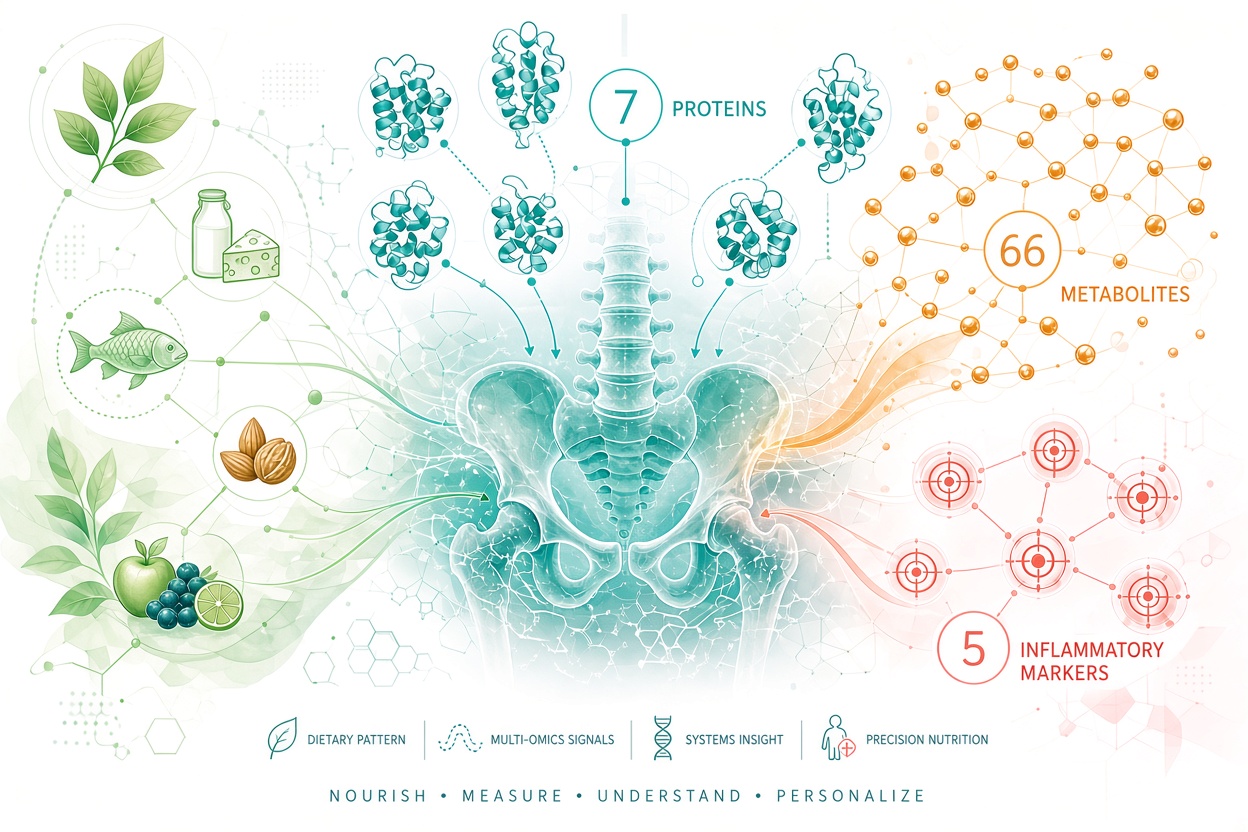
BHOD研究进一步整合多组学数据,识别出与膳食模式和骨质疏松风险共同相关的7种蛋白质、66种代谢物及5种炎症标志物,提示免疫炎症调控与脂质代谢可能参与膳食影响骨健康的过程。[1] 这些结果为后续研究提供了候选生物标志物及机制线索,但目前不能据此认定相关分子已经构成明确的因果通路,也不能将其直接用于临床诊断或个体化营养处方。
The BHOD study also integrated multi-omics data, identifying seven proteins, 66 metabolites, and five inflammatory markers jointly associated with dietary adherence and osteoporosis risk. These findings implicate immune-inflammatory regulation and lipid metabolism as potential pathways linking diet to skeletal health.[1] They provide candidate biomarkers and mechanistic hypotheses, but do not establish causal pathways or justify immediate clinical use of these molecules for diagnosis or personalized dietary prescribing.
从生物学角度看,膳食可能通过多条相互作用的路径影响骨重塑,包括提供钙、维生素D、蛋白质及其他必需营养素,影响氧化应激和炎症状态,并调节能量代谢与肌肉功能。膳食模式分析的优势在于评估食物组合及其协同效应;其局限则在于难以完全分离单个食物、营养素、生活方式和社会经济因素的独立贡献。
Biologically, dietary patterns may influence bone remodeling through interacting pathways, including provision of calcium, vitamin D, protein, and other essential nutrients; modulation of oxidative stress and inflammation; and effects on energy metabolism and muscle function. Dietary-pattern analysis captures food combinations and potential synergies, but it cannot fully isolate the independent contributions of individual foods, nutrients, lifestyle, and socioeconomic factors.
四、临床应用前景与研究重点
目前BHOD更适合作为研究和营养风险评估的候选框架,而不是已确立的临床膳食指南。实际管理仍应强调膳食多样化、充足蛋白质与钙摄入、纠正维生素D缺乏、避免过度限制能量,以及根据患者年龄、肾功能、营养状况和合并疾病制定个体化方案。BHOD不应替代DXA评估、骨折风险分层或具有适应证时的抗骨质疏松药物治疗。
At present, BHOD is best regarded as a candidate framework for research and nutritional risk assessment rather than an established clinical dietary guideline. Practical care should continue to emphasize dietary diversity, adequate protein and calcium intake, correction of vitamin D deficiency, avoidance of excessive energy restriction, and individualized planning based on age, renal function, nutritional status, and comorbidities. BHOD should not replace DXA assessment, fracture-risk stratification, or indicated pharmacological treatment for osteoporosis.
下一步研究应在不同国家、饮食文化、年龄及性别群体中验证BHOD的适用性,并明确评分体系、食物组成和依从性评估方法。尤其需要前瞻性队列与随机对照试验,检验其对骨密度变化、骨转换标志物、跌倒、脆性骨折及生活质量的影响,同时评估成本效益和长期可持续性。只有在可重复验证及干预试验支持下,BHOD才可能从统计学相关模式发展为具有明确临床价值的骨健康营养策略。
Future research should validate BHOD across countries, dietary cultures, age groups, and sexes, while clarifying its scoring system, food composition, and adherence assessment. Prospective cohorts and randomized controlled trials are needed to evaluate effects on BMD, bone-turnover markers, falls, fragility fractures, and quality of life, alongside cost-effectiveness and long-term sustainability. Only after reproducible validation and intervention trials can BHOD progress from an epidemiological association to a dietary strategy with established clinical value.
参考文献
1. Zheng Y, Li Y, Gao Y, et al. BHOD: a bone health optimized dietary pattern designed for osteoporosis prevention. npj Science of Food. 2026; published online July 1.
2. Tan B, Su H, Wei L, et al. Association of dietary patterns with osteoporosis risk: a meta-analysis of observational studies. Journal of Orthopaedic Surgery and Research. 2025;20:551.
3. Sui J, Yin H, Zhang L, Li J. The impact of high-quality dietary patterns on the prevention of osteoporosis: a meta-analysis of observational studies. Frontiers in Nutrition. 2025;12:1609442.
4. Impact of Dietary Patterns on Skeletal Health: A Systematic Review and Meta-Analysis of Bone Mineral Density, Fracture, Bone Turnover Markers, and Nutritional Status. Nutrients. 2025;17(24):3845.
说明:本文为叙述性综述,重点解读2026年BHOD研究及相关膳食模式证据。BHOD目前不应被视为已通过临床试验证实的骨质疏松预防处方。