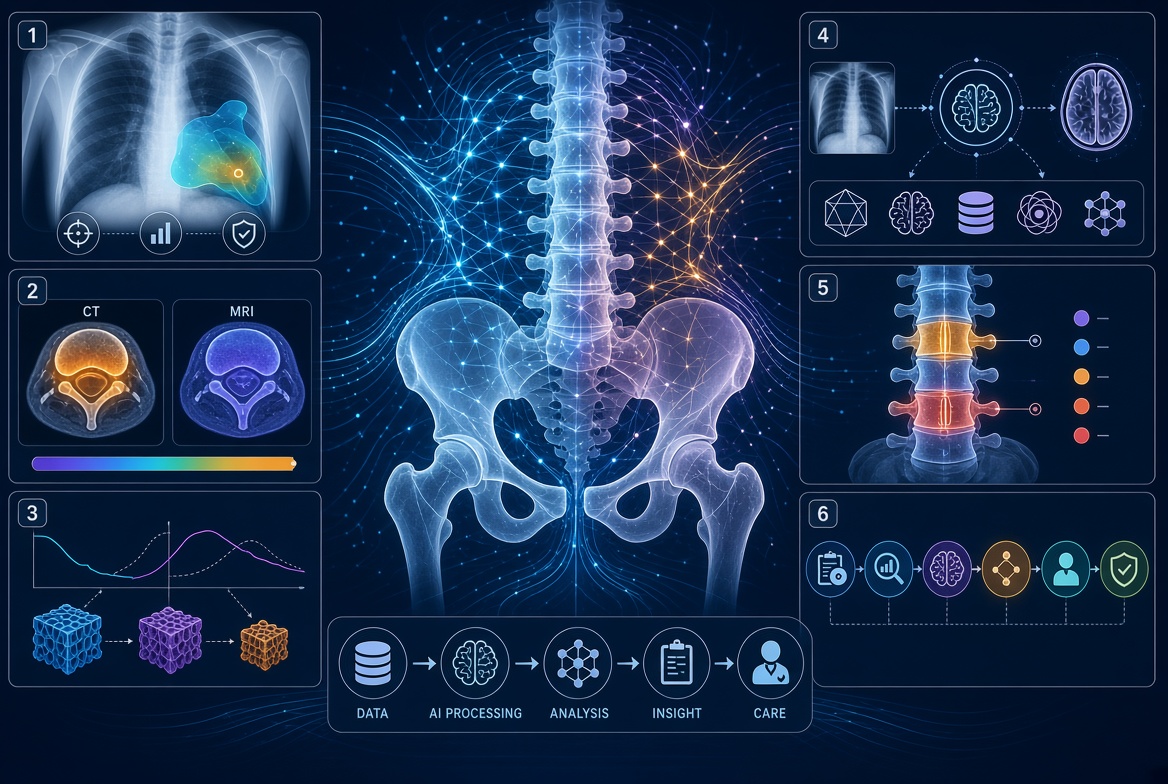
人工智能(artificial intelligence,AI)正在推动骨健康管理从传统骨密度检测向机会性筛查、影像智能分析、骨折风险预测和临床决策支持发展。2026年,国际研究不仅关注算法的诊断性能,也开始更加重视多中心外部验证、真实世界临床效用、工作流程整合及伦理监管。本文结合2026年发表的研究、系统综述与专家共识,归纳骨健康领域AI辅助诊疗的主要进展,并讨论其临床应用边界。
Artificial intelligence (AI) is expanding bone health assessment beyond conventional bone mineral density testing toward opportunistic screening, automated image analysis, fracture-risk prediction, and clinical decision support. In 2026, research has increasingly emphasized not only algorithmic accuracy but also multicenter external validation, real-world clinical utility, workflow integration, and ethical governance. This review summarizes major advances based on recent studies, systematic reviews, and expert consensus, while discussing their implications for clinical practice.
一、主要技术进展
1. 常规影像机会性骨质疏松筛查
Opportunistic Osteoporosis Screening from Routine Imaging
AI可重新分析因其他临床目的获取的胸部X线、CT及MRI影像,自动识别低骨密度风险人群,减少对专门筛查检查的依赖。2026年一项系统综述纳入57项研究,CT占38项,模型AUC范围为0.630–1.000;但研究间异质性较大,临床推广仍需更充分的外部验证。
AI can reanalyze chest radiographs, CT scans, and MRI examinations obtained for other clinical indications to identify individuals at risk of low bone mineral density. A 2026 systematic review included 57 studies, of which 38 used CT; reported AUCs ranged from 0.630 to 1.000. However, substantial heterogeneity and limited external validation remain important barriers to clinical implementation.
2. 胸部X线AI筛查进入大样本外部验证阶段
Large-Scale External Validation of AI Screening on Chest Radiographs
2026年发表于 npj Digital Medicine 的研究开发了AI-OsRM模型,利用46,478组胸片与DXA配对检查进行训练,并在三个独立队列中验证。在两个健康体检队列中,骨质疏松识别AUROC分别达到0.93和0.92。模拟结果显示,预筛查有望减少约50%的DXA使用量,同时检出98%–99%的骨质疏松病例。该结果提示,胸片可能成为规模化筛查的重要入口,但仍需关注真实临床实施效果。
A 2026 study in npj Digital Medicine developed AI-OsRM using 46,478 paired chest radiograph and DXA examinations and evaluated it across three independent cohorts. AUROCs for osteoporosis detection reached 0.93 and 0.92 in two health-checkup cohorts. Simulation suggested that prescreening could reduce DXA utilization by approximately 50% while detecting 98%–99% of osteoporosis cases. Prospective implementation studies are still needed to establish real-world effectiveness.
3. 从骨密度预测拓展至骨折风险评估
Beyond Bone Density: Imaging-Based Fracture-Risk Prediction
2026年影像研究进一步关注骨结构、骨小梁微结构、肌肉质量及骨骼几何特征等传统骨密度难以充分反映的信息。深度学习模型开始探索直接从原始影像推断未来骨折风险,推动评估从单一骨密度指标向综合骨脆性表征发展。不过,影像预测模型仍需与FRAX等临床风险工具进行比较,并验证其能否改善风险分层和临床结局。
Imaging-based research increasingly examines features that BMD alone may not fully capture, including bone microarchitecture, muscle quality, and skeletal geometry. Deep-learning models are also being investigated for direct fracture-risk prediction from raw images. Their incremental value over established tools such as FRAX must be demonstrated through comparative validation and clinical outcome studies.
4. 多模态影像与基础模型的融合
Multimodal Imaging and Foundation Models
AI骨健康研究正由单一CT模型向胸片、CT及MRI等多模态影像拓展,并开始探索视觉基础模型的迁移学习。2026年系统综述指出,基础模型已成为新兴研究方向,有望降低部分任务对大规模专用标注数据的依赖。未来的重点不是简单增加模型复杂度,而是验证不同设备、医院及人群中的泛化能力。
AI research is expanding from CT-specific models toward chest radiography, CT, and MRI, with increasing interest in transfer learning using vision foundation models. These approaches may reduce dependence on large, task-specific annotated datasets. Their clinical value will depend on reliable generalization across scanners, institutions, and patient populations rather than model complexity alone.
5. AI辅助椎体骨折识别与诊断流程优化
AI-Assisted Vertebral Fracture Detection and Workflow Optimization
机会性筛查的另一重要方向是自动识别常规影像中的椎体压缩性骨折。AI可协助定位可疑椎体、提示骨折形态异常,并将结果纳入放射科报告或临床预警流程,从而减少影像中既存骨折的漏诊。相关研究仍需评估不同骨折分级、退变性改变及其他椎体病变对算法准确性的影响,并明确阳性结果的复核机制。
Another important application is automated detection of vertebral compression fractures on routine imaging. AI can flag suspicious vertebrae and support radiology reporting or clinical alerts, potentially reducing missed prevalent fractures. Validation must address fracture severity, degenerative changes, competing spinal abnormalities, and the need for confirmatory interpretation.
6. 从算法研究转向临床实施规范
From Algorithm Development to Clinical Implementation Standards
2026年亚太地区专家共识提出12项AI应用共识声明,覆盖机会性筛查、影像质量、模型透明度、验证标准、临床风险分层、真实世界效用、数据保护及上市后监测。共识强调,AI应作为筛查和临床决策的辅助工具,而非独立确诊手段。该方向标志着骨健康AI的发展重点正由单纯追求准确率转向安全、有效、公平且可持续的临床应用。
A 2026 Asia-Pacific consensus issued 12 statements addressing opportunistic screening, image quality, model transparency, validation, risk stratification, real-world utility, data protection, and post-market surveillance. It emphasizes that AI should support screening and clinical decision-making rather than independently establish a diagnosis. The field is shifting from optimizing accuracy alone toward safe, effective, equitable, and sustainable implementation.
二、临床转化面临的关键问题
当前主要挑战包括外部验证不足、研究人群代表性有限、不同设备与机构间性能差异,以及AI提示能否真正改善治疗启动率和骨折结局尚未充分明确。2026年系统综述中,仅36%的纳入研究开展了外部验证,提示现有高性能结果不能直接等同于临床有效性。
Major barriers include inadequate external validation, limited population representativeness, variation across scanners and institutions, and insufficient evidence that AI alerts improve treatment initiation or fracture outcomes. In the 2026 systematic review, only 36% of included studies performed external validation, underscoring that strong reported performance does not automatically establish clinical effectiveness.
临床应用建议采用“AI识别高风险—医生复核—DXA或其他适当检查确认—综合评估骨折风险—制定干预方案”的路径,并持续监测假阳性、假阴性及不同人群的性能差异。AI输出不应取代规范诊断标准或临床判断。
A practical pathway is to use AI to flag high-risk individuals, obtain clinician review, confirm findings with DXA or other appropriate investigations, assess overall fracture risk, and initiate individualized management. False-positive and false-negative results, as well as performance disparities across patient groups, should be monitored continuously. AI outputs must not replace established diagnostic criteria or professional judgment.
参考文献
1. Chen X, Wu W, Shen J, Chen Y. Artificial intelligence for opportunistic screening of osteoporosis across multiple imaging modalities: a systematic review. Frontiers in Medicine. 2026;13.
2. AI-OsRM chest radiograph screening study. npj Digital Medicine. 2026.
3. Kim Y, Kong SH. Advances in imaging-based fracture risk assessment for unlocking latent skeletal fragility. Current Osteoporosis Reports. 2026;24:13.
4. Huang CF, Fang WH, Chen KH, et al. Consensus statement on the application of artificial intelligence in osteoporosis screening and management: perspectives from the Asia-Pacific region. Osteoporosis International. 2026.
5. Single-component imaging and ultrasound-based tools for the assessment of fracture risk. Nature Reviews Rheumatology. 2026;22:707–718.