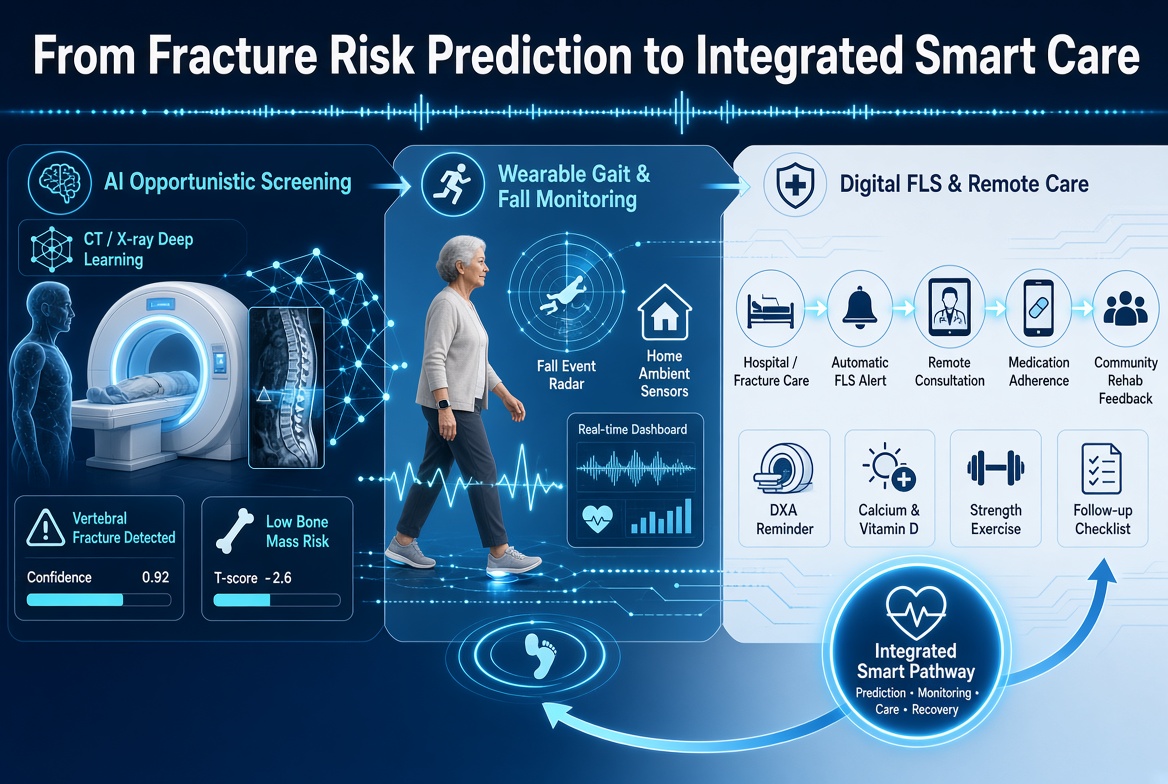
老龄化背景下,骨质疏松、脆性骨折、跌倒及骨折后功能衰退相互关联,传统以门诊评估和间断骨密度检测为主的管理模式难以充分覆盖老年人的动态风险。2026年,人工智能(AI)辅助骨质疏松筛查、可穿戴设备监测活动与步态、远程患者管理,以及骨折联络服务(FLS)的数字化整合,成为骨健康管理的重要发展方向。其核心价值是将风险识别、个体化干预、治疗依从性管理和骨折后随访连接起来。不过,算法外部验证不足、数字鸿沟、数据隐私及临床工作流整合仍是主要挑战。
Osteoporosis, fragility fractures, falls, and post-fracture functional decline are interconnected challenges in ageing populations. Conventional care based on clinic visits and intermittent bone mineral density testing may not adequately capture dynamic changes in risk. In 2026, artificial intelligence (AI)-assisted osteoporosis screening, wearable monitoring of mobility and gait, remote patient management, and digital integration of fracture liaison services (FLS) are emerging as important directions. Their principal value lies in connecting risk identification, personalized intervention, treatment adherence, and post-fracture follow-up. However, limited external validation, the digital divide, data privacy, and workflow integration remain significant challenges.
一、人工智能推动骨质疏松早期识别
AI机会性筛查是当前最值得关注的进展之一。通过深度学习分析既往CT、X线等常规影像,系统有望在患者接受其他疾病检查时识别骨量减少、骨质疏松或椎体脆性骨折线索,减少对专门筛查流程的依赖。2026年一项发表于 Frontiers in Medicine 的系统综述纳入57项研究,显示多种影像AI模型具有较好的筛查潜力;但多数研究为回顾性、单中心研究,仅36%开展外部验证,提示其性能可能被高估。[1]
AI-enabled opportunistic screening is a promising development. Deep-learning systems can analyze routine CT and X-ray images to identify possible low bone mass, osteoporosis, or vertebral fragility fractures during imaging performed for other indications, potentially reducing reliance on dedicated screening pathways. A 2026 systematic review in Frontiers in Medicine included 57 studies and found encouraging performance across imaging-based approaches. However, most studies were retrospective and single-center, and only 36% reported external validation, raising concerns about overestimated performance and limited generalizability.[1]
另一重要方向是将临床危险因素、既往骨折、用药、实验室指标和影像数据整合,用于患者分层及临床决策支持。AI不应取代DXA、FRAX或医生的综合判断,而应帮助发现尚未诊断的高风险患者,提醒进一步检查并衔接规范治疗。2026年亚太地区AI共识也强调,将AI嵌入现有骨质疏松筛查和管理路径,比单纯追求模型准确率更具临床意义。[2]
A complementary direction is to combine clinical risk factors, previous fractures, medication history, laboratory findings, and imaging to support risk stratification and clinical decisions. AI should complement rather than replace DXA, FRAX, or clinical judgment. Its practical role is to flag potentially high-risk patients, prompt confirmatory assessment, and facilitate evidence-based treatment. A 2026 Asia-Pacific consensus similarly emphasizes integration into established osteoporosis pathways rather than focusing on algorithmic accuracy alone.[2]
二、可穿戴设备与跌倒风险动态监测
可穿戴设备、智能鞋垫、惯性传感器及居家环境传感系统,可用于采集步速、步态变异性、活动量、起坐转换和跌倒事件等信息。这些指标有助于发现传统门诊评估不易捕捉的活动能力下降,为老年人骨折风险管理提供动态补充。2026年发表于 Frontiers in Public Health 的一项范围综述纳入243项研究,其中仅21项涉及老年人真实世界或混合场景验证,提示目前技术进步快于实际部署和长期效果验证。[3]
Wearables, smart insoles, inertial sensors, and ambient home sensors can capture gait speed, gait variability, physical activity, sit-to-stand transitions, and fall events. These measurements may reveal functional decline that is difficult to detect during occasional clinic visits, adding a dynamic dimension to fracture-risk management. A 2026 scoping review in Frontiers in Public Health included 243 studies, but only 21 involved real-world or mixed-setting validation in older adults, illustrating the gap between technological development and implementation evidence.[3]
2026年一项可穿戴设备预测跌倒的系统综述与荟萃分析报告,汇总敏感度约为0.55、特异度约为0.89,AUC约为0.85。[4] 这表明设备具备一定风险区分能力,但尚不能单独用于排除跌倒风险或决定干预措施。临床上更合理的做法,是将传感器数据与既往跌倒史、步态和平衡检查、视力、药物及居家环境评估结合,再制定肌力和平衡训练、辅助器具使用或环境改造方案。
A 2026 systematic review and meta-analysis of wearable-based fall prediction reported a pooled sensitivity of approximately 0.55, specificity of 0.89, and area under the curve of 0.85.[4] These results suggest useful discrimination but insufficient sensitivity for ruling out fall risk or using device output alone to determine interventions. A more appropriate clinical approach combines sensor data with previous falls, gait and balance assessment, vision, medications, and home hazards to guide strength and balance training, assistive-device use, and environmental modification.
三、远程管理与数字化骨折联络服务
远程医疗、移动健康应用、视频随访及自动提醒,可支持老年患者开展用药教育、钙与维生素D摄入管理、运动指导和治疗依从性监测。2026年有关老年人出院后数字健康管理的系统综述显示,数字化随访总体具有可行性和较好的患者接受度,但对再住院等临床结局的影响并不一致。[5] 因此,数字工具的价值应以能否改善治疗持续性和健康结局衡量,而非仅以注册人数、消息点击率或设备佩戴率评价。
Telemedicine, mobile health applications, video consultations, and automated reminders can support medication education, calcium and vitamin D management, exercise guidance, and treatment-adherence monitoring. A 2026 systematic review of digital post-discharge management in older adults found that such interventions were generally feasible and acceptable, although effects on outcomes such as hospital readmission were inconsistent.[5] Digital programs should therefore be evaluated by their effects on treatment persistence and health outcomes, not simply by registrations, message engagement, or device-wearing rates.
对于脆性骨折患者,数字化FLS有望将住院骨折病例识别、骨质疏松评估、治疗启动、跌倒风险干预及出院后随访纳入统一流程。系统可自动生成待办清单、提示未完成的DXA或实验室检查、追踪治疗中断,并将社区康复反馈至专科团队。2026年国际多组织立场文件进一步强调,应加强骨折预防与跌倒预防服务的协同,减少骨折患者在评估、转诊和干预之间的管理断点。[6]
For patients with fragility fractures, a digitally enabled FLS can integrate inpatient case identification, osteoporosis assessment, treatment initiation, fall-prevention interventions, and post-discharge follow-up. Automated workflows can flag outstanding DXA scans or laboratory tests, identify treatment interruptions, and transmit community rehabilitation updates to specialist teams. A 2026 international position paper from multiple organizations further emphasizes coordination between fracture prevention and falls services to reduce gaps in assessment, referral, and intervention.[6]
四、临床实施路径与未来展望
未来老年人骨健康数字化管理可形成四层架构:第一层通过常规影像与临床数据发现潜在高风险患者;第二层结合DXA、FRAX及综合老年评估完成风险分层;第三层实施个体化药物治疗、营养支持、运动和跌倒预防;第四层通过远程随访、可穿戴设备及FLS持续评价依从性、再骨折和功能变化。各层之间应建立明确的异常预警、人工复核和转诊机制。
A future digital bone-health pathway could comprise four layers: identifying potentially high-risk patients through routine imaging and clinical data; stratifying risk with DXA, FRAX, and comprehensive geriatric assessment; delivering individualized pharmacological treatment, nutritional support, exercise, and fall prevention; and monitoring adherence, refractures, and functional changes through remote follow-up, wearables, and FLS. Clear escalation rules, clinician review, and referral pathways should connect these layers.
实施过程中,应特别关注高龄、认知或视听功能受限及数字技能不足者,提供简化界面、家属协助和电话等非数字渠道,并严格遵循知情同意、数据最小化和隐私保护原则。当前最重要的研究任务,是开展多中心前瞻性验证与务实性临床试验,评价数字化管理对骨折发生率、治疗持续性、生活质量、医疗资源利用及成本效益的影响。数字化并非取代医生,而是将分散的风险信号转化为及时、可追踪、可执行的临床行动。
Implementation must account for very old adults and people with cognitive, visual, hearing, or digital-literacy limitations. Simplified interfaces, caregiver assistance, and non-digital alternatives such as telephone follow-up should remain available, alongside informed consent, data minimization, and privacy safeguards. Priority research should include multicenter prospective validation and pragmatic clinical trials evaluating fracture incidence, treatment persistence, quality of life, healthcare utilization, and cost-effectiveness. Digitalization should not replace clinicians; it should transform fragmented risk signals into timely, traceable, and actionable care.
参考文献
1. Chen X, Wu W, Shen J, et al. Artificial intelligence for opportunistic screening of osteoporosis across multiple imaging modalities: a systematic review. Frontiers in Medicine. 2026;13.
2. Consensus statement on the application of artificial intelligence in osteoporosis screening and management: perspectives from the Asia-Pacific region. Osteoporosis International. 2026.
3. Chen LC, Yao W. Fall detection and pre-impact prediction technologies in older adults: a scoping review of translational maturity and public health integration. Frontiers in Public Health. 2026;14.
4. Accuracy of wearable devices in predicting falls in older adults: a systematic review and meta-analysis. Frontiers in Public Health. 2026.
5. Effectiveness of digital health technologies for post-discharge follow-up and management in older adults: a systematic review. PubMed. 2026.
6. Position paper: a coordinated approach to fracture and fall prevention from seven international organizations. European Geriatric Medicine. 2026.
7. Montero-Odasso M, van der Velde N, Martin FC, et al. World guidelines for falls prevention and management for older adults: a global initiative. Age and Ageing. 2022;51(9):afac205.
注:本文为叙述性综述。2026年相关数字技术的证据成熟度存在差异,尤其是可穿戴设备驱动的动态骨折风险预测,仍需更充分的前瞻性临床验证。