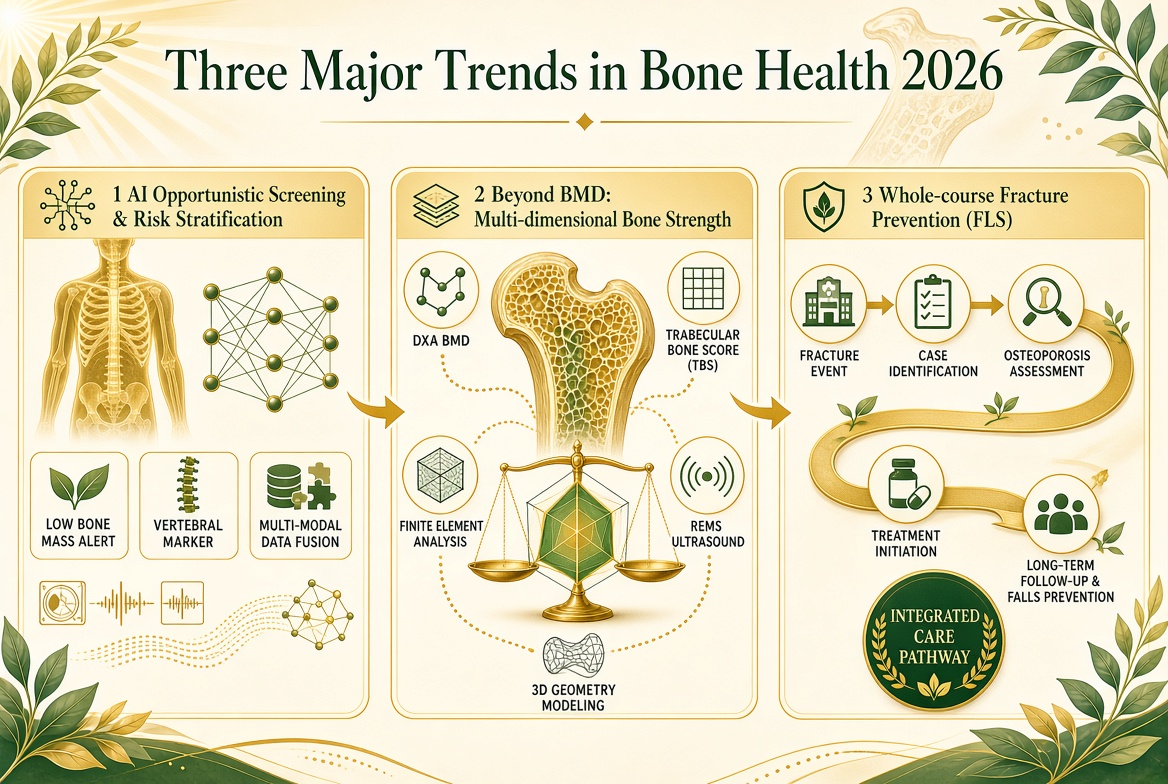
2026年,骨健康领域的研究与临床实践正在从单一骨密度测量和骨折发生后的治疗,逐步转向早期风险识别、多维度风险预测及全程管理。人工智能、骨强度综合评估和系统化骨折预防服务,是值得医学专业人员重点关注的三大趋势。需要强调的是,这些趋势代表研究热点与临床转化方向,并不意味着所有新技术都已具备常规临床应用的证据。
In 2026, bone health research and clinical practice are moving beyond isolated bone mineral density measurements and post-fracture treatment toward early risk identification, multidimensional risk prediction, and longitudinal care. Artificial intelligence, comprehensive assessment of bone strength, and integrated fracture-prevention services are three major trends for healthcare professionals to follow. These trends reflect emerging priorities and translational directions; they do not imply that every new technology is ready for routine clinical use.
趋势一:人工智能驱动的机会性筛查与风险分层
1. 从专门检查走向常规影像的机会性筛查
人工智能(AI)在骨健康领域的重要方向,是利用因其他临床原因获得的X线、CT及其他影像资料,辅助识别低骨量、骨质疏松或椎体骨折风险。其潜在价值在于减少对额外检查的依赖,帮助发现尚未接受骨密度检测的高风险人群,尤其适用于骨密度仪可及性有限的医疗环境。
One major application of artificial intelligence (AI) in bone health is the use of radiographs, CT scans, and other images obtained for unrelated clinical indications to identify possible low bone mass, osteoporosis, or vertebral fractures. This approach may help identify high-risk individuals who have not undergone bone mineral density testing, particularly in healthcare settings with limited access to DXA.
2. 从图像识别走向多模态风险预测
2026年的研究方向不仅包括医学影像分析,还包括将影像特征与年龄、既往脆性骨折、合并症、实验室指标及临床风险因素整合,用于风险分层和决策支持。亚太地区专家共识强调,AI应作为机会性筛查与临床评估的辅助工具,而非替代DXA诊断、既有风险评估体系或医生判断。模型必须经过目标人群验证,并报告校准、敏感度、特异度及临床效用等指标。
The field is moving beyond image classification toward multimodal prediction that combines imaging features with age, previous fragility fractures, comorbidities, laboratory measurements, and established clinical risk factors. An Asia-Pacific expert consensus emphasizes that AI should support opportunistic screening and clinical assessment rather than replace DXA, established risk-assessment frameworks, or professional judgment. Models require validation in their intended populations, with reporting of calibration, sensitivity, specificity, and clinical utility.
趋势二:从骨密度中心化走向骨强度与多维度评估
1. 骨密度仍是基础,但不再是唯一信息来源
DXA测得的骨矿物质密度(BMD)仍是骨质疏松症诊断的重要依据,但骨折风险还受到骨微结构、骨几何形态、跌倒风险及其他临床因素影响。2026年发表于 Nature Reviews Rheumatology 的综述梳理了多类补充评估方法,包括有限元分析、骨小梁评分(TBS)、基于DXA的三维形态建模、定量超声(QUS)、射频超声多频谱分析(REMS),以及AI辅助常规影像判读。不同方法提供的信息并不相同,应依据其验证证据与临床适用场景选择。
Dual-energy X-ray absorptiometry (DXA)-derived bone mineral density (BMD) remains central to osteoporosis diagnosis, but fracture risk is also influenced by bone microarchitecture, geometry, falls, and other clinical factors. A review published in Nature Reviews Rheumatology in 2026 examined complementary approaches, including finite element analysis, trabecular bone score (TBS), DXA-based three-dimensional shape modeling, quantitative ultrasound (QUS), radiofrequency echographic multi-spectrometry (REMS), and AI-assisted interpretation of routine imaging. These methods provide different types of information and should be selected according to their validation evidence and intended clinical use.
2. 从单项指标走向综合风险画像
临床实践中,综合评估的重点不是简单增加检测项目,而是明确不同指标能否提供独立、可解释且可改变管理决策的信息。例如,BMD用于骨质疏松诊断,FRAX用于估算一定时间内主要骨质疏松性骨折和髋部骨折概率,TBS或骨力学指标则可能在特定人群中补充骨质量信息。应用时应避免将不同工具的输出直接等同,也不能仅凭某项新指标替代标准诊断流程。
The goal of multidimensional assessment is not simply to order more tests, but to determine whether each measure provides independent, interpretable information that can change clinical decisions. For example, BMD supports osteoporosis diagnosis, FRAX estimates the probability of major osteoporotic and hip fractures over a defined period, and TBS or biomechanical measures may provide additional information in selected populations. Their outputs are not interchangeable, and no single emerging marker should automatically replace standard diagnostic pathways.
趋势三:从骨折后干预走向全程骨折预防管理
1. 骨折联络服务与二级预防持续受到关注
脆性骨折不仅是一次急性事件,也是后续骨折风险升高的重要信号。骨折联络服务(Fracture Liaison Service,FLS)通过病例识别、骨质疏松评估、治疗转介、用药随访及跌倒风险管理,帮助减少骨折后诊疗链条中的遗漏。2026年骨健康管理的重要方向,是将骨折预防从单一科室的任务转变为可追踪、可评估的跨学科服务流程。
A fragility fracture is not merely an acute event; it is also a warning sign of increased risk of subsequent fractures. Fracture Liaison Services (FLS) aim to reduce gaps in care through case identification, osteoporosis assessment, treatment referral, medication follow-up, and falls-risk management. A key direction in 2026 is to move fracture prevention from an isolated departmental responsibility toward a coordinated, measurable, multidisciplinary care pathway.
2. 从一次性治疗走向长期随访与个体化管理
骨健康管理正在更多地关注治疗启动后的持续性:是否完成骨密度评估、是否及时开始适当治疗、患者能否坚持用药,以及治疗期间是否出现新发骨折或跌倒。真实世界队列、电子病历和登记系统可用于识别管理缺口、评估长期结局,并为不同风险层级设计随访策略。未来的重点不仅是发现高风险患者,更是确保风险识别能够转化为实际干预和可衡量的临床获益。
Bone health management increasingly emphasizes continuity after treatment initiation: whether BMD assessment is completed, appropriate therapy is started promptly, medication adherence is maintained, and new fractures or falls occur during follow-up. Real-world cohorts, electronic health records, and registries can help identify care gaps, evaluate long-term outcomes, and tailor follow-up to different risk levels. The goal is not merely to identify high-risk patients, but to ensure that risk detection leads to intervention and measurable clinical benefit.
对临床实践与研究设计的启示
三大趋势共同指向一个核心转变:骨健康管理的评价标准,正在从“测得骨密度、诊断骨质疏松”扩展到“识别风险、实施干预、持续随访并改善结局”。临床机构可优先完善脆性骨折病例识别、DXA检查转介、治疗随访和跌倒预防流程;研究者则应加强AI模型外部验证、前瞻性研究及真实世界临床效用评价。对于新型骨强度指标,需要明确其相对于BMD和既有风险工具的增量价值。
Together, these trends suggest a shift from measuring BMD and diagnosing osteoporosis toward identifying risk, delivering interventions, maintaining follow-up, and improving outcomes. Clinical institutions can prioritize systematic fragility-fracture identification, DXA referral, treatment follow-up, and falls prevention. Researchers should strengthen external validation of AI models, prospective studies, and real-world evaluations of clinical utility. For emerging bone-strength measures, their incremental value over BMD and established risk tools must be demonstrated.
总结
2026年骨健康领域最值得关注的三大趋势,是AI辅助早期筛查与风险分层、超越单一骨密度的多维度骨强度评估,以及以FLS为代表的全程骨折预防管理。三者分别回应“如何更早发现”“如何更准确评估”和“如何真正改善结局”这三个临床问题。现阶段仍需重视外部验证、临床效用和实施可行性,避免将技术进步直接等同于患者获益。
The three trends most worth watching in the bone health field in 2026 are AI-assisted early screening and risk stratification, multi-dimensional bone strength assessment that goes beyond single BMD metrics, and whole-course fracture prevention management represented by FLS. These three trends respectively address the clinical questions of "how to detect earlier," "how to assess more accurately," and "how to truly improve outcomes." At this stage, we still need to prioritize external validation, clinical utility, and implementation feasibility, avoiding the assumption that technological progress is directly equivalent to patient benefit.
参考文献
1. Huang CF, Fang WH, Chen KH, et al. Consensus statement on the application of artificial intelligence in osteoporosis screening and management: perspectives from the Asia-Pacific region. Osteoporosis International. 2026.
2. Single-component imaging and ultrasound-based tools for the assessment of fracture risk. Nature Reviews Rheumatology. 2026;22:707–718.
3. Wang B, Tang S, Tan P, et al. Artificial intelligence in osteoporosis screening and fracture risk prediction among aging populations: a bibliometric evidence map. Frontiers in Endocrinology. 2026;17.
4. Raja M, Reddy A J. Artificial intelligence, explainable deep learning, and generative models for osteoporosis and bone disease prediction: a systematic review and future research roadmap. Frontiers in Artificial Intelligence. 2026;9.