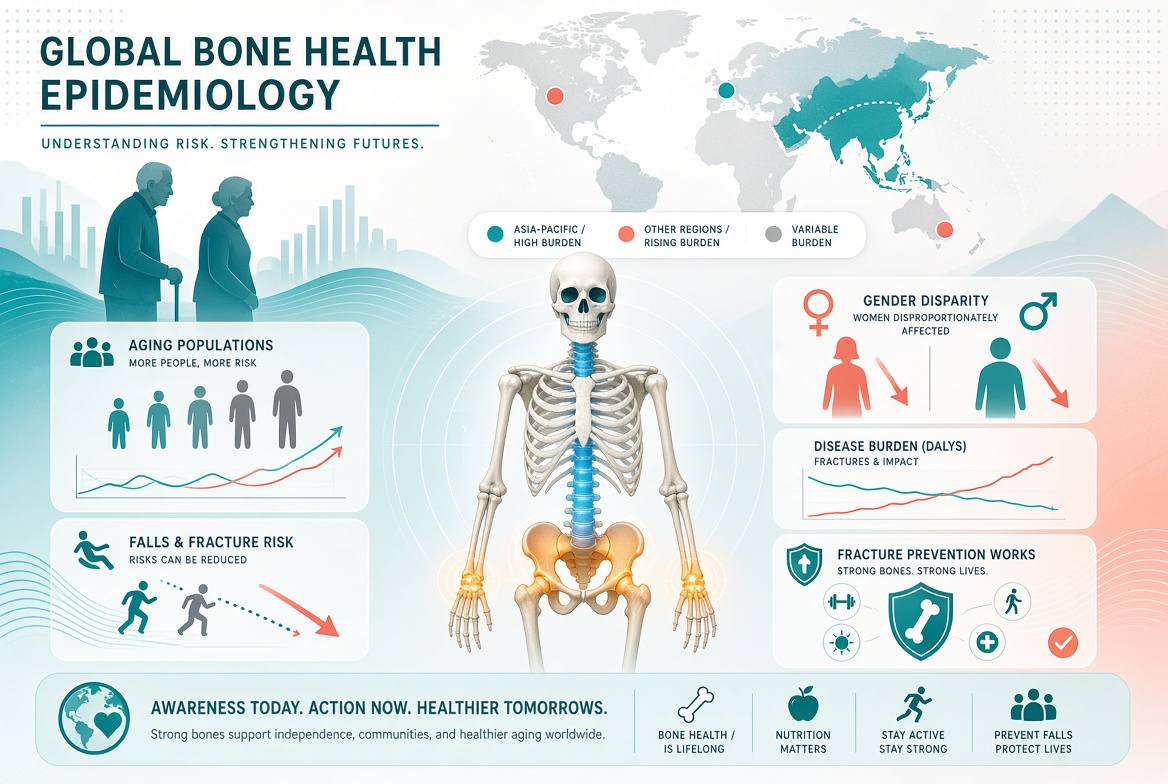
2026年,全球骨健康领域陆续发布基于全球疾病负担研究(Global Burden of Disease,GBD)、区域流行病学审计、国家数据库及社区人群调查的最新分析。这些数据揭示了骨质疏松症与低骨密度相关疾病负担的长期变化,以及人口老龄化、性别差异、跌倒和诊疗不足带来的公共卫生挑战。本文以2026年公开发表或更新的报告和研究为线索,按发布机构或研究项目逐条介绍其主要流行病学发现,并明确数据所对应的统计年份,避免将“2026年发表”误解为“2026年发生率”。
In 2026, new analyses based on the Global Burden of Disease (GBD) Study, regional epidemiological audits, national databases, and community-based surveys have expanded the evidence on skeletal health. These reports illuminate long-term trends in osteoporosis and low bone mineral density (LBMD), alongside the effects of population ageing, sex differences, falls, and gaps in diagnosis and treatment. This review summarizes major publications and data updates released in 2026, organized by the issuing organization or research project. The underlying observation periods are specified because publication in 2026 does not mean that the data describe disease occurrence in that calendar year.
一、2026年主要流行病学数据更新
1. 全球疾病负担研究(GBD 2023):中国与全球低骨密度疾病负担趋势
发布机构: 中国相关研究团队;发表于《中华修复重建外科杂志》,2026年3月。
该研究利用GBD 2023数据库,分析1990—2023年全球及中国40岁及以上人群低骨密度相关死亡、伤残调整寿命年(DALYs)、伤残生存年(YLDs)和早逝损失寿命年(YLLs)。中国低骨密度相关DALYs率从1990年的每10万人311.54下降至2023年的268.55;全球则由288.85下降至265.11。值得关注的是,中国YLDs率由170.42上升至197.91,提示年龄标化后的伤残负担仍在增加。研究还显示,人口增长与老龄化是相关死亡绝对数量上升的重要因素,跌倒是低骨密度相关死亡和DALYs的首要归因伤害因素。
A study published in March 2026 used the GBD 2023 database to examine LBMD-attributable deaths, disability-adjusted life years (DALYs), years lived with disability (YLDs), and years of life lost (YLLs) among people aged 40 years and older from 1990 to 2023. China's LBMD-attributable DALY rate fell from 311.54 to 268.55 per 100,000, while the global rate declined from 288.85 to 265.11. However, China's YLD rate rose from 170.42 to 197.91 per 100,000, suggesting a growing disability burden despite declining age-standardized DALY rates. Population growth and ageing contributed substantially to rising absolute mortality, while falls were the leading injury-related contributor.
2. APCO–IOF亚太区域审计:22个国家和地区的骨质疏松负担
发布机构: 亚太骨质疏松联盟(APCO)与国际骨质疏松基金会(IOF);区域审计报告于2025年发布,相关综述于2026年6月刊载。
该审计汇总亚太22个国家和地区的骨质疏松及脆性骨折流行病学、诊疗体系、医疗费用与政策数据。其突出发现并非单纯的患病率差异,而是疾病管理体系之间存在明显缺口:仅有6个国家或地区将骨质疏松列为国家卫生优先事项;骨折登记、诊断可及性、医保支付与骨折后预防管理均存在不足。报告强调,亚太地区快速老龄化可能进一步放大骨折负担,建议加强骨折登记系统、骨折后管理路径和国家级防治政策。
The APCO–IOF regional audit compiles epidemiological, healthcare-system, cost, and policy data from 22 Asia-Pacific countries and regions. Its key finding is the substantial gap between disease burden and health-system response: only six jurisdictions identified osteoporosis as a national health priority. Deficiencies include fracture surveillance, diagnostic access, reimbursement, and secondary fracture prevention. The audit recommends fracture registries, structured post-fracture pathways, and stronger national policies. Although the audit was released in 2025, its findings were revisited in a review published in June 2026.
3. 中国社区老年人骨质疏松患病率研究
发布机构: Medical Science Monitor;2026年9月8日发表。
该横断面研究纳入中国社区老年人2533名,其中女性1317名、男性1310名。总体骨质疏松患病率在女性中为20.4%,男性为3.5%;女性患病率随年龄增长而上升,65—69岁、70—79岁和80岁及以上女性的患病率分别为16.5%、22.5%和39.0%。男性对应年龄组分别为1.5%、3.8%和10.5%。这些数据提示,在该研究人群中,女性及高龄群体是骨质疏松识别与管理的重点。不过,该研究来自特定社区样本,不宜直接外推为全国患病率。
Published on September 8, 2026, this cross-sectional study included 2,533 community-dwelling older adults in China, comprising 1,317 women and 1,310 men. Osteoporosis prevalence was 20.4% in women and 3.5% in men. Among women, prevalence increased from 16.5% at ages 65–69 to 39.0% at age 80 or older; corresponding estimates in men were 1.5% and 10.5%. These findings highlight older women as a priority group, but the sample should not be treated as nationally representative.
4. GBD 2023:绝经后女性及G20国家低骨密度疾病负担
发布机构: INQUIRY: The Journal of Health Care Organization, Provision, and Financing;2026年发表。
该研究使用GBD 2023数据,分析中国及G20国家55岁及以上女性1994—2023年低骨密度归因死亡、DALYs、YLDs和YLLs的变化。其研究重点是区分绝对疾病负担与年龄标化率的变化,并关注死亡负担下降与伤残负担上升并存的现象。对于骨健康政策而言,这种分析有助于识别:即使年龄标化指标改善,人口老龄化仍可能使患者总数、长期照护需求及康复资源需求持续增长。
Published in 2026, this analysis used GBD 2023 data to assess LBMD-attributable deaths, DALYs, YLDs, and YLLs among women aged 55 years and older in China and G20 countries from 1994 to 2023. Its focus is the distinction between absolute burden and age-standardized rates, including the coexistence of declining mortality burden and rising disability. This framework helps explain why total patient numbers and long-term rehabilitation needs may increase even when age-standardized indicators improve.
5. 国际骨质疏松基金会(IOF):全球患病规模与脆性骨折负担
发布机构: 国际骨质疏松基金会;2026年更新的公开流行病学资料。
IOF公开资料指出,全球约有5亿人患骨质疏松症;55岁以上人群每年发生的脆性骨折可达3700万例,相当于每分钟约70例。按50岁以上人群估计,女性约每3人中有1人、男性约每5人中有1人一生可能发生骨质疏松相关骨折。这些数字可用于公共卫生宣传和资源规划,但其依据包括既往流行病学研究及GBD 2019骨折数据,并非2026年新开展的全球人口调查。
The International Osteoporosis Foundation reports that approximately 500 million people worldwide have osteoporosis and that up to 37 million fragility fractures occur annually among people older than 55—roughly 70 per minute. Lifetime fracture risk after age 50 is estimated at approximately one in three women and one in five men. These figures are useful for public health planning, but they derive from earlier epidemiological studies and GBD 2019 fracture estimates rather than a new global population survey conducted in 2026.
6. GBD 2021:全球低骨密度归因疾病负担的补充分析
发布机构: 国际研究团队;相关研究于2025年在线发表,2026年仍是解读全球骨健康负担的重要数据来源。
这项基于GBD 2021的分析估计,2020年全球低骨密度归因死亡约47.7万人,DALYs约1720万。1990—2020年,全球低骨密度归因死亡绝对数量增加127.1%,DALYs增加89.8%;但年龄标化DALYs率下降12.7%。这一结果再次说明,绝对病例负担与年龄标化指标可能呈现不同趋势。低骨密度在该研究中被视为骨折相关健康损失的可干预风险因素,因此其统计范围并不等同于临床诊断的骨质疏松症患者总数。
A GBD 2021 analysis estimated approximately 477,000 LBMD-attributable deaths and 17.2 million DALYs worldwide in 2020. Between 1990 and 2020, absolute deaths increased by 127.1% and DALYs by 89.8%, while the age-standardized DALY rate decreased by 12.7%. These contrasting trends illustrate the importance of reporting both absolute counts and age-standardized measures. LBMD is modelled as a modifiable fracture-related risk factor and should not be interpreted as equivalent to the number of people clinically diagnosed with osteoporosis.
二、综合分析与临床启示
2026年公布的骨健康流行病学证据呈现三个主要趋势。第一,人口老龄化持续推高骨折和长期照护的绝对需求;第二,女性及高龄人群仍是骨质疏松防治的重要目标人群,但男性椎体骨折及低骨密度相关疾病负担也不应被忽视;第三,疾病负担正在从死亡指标向伤残、康复及长期照护需求延伸。
The epidemiological evidence available in 2026 points to three major trends. First, population ageing continues to increase the absolute need for fracture care and long-term support. Second, women and older adults remain key target populations, while vertebral fractures and LBMD-related burden in men also require attention. Third, the impact of skeletal disease extends beyond mortality to disability, rehabilitation, and long-term care.
临床与公共卫生实践应同时关注骨密度、既往脆性骨折、跌倒风险、继发性骨质疏松因素及治疗覆盖率。对于流行病学研究,还应严格区分骨质疏松患病率、低骨密度归因疾病负担、脆性骨折发生数和模型估计的归因死亡,避免将不同统计口径直接比较。
Clinical and public health strategies should integrate BMD, prior fragility fractures, fall risk, secondary osteoporosis factors, and treatment coverage. Epidemiological reports must distinguish osteoporosis prevalence, LBMD-attributable burden, fragility fracture counts, and modelled attributable mortality; these measures have different definitions and should not be compared as though they were interchangeable.
参考文献
1. Wu Y, Lai Z, Yan H, et al. Trends in burden of osteoporosis in China from 1990 to 2023 and analysis of epidemiological factors. Chinese Journal of Reparative and Reconstructive Surgery. 2026;40(3):378–386.
2. Asia Pacific Consortium on Osteoporosis; International Osteoporosis Foundation. The APCO–IOF Asia Pacific Regional Audit: Epidemiology, Costs and Burden of Osteoporosis in 2025. 2025.
3. Sun D, Yang M, Zhu J, et al. Prevalence and associated risk factors of osteoporosis in community-dwelling older adults in China: a cross-sectional study of 2533 participants. Medical Science Monitor. 2026;32:e953854.
4. Yang W, Hai B, Wu S, et al. Declining mortality and rising disability from low bone mineral density in postmenopausal women in China and G20 countries. INQUIRY. 2026.
5. International Osteoporosis Foundation. Epidemiology of Osteoporosis and Fragility Fractures.
6. GBD 2021 Low Bone Mineral Density Collaborators. The global, regional, and national burden attributable to low bone mineral density, 1990–2020: an analysis of a modifiable risk factor from the Global Burden of Disease Study 2021. The Lancet Healthy Longevity. 2025.
说明: 本文以截至2026年10月14日可检索的公开资料为基础。上述数据涵盖不同统计年份、研究人群和疾病定义;部分报告在2026年发布或更新,但其底层数据截至2020、2021、2023年或更早。本文不将这些结果表述为2026年全球实时患病率。