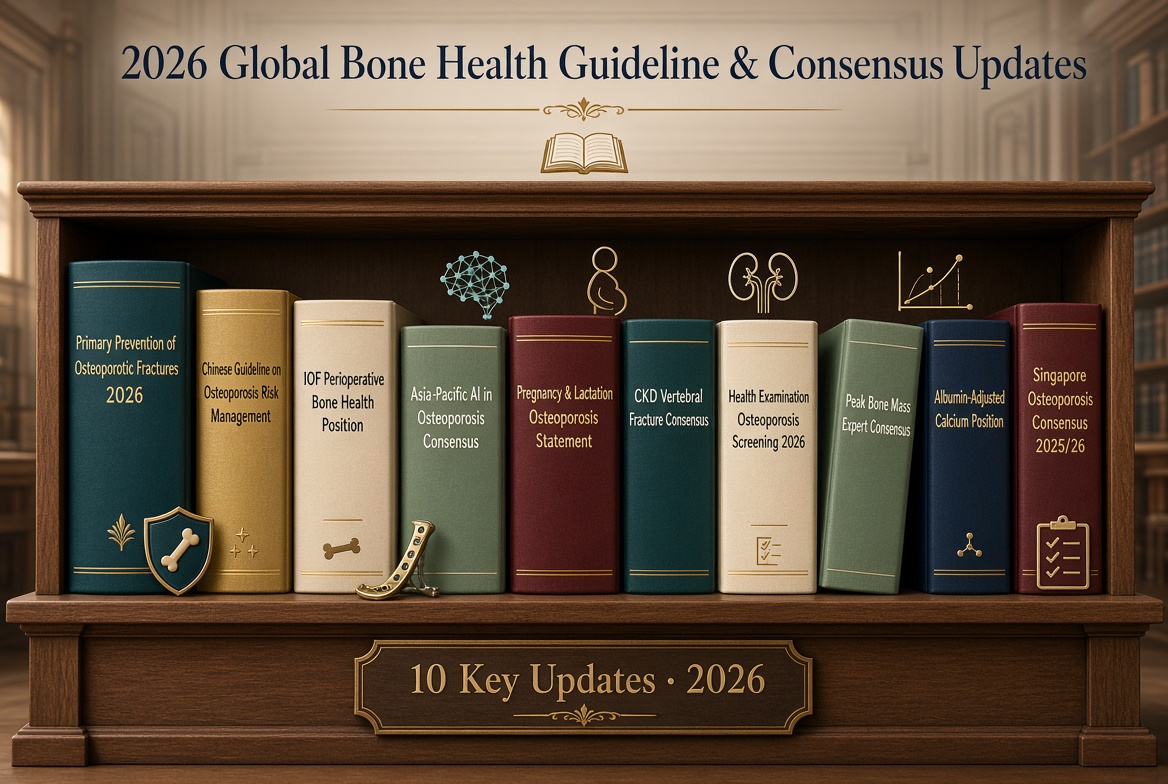
2026年,骨健康领域的指南与专家共识更新呈现出从骨质疏松症诊断和药物治疗,向骨折一级预防、围手术期骨健康管理、人工智能辅助筛查、特殊人群管理及全生命周期骨骼健康延伸的趋势。本文检索截至2026年10月14日公开发表的相关指南、专家共识及国际学会立场文件,综合临床适用性、潜在影响人群、专业组织影响力与实践价值,遴选10项值得关注的更新。需要说明的是,本文排序属于编辑性综合排序,并非正式的指南质量评价或学术影响力排名;部分文件属于专家立场声明,而非严格意义上的临床实践指南。
In 2026, bone health guidance has increasingly extended beyond osteoporosis diagnosis and pharmacotherapy to primary fracture prevention, perioperative bone optimization, artificial intelligence–assisted screening, special populations, and life-course skeletal health. This review identifies ten notable guidelines, consensus statements, and position papers published or formally updated by October 14, 2026. The ranking reflects an editorial assessment of clinical applicability, population impact, professional authority, and practical relevance; it is not a validated guideline-quality ranking. Some documents are position statements rather than formal clinical practice guidelines.
一、2026年更新概览
本次列出10项具有较明确2026年发表、在线发表或正式更新记录的代表性文件。中国文件侧重骨质疏松性骨折一级预防、健康体检筛查与峰值骨量;国际文件则进一步覆盖围手术期管理、人工智能、妊娠与哺乳相关骨质疏松及复杂共病。不同文件的证据等级、适用人群与推荐强度并不相同,临床应用时应阅读原文。
The search identified ten representative documents with identifiable publication or update records in 2026. Chinese guidance emphasizes primary fracture prevention, screening during health examinations, and peak bone mass. International publications address perioperative care, artificial intelligence, pregnancy- and lactation-associated osteoporosis, and complex comorbidities. Their evidence certainty, target populations, and recommendation strengths differ; clinicians should consult the original documents before implementation.
二、更新要点
1. 骨质疏松性骨折一级预防指南(2026版)
Guideline for Primary Prevention of Osteoporotic Fractures (2026 Edition)
发布范围:中国|《中华医学杂志》2026年3月。
该指南形成11条循证推荐,重点包括骨折高危人群识别、骨折风险评估、风险人群教育、跌倒预防,以及骨质疏松症评估、诊断与治疗。其临床价值在于推动干预前移,将风险筛查与可执行的预防措施相衔接,而不局限于骨折发生后的处理。
Published in China in March 2026, this guideline provides 11 evidence-based recommendations addressing high-risk identification, fracture-risk assessment, patient education, fall prevention, and osteoporosis evaluation and treatment. Its main contribution is to strengthen primary prevention by connecting risk identification with actionable interventions before fractures occur.
2. 中国普通人群骨质疏松风险管理指南
Chinese Guideline on Risk Management of Osteoporosis in the General Public
发布范围:中国|2026年8月11日在线发表。
指南提出15项推荐,涉及OSTA、国际骨质疏松基金会一分钟风险测试及FRAX筛查,以及蛋白质、乳制品、钙、维生素D、运动、体重管理、日照和戒烟限酒等措施。其特点是将专业循证建议转化为适用于基层医疗与普通人群的风险管理策略。
Published online on August 11, 2026, the guideline presents 15 recommendations covering OSTA, the IOF One-Minute Osteoporosis Risk Test, FRAX, nutrition, physical activity, weight management, sunlight exposure, smoking cessation, and alcohol reduction. It translates evidence-based prevention into practical strategies for primary care and the general population.
3. 国际骨质疏松基金会围手术期骨健康立场声明
IOF Position Statement on Osteoporosis and Implant Fixation Failure in Arthroplasty and Spinal Fusion
发布范围:国际|2026年6月在线发表。
该声明将骨质疏松与关节置换、脊柱融合术后的假体松动、螺钉松动、假关节形成及假体周围骨折等问题联系起来。建议对老年、有脆性骨折史或其他骨质疏松风险因素的手术患者开展骨健康评估,并整合营养、跌倒预防和药物干预。脊柱融合患者可考虑围手术期特立帕肽治疗,具体方案需结合手术类型及个体风险。
Published internationally in June 2026, this position statement links osteoporosis to implant fixation failure after arthroplasty and spinal fusion. It advocates perioperative bone assessment, nutritional optimization, fall prevention, and individualized pharmacotherapy. Teriparatide may be considered for osteoporotic patients undergoing spinal fusion, with treatment timing and duration determined by clinical circumstances.
4. 亚太地区骨质疏松筛查与管理人工智能应用共识
Consensus Statement on the Application of Artificial Intelligence in Osteoporosis Screening and Management: Asia-Pacific Perspectives
发布范围:亚太地区|2026年5月16日在线发表。
共识聚焦AI在影像骨评估、骨折风险预测及筛查流程中的应用,强调工具验证、性能报告、临床适用性、公平性和伦理要求。核心意义是明确AI应辅助而非替代临床判断;未经充分验证的算法不应直接作为确诊或治疗决策的唯一依据。
Published on May 16, 2026, this consensus addresses AI-assisted imaging-based bone assessment, fracture prediction, and screening. It emphasizes validation, transparent performance reporting, clinical applicability, equity, and ethical safeguards. AI should support rather than replace clinical judgment, and unvalidated algorithms should not independently determine diagnosis or treatment.
5. 妊娠与哺乳相关骨质疏松国际立场声明
Pregnancy- and Lactation-Associated Osteoporosis: International Position Statement
发布范围:国际|2026年7月16日在线发表。
该声明由IAPM、IOF、ECTS、ESCEO、IMS及EMAS相关专家共同参与。文件建议结合病史、体格检查、实验室检查与影像学完成评估,排查继发性骨质疏松,并根据妊娠或产后阶段制定个体化方案。药物选择需充分考虑生育计划、哺乳状态及妊娠安全性;现有比较研究有限,不宜将有限证据解释为确定的治疗优劣。
Published online on July 16, 2026, this international statement recommends comprehensive assessment, exclusion of secondary osteoporosis, and individualized management according to pregnancy or postpartum status. Treatment decisions must account for breastfeeding, future pregnancy plans, and drug safety. Limited comparative evidence warrants caution when interpreting treatment preferences.
6. 晚期慢性肾脏病椎体骨折管理国际共识
A Consensus Statement on the Management of Vertebral Fractures in CKD Stages G4–G5D
发布范围:国际|2026年《Nephrology Dialysis Transplantation》刊载。
该共识聚焦CKD G4–G5D患者的椎体骨折,涵盖骨脆性识别、影像学诊断、骨代谢异常评估与治疗决策。其重要提示是:晚期肾病患者的骨折管理不能简单套用一般骨质疏松治疗路径,应综合考虑CKD相关矿物质和骨代谢异常(CKD-MBD)及药物安全性。
Published in Nephrology Dialysis Transplantation in 2026, this consensus addresses vertebral fractures in CKD stages G4–G5D, including skeletal fragility, imaging, metabolic assessment, and treatment decisions. Management should account for CKD–mineral and bone disorder and drug safety rather than simply applying standard osteoporosis treatment pathways.
7. 体检人群骨质疏松筛查及健康管理指南(2026)
Guideline for Osteoporosis Screening and Health Management in Health Examination Populations (2026)
发布范围:中国|《中华健康管理学杂志》2026年第20卷第2期。
指南提出16条核心推荐,建立“筛查—评估—分层干预—健康教育—随访”的管理路径,覆盖适宜筛查人群、筛查项目、实施流程及不同风险等级的管理策略。其主要价值是将骨质疏松防治纳入常规健康体检与连续性健康管理,而不是仅依赖患者出现骨折后再开展诊疗。
Published in China in 2026, this guideline provides 16 core recommendations organized around screening, assessment, risk-stratified intervention, education, and follow-up. It integrates osteoporosis prevention into routine health examinations and longitudinal health management.
8. 提高峰值骨量预防骨骼疾病专家共识
Expert Consensus on Increasing Peak Bone Mass to Prevent Skeletal Diseases
发布范围:中国|《中华骨质疏松和骨矿盐疾病杂志》2026年第19卷第2期。
该共识强调生命早期骨骼健康管理,关注营养、运动及相关生活方式对峰值骨量形成的影响。其核心方向是将骨质疏松防治关口前移至儿童、青少年及青年阶段,强调成年前形成充足骨量储备对于降低后续骨骼疾病风险的重要性。
Published in China in 2026, this consensus emphasizes early-life skeletal health, including nutrition, exercise, and lifestyle factors affecting peak bone mass. It promotes a life-course prevention strategy that begins in childhood, adolescence, and young adulthood rather than focusing exclusively on older adults.
9. 妊娠与哺乳相关骨质疏松以外的实验室检测更新:停止常规报告白蛋白校正钙
Position Statement on Discontinuing Routine Reporting of Albumin-Adjusted (“Corrected”) Calcium
发布范围:国际|2026年4月在线发表,7月正式刊载。
IOF、IFCC及EFLM相关工作组联合提出,不应继续常规报告白蛋白校正钙,原因在于传统校正公式可能产生不准确结果,进而影响临床判断。该文件虽非骨质疏松诊疗指南,但对骨代谢、内分泌及慢性肾病相关实验室评估具有直接参考价值。临床应结合具体情境解释总钙、白蛋白及必要时的离子钙结果。
Published online in April and in print in July 2026, this joint statement recommends discontinuing routine reporting of albumin-adjusted calcium because conventional correction formulas may be inaccurate. Although not an osteoporosis treatment guideline, it has implications for metabolic bone disease and CKD assessment. Calcium results should be interpreted in clinical context, with ionized calcium considered when indicated.
10. 新加坡骨质疏松管理共识(2025版,2026年发表)
2025 Singapore Consensus Statements on the Management of Osteoporosis
发布范围:新加坡|2026年5月20日在线发表。
该共识由10个医学组织的18名专家代表参与制定,共形成80条共识意见,涵盖筛查与骨折风险评估、初始骨密度检测、药物治疗适应证、药物选择、治疗目标与随访,以及药物相关颌骨坏死的预防和管理。尽管名称标注为2025版,其正式发表时间为2026年,因此纳入本次统计;其价值在于为多学科临床实践提供更细化的管理建议。
Developed by 18 representatives from ten medical organizations, the consensus comprises 80 statements on screening, fracture-risk assessment, initial BMD testing, pharmacotherapy, treatment targets, monitoring, and medication-related osteonecrosis of the jaw. Although designated the 2025 Singapore consensus, it was published online in May 2026 and is included here because of its publication date.
三、总结与临床启示
2026年的骨健康文件呈现出三个值得关注的方向:第一,骨折预防逐步从单纯骨密度检测转向综合风险评估与早期干预;第二,围手术期、慢性肾病及妊娠哺乳等特殊场景受到更多重视;第三,AI筛查和实验室检测规范成为骨健康管理的新议题。中国文件在一级预防、体检筛查和全生命周期管理方面尤为值得关注。
Three major directions emerge from the 2026 publications: a shift toward integrated fracture-risk assessment and early intervention; greater attention to perioperative care and special populations; and growing emphasis on AI validation and laboratory testing standards. Chinese guidance is particularly relevant to primary prevention, screening, and life-course bone health management.
需要强调的是,以上10项文件并不代表2026年全球全部指南与共识,也不意味着所有文件均为旧版指南的修订版。本文依据公开发表记录进行筛选,部分国际共识的实际制定工作始于2025年。临床决策仍应结合适用人群、证据等级、当地规范及患者个体情况。
These ten documents do not constitute an exhaustive inventory of all 2026 bone health guidance, nor are all of them revisions of earlier guidelines. Some international consensus processes began in 2025 despite publication in 2026. Clinical decisions should therefore incorporate evidence certainty, target populations, local standards, and individual patient circumstances.
参考文献
1. Professional Committee for Osteoporosis Prevention and Rehabilitation of Chinese Association of Rehabilitation Medicine, et al. Guideline for primary prevention of osteoporotic fractures (2026 edition). Zhonghua Yi Xue Za Zhi. 2026;106(9):799–812.
2. Zhang S, et al. Chinese Guideline on Risk Management of Osteoporosis in the General Public. Orthopaedic Surgery. 2026.
3. Chandran M, et al. Osteoporosis and osteoporosis therapies as determinants of implant fixation failure in arthroplasty and spinal fusion constructs: a position statement from the IOF. Osteoporosis International. 2026.
4. Huang CF, et al. Consensus statement on the application of artificial intelligence in osteoporosis screening and management: perspectives from the Asia-Pacific region. Osteoporosis International. 2026.
5. Hadji P, et al. Pregnancy- and lactation-associated osteoporosis: a position statement of the IAPM, IOF, ECTS, ESCEO, IMS, and EMAS. International Journal of Gynecology & Obstetrics. 2026.
6. Fusaro M, et al. A consensus statement on the management of vertebral fractures in CKD stages G4–G5D. Nephrology Dialysis Transplantation. 2026;41(3):584–598.
7. 《体检人群骨质疏松筛查及健康管理指南(2026)》. 中华健康管理学杂志. 2026;20(2):92–108.
8. 《提高峰值骨量预防骨骼疾病专家共识》. 中华骨质疏松和骨矿盐疾病杂志. 2026;19(2):161–173.
9. Cavalier E, et al. Albumin-adjusted (“corrected”) calcium should no longer be reported: a position statement from the Joint IOF Working Group and IFCC Committee on Bone Metabolism and EFLM Committee on CKD. Clinical Chemistry and Laboratory Medicine. 2026;64(8):1719–1721.
10. Gani L, et al. 2025 Singapore consensus statements on the management of osteoporosis. Annals, Academy of Medicine, Singapore. 2026;55(5):252–268.