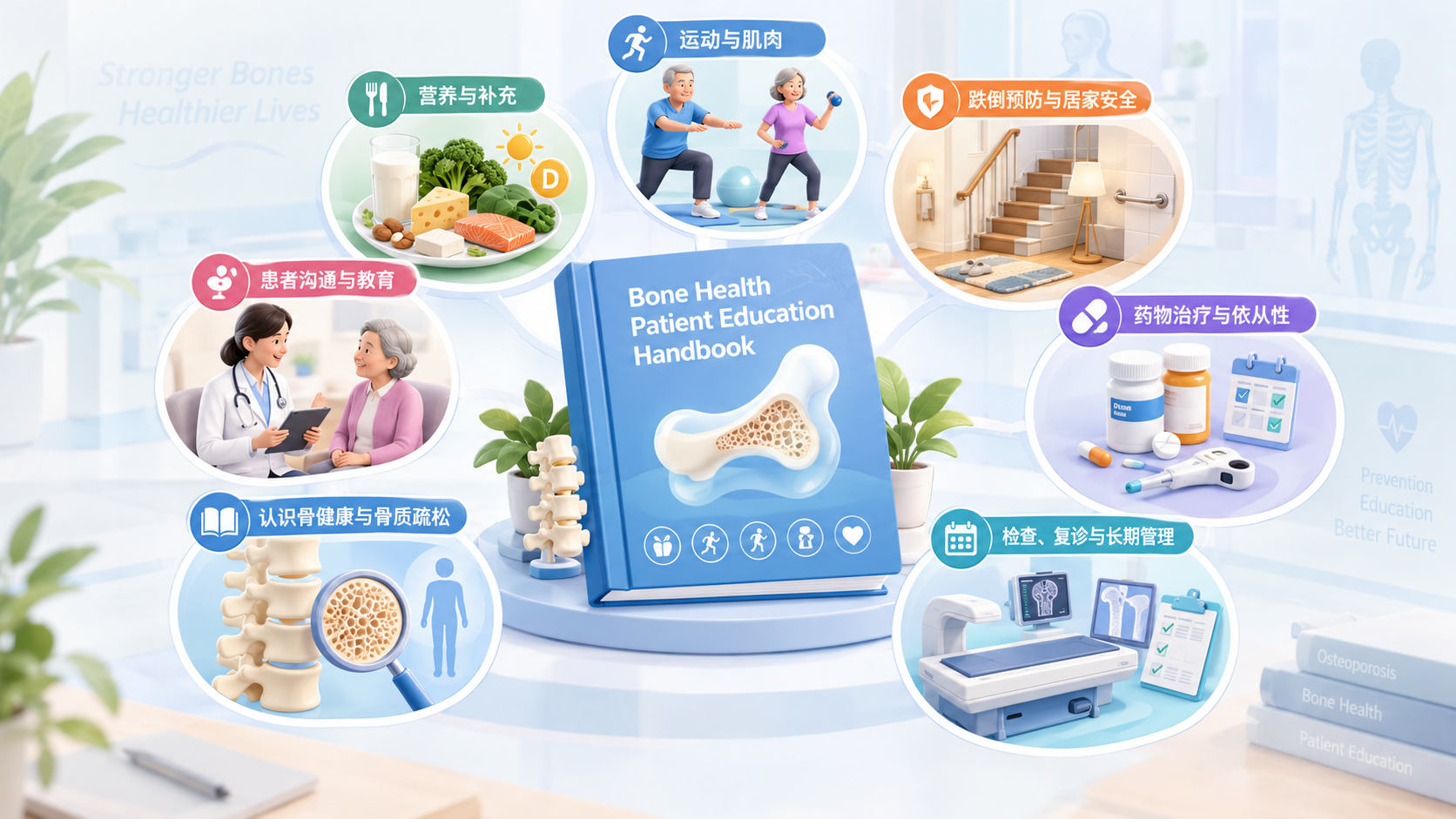
第一章 手册定位与教育目标|Purpose and Educational Objectives
骨健康患者教育是骨质疏松症全程管理的重要组成部分,目标不仅是提高患者对疾病的认知,还包括促进健康行为、改善治疗依从性、减少跌倒与脆性骨折,并帮助患者参与治疗决策。2025年新加坡卫生技术评估与临床指南机构(ACE)更新的《骨质疏松症:诊断与管理》指南,将营养、身体活动、戒烟、限制过量饮酒和跌倒预防纳入骨质疏松综合管理。
Patient education is an essential component of comprehensive osteoporosis care. Its objectives extend beyond disease awareness to include healthier behaviors, improved treatment adherence, fewer falls and fragility fractures, and meaningful participation in treatment decisions. Singapore’s Agency for Care Effectiveness (ACE), in its updated 2025 guideline on osteoporosis diagnosis and management, incorporates nutrition, physical activity, smoking cessation, moderation of alcohol intake, and fall prevention into comprehensive care.
本手册供骨科、内分泌科、全科医学、康复医学、临床护理、药学及骨折联络服务(Fracture Liaison Service,FLS)团队使用,可作为门诊宣教、住院患者教育、出院指导及慢病随访的基础框架。实际宣教应根据患者年龄、健康素养、文化背景、活动能力、合并症及骨折风险调整,而非向所有患者提供完全相同的信息。
This handbook is designed for orthopedic, endocrine, primary care, rehabilitation, nursing, pharmacy, and Fracture Liaison Service (FLS) teams. It can support outpatient counseling, inpatient education, discharge planning, and longitudinal follow-up. Educational content should be adapted to age, health literacy, cultural background, mobility, comorbidities, and fracture risk rather than delivered identically to every patient.
第二章 核心知识模块|Core Educational Modules
2.1 认识骨健康与骨质疏松|Understanding Bone Health and Osteoporosis
骨骼是持续更新的活体组织。骨质疏松症会削弱骨骼强度,增加低能量创伤下发生骨折的风险。患者即使没有疼痛,也可能存在椎体压缩性骨折;身高逐渐下降、驼背或新发背痛均值得进一步评估。应向患者解释,骨折风险取决于骨密度、既往骨折、年龄、跌倒风险及其他临床因素,不能仅凭是否疼痛或单一检查数值判断。
Bone is living tissue that undergoes continuous renewal. Osteoporosis weakens skeletal strength and increases the likelihood of fractures after low-energy trauma. Vertebral compression fractures may occur without obvious pain; progressive height loss, kyphosis, or new back pain warrants assessment. Patients should understand that fracture risk depends on BMD, previous fractures, age, fall risk, and other clinical factors—not pain symptoms or a single test result alone.
2.2 营养、钙与维生素D|Nutrition, Calcium, and Vitamin D
患者教育应优先鼓励通过均衡饮食获取足够的钙和蛋白质,合理安排乳制品、钙强化食品、豆制品及适宜的绿叶蔬菜。维生素D有助于钙吸收和骨矿化;对缺乏或缺乏风险较高者,应依据临床评估考虑补充。不同指南的推荐摄入量存在差异,应结合年龄、饮食、肾功能、结石史及当地指南制定方案,避免患者自行叠加多种补充剂。
Education should prioritize adequate calcium and protein from a balanced diet, including dairy products, calcium-fortified foods, soy products, and suitable leafy vegetables. Vitamin D supports calcium absorption and bone mineralization; supplementation should be considered according to clinical assessment, particularly in people with deficiency or increased risk. Recommended intakes vary across guidelines and should be individualized according to age, diet, renal function, stone history, and local guidance. Patients should avoid inadvertently combining multiple supplements.
2.3 身体活动与肌肉功能|Physical Activity and Muscle Function
运动宣教应兼顾骨骼负荷、肌肉力量、平衡能力和日常功能。一般可根据能力安排负重活动、渐进式抗阻训练及平衡训练;太极、弹力带训练、坐站练习等可作为部分患者的选择。对于既往发生椎体或髋部骨折、严重骨质疏松或平衡障碍者,应由专业人员指导运动强度和动作,避免未经评估的高冲击活动及增加脊柱屈曲负荷的动作。
Exercise education should address skeletal loading, muscle strength, balance, and daily function. Depending on individual ability, programs may include weight-bearing activity, progressive resistance training, and balance exercises. Tai chi, resistance-band exercises, and sit-to-stand practice may be suitable options for selected patients. Those with previous vertebral or hip fractures, severe osteoporosis, or balance impairment may require professional guidance to tailor intensity and technique, avoiding unassessed high-impact activities and movements that impose excessive spinal flexion loads.
2.4 跌倒预防与居家安全|Fall Prevention and Home Safety
跌倒预防应作为骨折预防的独立教育模块。医务人员可协助患者检查照明、地毯、电线、浴室扶手和楼梯等环境风险,并建议穿着合脚、防滑的鞋。视力问题、头晕、体位性低血压及可能增加跌倒风险的药物均应纳入评估。对反复跌倒或步态不稳者,应考虑综合跌倒风险评估和针对性康复干预,而不应仅强调患者“走路小心”。
Fall prevention should be treated as a distinct component of fracture prevention. Clinicians can help patients identify environmental hazards involving lighting, rugs, electrical cords, bathroom grab bars, and stairs, and recommend well-fitting, nonslip footwear. Visual impairment, dizziness, orthostatic hypotension, and medications that may increase fall risk should also be reviewed. Recurrent falls or gait instability warrant comprehensive assessment and targeted rehabilitation rather than advice simply to “be more careful.”
2.5 药物治疗与依从性|Medication and Adherence
患者应了解,生活方式干预是药物治疗的重要补充,但对于已经达到药物治疗指征的高风险患者,单靠补钙、运动或晒太阳通常不足以控制骨折风险。医务人员应解释处方药的预期获益、正确用法、常见不良反应及随访计划,并鼓励患者在出现不适或担忧时主动沟通,而不是自行停药。尤其需要提醒患者,地舒单抗不能随意延迟或停用;停药或转换治疗应由医生制定衔接方案,以降低反跳性骨转换增加及多发椎体骨折风险。
Patients should understand that lifestyle measures complement pharmacotherapy but are generally insufficient on their own for individuals at high fracture risk who meet treatment criteria. Clinicians should explain expected benefits, correct administration, common adverse effects, and follow-up arrangements. Patients should discuss concerns rather than discontinue treatment independently. Denosumab requires particular attention: doses should not be delayed or stopped casually, and discontinuation or transition should follow a clinician-directed plan to reduce the risk of rebound bone turnover and multiple vertebral fractures.
2.6 检查、复诊与共同决策|Testing, Follow-up, and Shared Decision-Making
骨密度检查(DXA)、临床骨折风险评估及必要的实验室检查应服务于个体化管理。患者需要知道,复查时间取决于初始风险、治疗类型、治疗持续时间及检查结果,不能机械地要求所有人每年重复DXA。复诊时可共同回顾是否按时用药、是否发生新骨折或跌倒、饮食与运动是否改善,以及是否出现需要进一步评估的不良反应。
DXA, clinical fracture-risk assessment, and indicated laboratory tests should support individualized management. Patients should understand that reassessment intervals depend on baseline risk, treatment type and duration, and clinical findings; annual DXA is not automatically necessary for everyone. Follow-up visits can review medication adherence, new fractures or falls, dietary and exercise changes, and adverse effects requiring further assessment.
第三章 宣教实施与效果评价|Implementation and Evaluation
推荐采用“评估—解释—共同制定计划—确认理解—随访强化”的流程。宣教结束时,可请患者用自己的语言复述药物服用方法、运动安排和跌倒预防措施,即采用“复述确认法”(teach-back),以识别误解并及时纠正。对高风险患者,应记录宣教内容、患者目标、照护者参与情况及下一次随访安排。
A practical education workflow is to assess needs, explain key concepts, develop a shared plan, confirm understanding, and reinforce the plan during follow-up. At the end of counseling, ask patients to explain medication instructions, exercise plans, and fall-prevention measures in their own words using the teach-back method. For high-risk patients, document the education provided, patient-defined goals, caregiver involvement, and follow-up arrangements.
可采用过程指标与临床结局指标共同评价项目质量,包括宣教覆盖率、患者对关键知识的掌握程度、治疗持续性、跌倒发生情况及新发脆性骨折。评估时应考虑患者年龄、合并症和疾病严重程度,避免将单一结局变化直接归因于宣教本身。患者教育的价值在于将循证建议转化为可执行、可追踪且适合个体生活情境的行动计划。
Program quality can be evaluated using both process and clinical outcomes, including education coverage, understanding of key concepts, treatment persistence, falls, and incident fragility fractures. Age, comorbidities, and disease severity should be considered when interpreting outcomes; changes in a single endpoint should not automatically be attributed to education alone. The purpose of patient education is to translate evidence-based recommendations into practical, trackable actions suited to each individual’s circumstances.
参考文献
1. Agency for Care Effectiveness (ACE). Osteoporosis: Diagnosis and Management. Updated August 15, 2025.
2. Gregson CL, et al. The 2024 UK clinical guideline for the prevention and treatment of osteoporosis. Archives of Osteoporosis. 2025.
3. LeBoff MS, et al. The clinician’s guide to prevention and treatment of osteoporosis. Osteoporosis International. 2022;33:2049–2102.
4. National Osteoporosis Guideline Group (NOGG). Clinical Guideline for the Prevention and Treatment of Osteoporosis. 2024 update.
5. Singapore Expert Panel. 2025 Singapore consensus statements on the management of osteoporosis. Annals, Academy of Medicine, Singapore. Published online May 20, 2026.
6. Bone Health and Osteoporosis Foundation (BHOF). Break Free From Osteoporosis: Resource Library.
说明: 本手册为面向医务人员的患者教育框架,可进一步拆分为饮食、运动、跌倒预防、药物依从性及复诊管理等独立宣教模块。具体建议应结合最新适用指南、患者个体情况及当地医疗规范更新。