关键词: 骨质疏松症;抗骨质疏松药物;抗骨吸收治疗;促骨形成治疗;序贯治疗;骨折联络服务
Keywords: Osteoporosis; pharmacotherapy; antiresorptive therapy; anabolic therapy; sequential treatment; Fracture Liaison Service (FLS)
一、概述|Overview
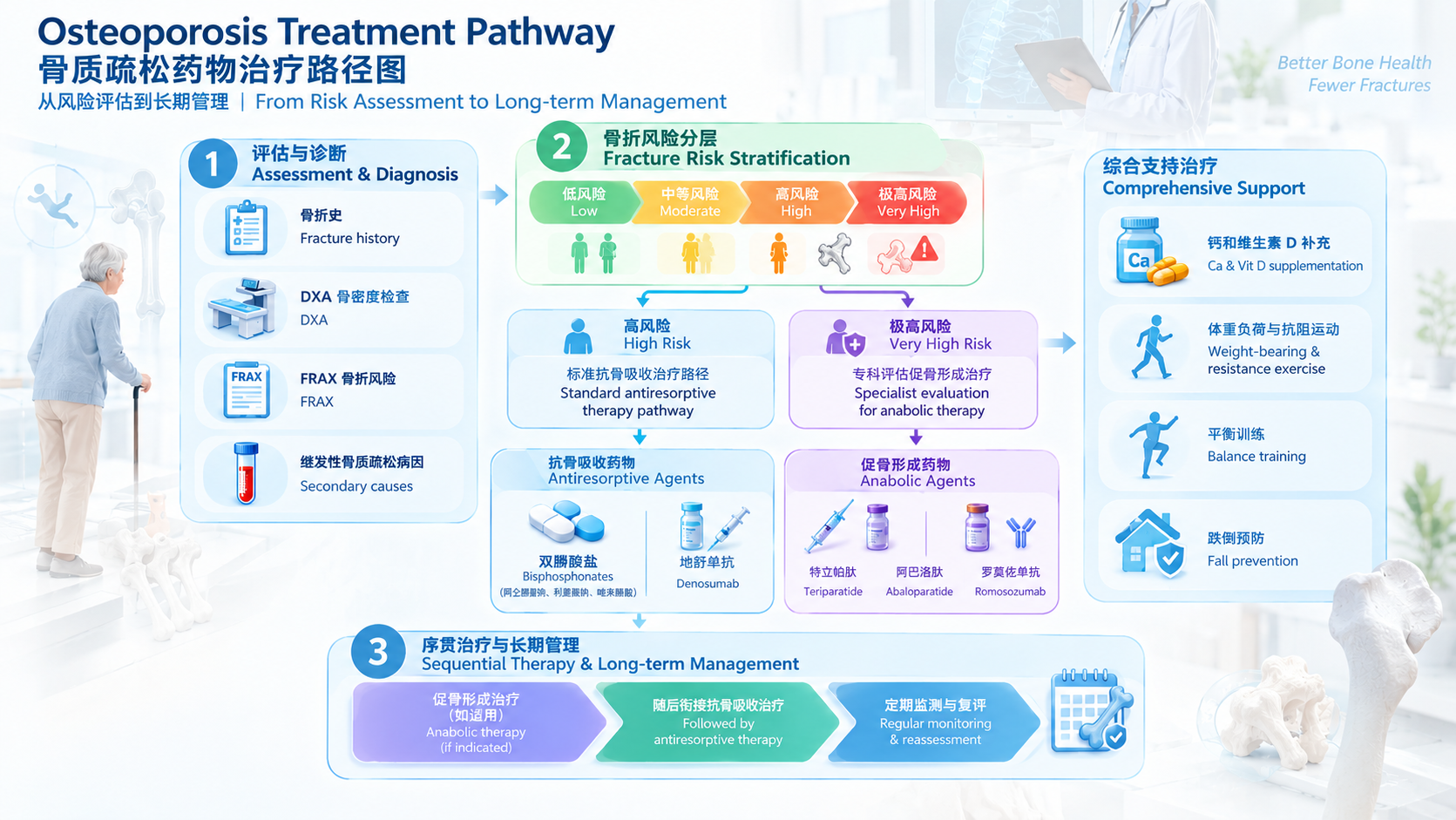
骨质疏松症药物治疗的核心目标是降低脆性骨折发生率,而非单纯提高骨密度(BMD)。临床决策应以既往脆性骨折、骨密度、FRAX 骨折概率、年龄、跌倒风险、合并疾病及患者偏好为基础。近期骨折、椎体或髋部骨折、多发骨折及极低骨密度患者,可能具有较高的近期再骨折风险,需要及时评估并启动适宜治疗。[1–2]
The primary goal of osteoporosis pharmacotherapy is to reduce fragility fractures, rather than simply increase bone mineral density (BMD). Treatment decisions should integrate prior fragility fractures, BMD, FRAX fracture probability, age, fall risk, comorbidities, and patient preferences. Recent fractures, hip or vertebral fractures, multiple fractures, and very low BMD may indicate substantial imminent fracture risk and warrant prompt assessment and appropriate treatment.[1–2]
2024 年英国国家骨质疏松症指南(NOGG)及新加坡卫生技术评估机构于 2025 年更新的骨质疏松临床指南均强调,应根据骨折风险选择药物。大多数需要药物治疗的患者可考虑双膦酸盐等抗骨吸收药物;对于极高骨折风险患者,则应考虑促骨形成治疗,并在疗程结束后及时衔接抗骨吸收治疗。具体药物选择与适应证应遵循当地指南和药品说明书。[1–3]
The 2024 UK National Osteoporosis Guideline Group (NOGG) guideline and Singapore’s updated 2025 clinical guidance emphasize risk-based drug selection. Bisphosphonates and other antiresorptive agents are appropriate options for many patients requiring treatment. For those at very high fracture risk, anabolic therapy should be considered, followed by timely antiresorptive treatment at the end of the anabolic course. Drug selection and indications should follow local guidelines and prescribing information.[1–3]
二、药物治疗决策路径|Pharmacological Treatment Pathway

该路径是临床决策的简化框架,并非所有患者均按同一顺序治疗。对于既往髋部或椎体脆性骨折、多个椎体骨折、极低 T 值或持续高剂量糖皮质激素暴露者,应进一步判断是否属于极高风险,并考虑骨质疏松专科转诊。不同指南对风险分层界值和药物优先级的规定可能不同。[1–3]
This pathway is a simplified decision framework; treatment does not follow an identical sequence for every patient. Individuals with prior hip or vertebral fragility fractures, multiple vertebral fractures, very low T-scores, or ongoing high-dose glucocorticoid exposure require careful assessment for very high fracture risk and possible specialist referral. Risk thresholds and treatment priorities vary across guidelines.[1–3]
三、主要药物类别及应用要点|Drug Classes and Key Considerations
1. 双膦酸盐|Bisphosphonates
阿仑膦酸钠、利塞膦酸钠及静脉唑来膦酸是常用的一线抗骨吸收药物,可降低骨折风险。口服制剂需评估食管疾病、服药依从性及肾功能;静脉唑来膦酸使用前应评估肾功能、血钙及维生素 D 状态,并注意输注后急性期反应。治疗约 3–5 年后,应根据药物种类、骨折史和当前风险重新评估是否继续治疗或考虑双膦酸盐假期,而非自动停药。[1,4]
Alendronate, risedronate, and intravenous zoledronate are commonly used first-line antiresorptive agents that reduce fracture risk. Oral therapy requires assessment of oesophageal disease, adherence, and renal function. Before intravenous zoledronate, evaluate renal function, calcium, and vitamin D status, and counsel patients about acute-phase reactions. After approximately 3–5 years, reassess fracture risk, fracture history, and treatment-specific factors to determine whether to continue therapy or consider a bisphosphonate holiday; treatment should not be stopped automatically.[1,4]
2. 地舒单抗|Denosumab
地舒单抗可作为适合患者的抗骨吸收治疗选择,尤其适用于部分不能耐受或不适合双膦酸盐治疗者。治疗期间需关注低钙血症风险,尤其是严重肾功能不全患者,并监测依从性。地舒单抗不应无计划地延迟或停用,因为停药后骨转换可能迅速反弹,并增加椎体骨折风险;停药前必须制定后续抗骨吸收治疗方案。[1,4]
Denosumab is an antiresorptive option for suitable patients, including some who cannot tolerate or are unsuitable for bisphosphonates. Monitor for hypocalcaemia, particularly in severe renal impairment, and ensure reliable dosing. Denosumab should not be delayed or discontinued without a plan, because bone turnover may rebound rapidly after cessation, increasing vertebral fracture risk. An appropriate subsequent antiresorptive regimen must be arranged before stopping treatment.[1,4]
3. 促骨形成治疗|Anabolic Therapy
特立帕肽、阿巴洛肽及罗莫佐单抗可用于符合适应证的高风险或极高风险患者,尤其是存在严重或多发椎体骨折者。特立帕肽和阿巴洛肽主要促进骨形成;罗莫佐单抗兼具促进骨形成和抑制骨吸收作用。疗程通常受药品说明书及当地指南限制,结束后应及时衔接抗骨吸收治疗,以维持骨密度获益并降低骨折风险。罗莫佐单抗还需特别评估心血管风险及相关禁忌证。[1–3]
Teriparatide, abaloparatide, and romosozumab may be considered for eligible high-risk or very-high-risk patients, particularly those with severe or multiple vertebral fractures. Teriparatide and abaloparatide primarily stimulate bone formation, whereas romosozumab both increases bone formation and suppresses bone resorption. Treatment duration is governed by prescribing information and local guidance. An antiresorptive agent should be initiated promptly after completion to preserve BMD gains and maintain fracture protection. Cardiovascular risk and relevant contraindications require particular attention with romosozumab.[1–3]
4. 其他治疗选择|Other Treatment Options
选择性雌激素受体调节剂(如雷洛昔芬)、绝经激素治疗及其他药物,可在特定人群中考虑。其应用需结合年龄、绝经状态、血栓风险、肿瘤风险、心血管情况及主要骨折类型进行个体化判断。伊班膦酸盐等药物对不同骨折部位的证据并不完全相同,不能仅依据骨密度变化判断临床获益。
Selective estrogen receptor modulators such as raloxifene, menopausal hormone therapy, and other agents may be appropriate for selected patients. Decisions should account for age, menopausal status, thromboembolic and malignancy risks, cardiovascular status, and the fracture sites requiring protection. Evidence for different fracture outcomes is not uniform across agents, including ibandronate; BMD changes alone should not determine clinical benefit.
四、治疗监测与复评|Monitoring and Reassessment
启动治疗前,应评估血钙、肾功能、维生素 D 状态及可能的继发性骨质疏松病因,并根据药物种类补充必要检查。治疗期间关注服药依从性、不良反应、新发骨折及跌倒风险;高风险患者可根据临床情况每 1–3 年复查 DXA。若治疗期间发生新发骨折,应重新核查依从性、继发病因、药物选择和骨折风险,而不应仅依据一次骨密度变化判断治疗失败。[1,4]
Before treatment, assess serum calcium, renal function, vitamin D status, and possible secondary causes of osteoporosis, with additional investigations tailored to the chosen drug. During therapy, monitor adherence, adverse effects, incident fractures, and fall risk. Repeat DXA at intervals guided by clinical status; high-risk patients may be reassessed every 1–3 years. If a fracture occurs during treatment, review adherence, secondary causes, drug choice, and overall fracture risk rather than diagnosing treatment failure solely from a single BMD change.[1,4]
对于髋部或其他脆性骨折后的患者,骨折联络服务(FLS)有助于整合骨折风险评估、继发病因检查、药物治疗启动及长期随访。药物治疗应与充足的钙和维生素 D 摄入、适宜的负重及抗阻运动、平衡训练和跌倒预防共同实施。[1–2]
For patients following hip or other fragility fractures, a Fracture Liaison Service (FLS) can coordinate risk assessment, investigation of secondary causes, treatment initiation, and long-term follow-up. Pharmacotherapy should be combined with adequate calcium and vitamin D intake, appropriate weight-bearing and resistance exercise, balance training, and fall prevention.[1–2]
参考文献|References
1. National Osteoporosis Guideline Group (NOGG). Clinical Guideline for the Prevention and Treatment of Osteoporosis. 2024.
2. Agency for Care Effectiveness, Singapore. Osteoporosis: Diagnosis and Management. Updated 15 August 2025.
Agency for Care Effectiveness
3. LeBoff MS, Greenspan SL, Insogna KL, et al. The clinician’s guide to prevention and treatment of osteoporosis. Osteoporosis International. 2022;33:2049–2102.
4. Eastell R, Rosen CJ, Black DM, Cheung AM, Murad MH, Shoback D. Pharmacological Management of Osteoporosis in Postmenopausal Women: An Endocrine Society Clinical Practice Guideline. Journal of Clinical Endocrinology & Metabolism. 2019;104(5):1595–1622.
说明: 本文仅用于医学专业人员检索骨质疏松药物治疗的基本路径。具体用药、剂量、疗程、禁忌证及序贯方案应依据当地现行指南、药品说明书和患者个体情况确定。