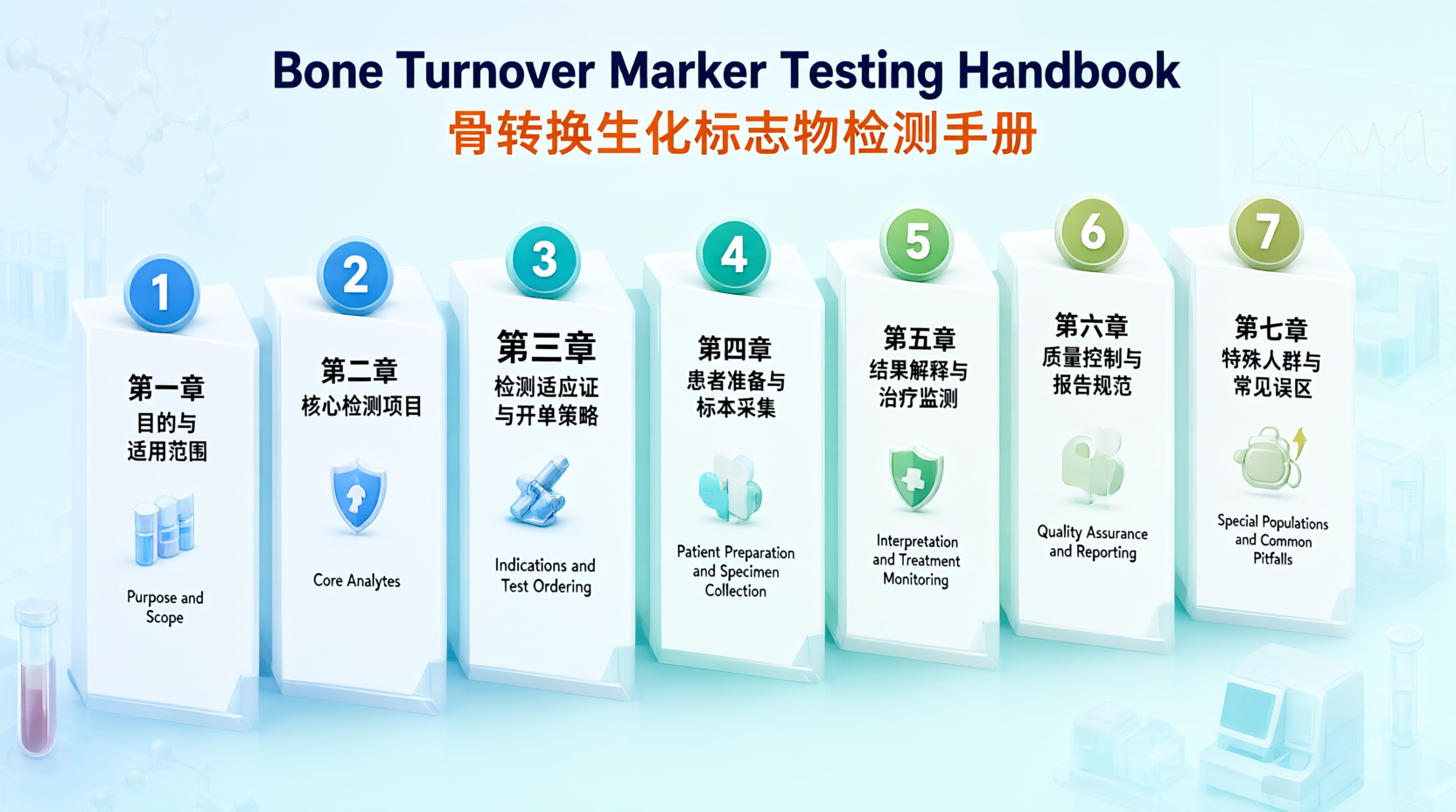
第一章 目的与适用范围|Purpose and Scope
骨转换生化标志物(bone turnover markers,BTMs)反映骨基质形成、降解及骨重塑活动,可用于辅助评估骨代谢状态、识别部分继发性骨病线索、监测抗骨吸收或促骨形成治疗的生化反应,并辅助评价患者用药依从性。2025年欧洲骨质疏松、骨关节炎及肌肉骨骼疾病临床与经济学学会(ESCEO)、国际骨质疏松基金会(IOF)和国际临床化学与检验医学联合会(IFCC)的联合共识,更新了BTMs在骨质疏松管理中的证据与检测建议。
Bone turnover markers (BTMs) reflect bone matrix formation, degradation, and remodeling activity. They can support the assessment of skeletal metabolism, identify clues to selected secondary bone disorders, monitor biochemical responses to antiresorptive or anabolic treatment, and help evaluate medication adherence. The 2025 joint consensus from ESCEO, IOF, and IFCC updates the evidence and recommendations for BTM measurement in osteoporosis management.
本手册面向骨科、内分泌科、风湿免疫科、肾脏科、临床检验科及骨健康研究人员,按照检测项目、适应证、采样要求、结果解释、治疗监测和特殊人群管理组织内容。BTMs不能单独确诊骨质疏松,也不能替代双能X线吸收法(DXA)、骨折风险评估或必要的影像学检查。
This handbook is intended for clinicians and laboratory professionals in orthopedics, endocrinology, rheumatology, nephrology, and bone health research. It is organized around analytes, indications, specimen collection, interpretation, treatment monitoring, and special populations. BTMs cannot independently establish a diagnosis of osteoporosis and do not replace dual-energy X-ray absorptiometry (DXA), fracture-risk assessment, or indicated imaging.
第二章 核心检测项目|Core Analytes
1. 总I型前胶原氨基端前肽(total PINP / tPINP)
骨形成标志物 · Bone formation marker
由I型胶原合成过程中释放,主要反映骨基质形成活动。总PINP是常规骨质疏松监测的参考标志物之一;晚期慢性肾病患者可能因清除减少而出现升高。
Released during type I collagen synthesis, tPINP reflects bone matrix formation. It is a reference marker for routine osteoporosis monitoring, but may be elevated in advanced chronic kidney disease because of reduced clearance.
2. β-CTX-I(I型胶原β异构化C端交联肽)
骨吸收标志物 · Bone resorption marker
反映I型胶原降解,是抗骨吸收治疗监测的常用指标。其受进食、昼夜节律及肾功能影响较大,必须严格标准化采样条件。
β-CTX-I reflects type I collagen degradation and is widely used to monitor antiresorptive treatment. It is sensitive to food intake, circadian variation, and renal function, making standardized sampling essential.
3. 骨特异性碱性磷酸酶(BALP)
骨形成标志物 · Bone formation marker
反映成骨细胞相关活动。对于肾功能严重受损、常规PINP或CTX解释困难的患者,BALP具有重要参考价值;应注意不同检测平台的特异性和方法学差异。
BALP reflects osteoblast-related activity and is particularly useful when conventional PINP or CTX results are difficult to interpret in advanced renal disease. Assay specificity and method-dependent differences must be considered.
4. 抗酒石酸酸性磷酸酶5b(TRACP-5b / TRAP5b)
骨吸收标志物 · Bone resorption marker
与破骨细胞活性相关。由于其清除特征不同于CTX,在晚期慢性肾病相关骨病的评估中具有潜在优势。
TRACP-5b is associated with osteoclast activity. Its clearance characteristics differ from those of CTX, making it a promising marker in the assessment of chronic kidney disease–associated bone disorders.
其他项目包括骨钙素(OC)、骨特异性以外的总碱性磷酸酶(ALP)、尿脱氧吡啶啉(DPD)及尿NTX等。它们可在特定临床或研究场景中使用,但常规骨质疏松监测通常优先考虑血清或血浆PINP与β-CTX-I。应区分总PINP与完整PINP(intact PINP),并在报告中注明检测方法和分析物类型。
Other markers include osteocalcin (OC), total alkaline phosphatase (ALP), urinary deoxypyridinoline (DPD), and urinary NTX. These may be useful in selected clinical or research settings, but serum or plasma PINP and β-CTX-I are generally preferred for routine osteoporosis monitoring. Total PINP must be distinguished from intact PINP, and laboratory reports should specify the analyte and assay method.
第三章 检测适应证与开单策略|Indications and Test Ordering
建议在以下情境中考虑BTM检测:①开始抗骨质疏松治疗前建立基线;②治疗后评价早期生化反应及口服药物依从性;③怀疑治疗反应不足、吸收不良或继发性骨代谢异常;④评估高骨转换状态;⑤慢性肾病相关骨矿物质代谢异常的专科评估。检测应服务于明确的临床问题,而不是无差别筛查。
Consider BTM testing when establishing a pretreatment baseline, assessing early biochemical responses or adherence to oral therapy, investigating an inadequate treatment response or possible malabsorption, evaluating suspected secondary metabolic bone disease, or assessing selected patients with chronic kidney disease–mineral and bone disorder (CKD-MBD). Testing should answer a defined clinical question rather than serve as indiscriminate screening.
常规骨质疏松管理可优先选择tPINP与β-CTX-I。若仅能选择一项,应根据临床问题决定:需要观察骨吸收抑制时,β-CTX-I通常较直接;需要评价骨形成反应时,PINP更具针对性。对肾功能明显下降者,应优先考虑BALP及TRACP-5b,并结合肾功能、甲状旁腺激素(PTH)、钙、磷及维生素D状态综合判断。
For routine osteoporosis care, tPINP and β-CTX-I are generally preferred. If only one marker is available, select it according to the clinical question: β-CTX-I is particularly informative for assessing suppression of bone resorption, whereas PINP is more directly related to bone formation. In patients with substantially impaired renal function, BALP and TRACP-5b may be preferable, interpreted alongside renal function, parathyroid hormone (PTH), calcium, phosphate, and vitamin D status.
第四章 患者准备与标本采集|Patient Preparation and Specimen Collection
- 采血时间: β-CTX-I具有明显昼夜节律,建议清晨采血,并保持每次复查的时间一致。
- 空腹要求: β-CTX-I宜空腹采集,避免进食导致的标志物下降;具体空腹时长依实验室操作规范执行。
- 标本类型: 按检测平台要求采集血清或指定血浆,不应将不同标本类型的结果直接比较。
- 前分析控制: 记录近期骨折、手术、急性疾病、药物调整及肾功能变化;严格遵守标本分离、储存和运输要求。
- 纵向比较: 尽量使用同一实验室、同一检测平台和一致的采样条件。
- Sampling time: β-CTX-I exhibits substantial circadian variation. Morning sampling at a consistent time is recommended.
- Fasting: β-CTX-I should preferably be measured in the fasting state because food intake can lower concentrations. Follow the laboratory's specified fasting protocol.
- Specimen type: Collect serum or the designated plasma type validated for the assay. Results from different specimen types should not be assumed interchangeable.
- Preanalytical control: Document recent fractures, surgery, acute illness, medication changes, and renal-function changes. Follow validated procedures for specimen separation, storage, and transport.
- Longitudinal comparison: Use the same laboratory, assay platform, and sampling conditions whenever possible.
第五章 结果解释与治疗监测|Interpretation and Treatment Monitoring
BTM结果应结合年龄、性别、绝经状态、骨折时间、肾功能、肝胆疾病及其他骨代谢相关疾病解释。近期骨折可引起骨转换标志物升高;肾功能下降可能使部分标志物蓄积;维生素D缺乏、甲状旁腺功能异常及某些药物也可能改变结果。因此,单次异常值不能直接等同于骨质疏松加重或治疗失败。
BTM results should be interpreted in the context of age, sex, menopausal status, fracture timing, renal function, hepatobiliary disease, and other metabolic bone conditions. Recent fractures may increase marker concentrations; renal impairment can cause accumulation of certain markers; vitamin D deficiency, parathyroid disorders, and medications may also alter results. An isolated abnormal value does not establish worsening osteoporosis or treatment failure.
抗骨吸收治疗后,β-CTX-I通常较早下降,PINP也可随骨重塑受到抑制而下降;促骨形成治疗则可引起PINP升高。临床可在治疗前建立基线,并于治疗后约3个月复查,必要时在6个月再次评估。应结合药物特点、临床情况及实验室参考变化判断反应,不宜把单一百分比作为适用于所有检测平台和患者的统一标准。
After antiresorptive treatment, β-CTX-I usually declines early, and PINP may also decrease as remodeling is suppressed. Anabolic therapy can increase PINP. A baseline measurement followed by reassessment at approximately three months—and, when indicated, six months—can help characterize the biochemical response. Interpretation should reflect the drug, clinical context, and assay-specific criteria rather than rely on a single percentage threshold for all patients.
第六章 质量控制与报告规范|Quality Assurance and Reporting
实验室应注明分析物全称、标本类型、检测方法、单位、参考区间及采样要求。对于治疗前后比较,应评估检测方法的分析变异、个体内生物学变异及最小显著变化(least significant change,LSC)。只有当变化幅度超过相应方法和人群适用的判断阈值时,才更有把握认为变化超出了测量与生物学波动。
Laboratories should report the full analyte name, specimen type, assay method, units, reference interval, and sampling requirements. For serial measurements, consider analytical variation, within-person biological variation, and the least significant change (LSC). A change is more likely to represent a genuine biological response when it exceeds the applicable threshold for the assay and population.
应特别注意:参考区间不等于治疗目标值;不同检测平台之间可能存在系统性差异;BTMs对骨折风险的预测价值不能取代临床危险因素和DXA。2025年IOF–IFCC联合立场文件还强调规范生化骨状态指标的命名,以减少不同分析物、检测方法和研究报告之间的混淆。
A reference interval is not a treatment target. Systematic differences may exist between assay platforms, and BTM-based fracture-risk prediction cannot replace clinical risk factors or DXA. The 2025 joint IOF–IFCC position statement also emphasizes standardized nomenclature for biochemical indices of bone status to reduce confusion between analytes, methods, and research reports.
第七章 特殊人群与常见误区|Special Populations and Common Pitfalls
慢性肾病(CKD): tPINP及β-CTX-I可能受到肾脏清除影响。晚期CKD患者应结合BALP、TRACP-5b、PTH及临床背景,必要时转由熟悉CKD-MBD的专科团队评估。
近期骨折: 骨折修复过程会影响BTM水平,应将骨折部位、发生时间和愈合阶段纳入解释,避免将骨折后的生理性升高误判为基础骨转换异常。
儿童与青少年: 生长发育显著影响BTM浓度,不能直接套用成人参考区间,应采用适合年龄、性别和发育阶段的参考数据。
治疗反应不佳: 应先复核采样条件、检测方法、用药依从性、药物吸收、继发性骨质疏松原因及肾功能,再考虑调整治疗方案。
Chronic kidney disease: Renal clearance can affect tPINP and β-CTX-I. In advanced CKD, interpret BALP, TRACP-5b, and PTH alongside clinical findings, with specialist assessment when appropriate.
Recent fractures: Fracture repair alters BTM concentrations. Consider fracture site, timing, and healing stage before interpreting elevated values as evidence of an underlying turnover disorder.
Children and adolescents: Growth and skeletal maturation substantially influence BTMs. Adult reference intervals should not be applied directly; age-, sex-, and maturation-appropriate data are required.
Inadequate treatment response: First review sampling conditions, assay methods, adherence, drug absorption, secondary causes of osteoporosis, and renal function before modifying treatment.
参考文献
1. Bhattoa HP, et al. (2025). Update on the role of bone turnover markers in the diagnosis and management of osteoporosis: a consensus paper from ESCEO, IOF, and IFCC. Osteoporosis International. 36:579–608.
2. Lombardi G, et al. (2025). Guidelines for the correct use of the nomenclature of biochemical indices of bone status: a position statement of the Joint IOF Working Group and IFCC Committee on Bone Metabolism. Clinical Chemistry and Laboratory Medicine.
3. Diez-Perez A, et al. (2019). Treatment failure in osteoporosis. Osteoporosis International. 30:1487–1497.
4. Vasikaran S, et al. (2011). Markers of bone turnover for the prediction of fracture risk and monitoring of osteoporosis treatment: a need for international reference standards. Osteoporosis International. 22:391–420.
5. Camacho PM, et al. (2020). American Association of Clinical Endocrinologists/American College of Endocrinology Clinical Practice Guidelines for the Diagnosis and Treatment of Postmenopausal Osteoporosis—2020 Update. Endocrine Practice. 26(Suppl 1):1–46.
6. International Osteoporosis Foundation(IOF)与 International Federation of Clinical Chemistry and Laboratory Medicine(IFCC)