关键词: 老年人;跌倒风险;TUG;Berg 平衡量表;Morse 跌倒量表;STRATIFY;Hendrich II;STEADI
Keywords: Older adults; fall risk; Timed Up and Go; Berg Balance Scale; Morse Fall Scale; STRATIFY; Hendrich II; STEADI
一、概述|Overview
跌倒是老年人发生髋部骨折、其他脆性骨折、头部损伤及功能衰退的重要危险因素。跌倒风险评估的目的不仅是预测跌倒事件,还包括识别可干预的危险因素,为运动训练、药物调整、环境改造及骨折预防提供依据。临床评估应结合既往跌倒史、步态和平衡能力、肌力、认知功能、用药情况及心血管因素,而不宜仅依赖单一量表评分。[1]
Falls are an important cause of hip and other fragility fractures, head injuries, and functional decline in older adults. Assessment aims not only to estimate fall risk but also to identify modifiable factors that guide exercise, medication review, environmental modification, and fracture prevention. Clinical evaluation should integrate fall history, gait and balance, muscle strength, cognition, medication exposure, and cardiovascular factors rather than relying on a single score.[1]
现有工具可分为三类:第一类为简易筛查与功能测试,如 Timed Up and Go(TUG)、步速测试及 STEADI 筛查流程;第二类为平衡和移动能力的量化评估,如 Berg Balance Scale(BBS)、Performance-Oriented Mobility Assessment(POMA)和 Short Physical Performance Battery(SPPB);第三类为医疗机构内的跌倒风险评分,如 Morse Fall Scale(MFS)、STRATIFY 及 Hendrich II Fall Risk Model。不同工具的设计目的不同,不能直接将功能测试结果与住院风险评分相互替代。
Available tools fall into three broad groups: brief screening and functional tests, such as the Timed Up and Go (TUG), gait speed, and the STEADI pathway; quantitative measures of balance and mobility, such as the Berg Balance Scale (BBS), Performance-Oriented Mobility Assessment (POMA), and Short Physical Performance Battery (SPPB); and institutional risk scores, such as the Morse Fall Scale (MFS), STRATIFY, and the Hendrich II Fall Risk Model. These instruments serve different purposes and should not be used interchangeably.
二、常用工具及临床适用场景|Common Tools and Clinical Applications
1. TUG:起立行走计时测试
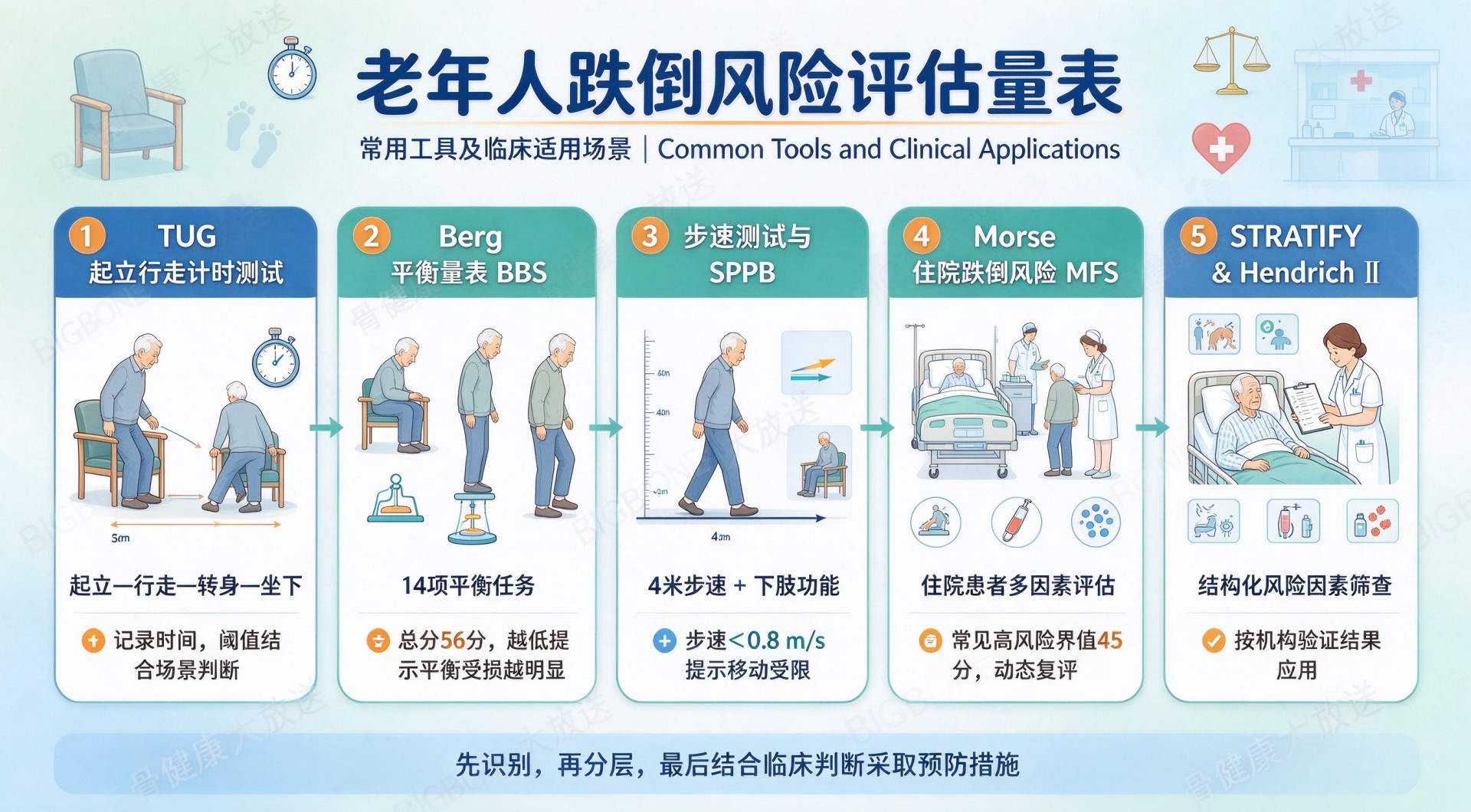
TUG 适用于门诊、社区、康复及老年医学评估,可快速观察患者从坐位起立、行走、转身及重新坐下的综合能力。常用流程为从有扶手的椅子起立,按指令行走 3 米、转身、返回并坐下,同时记录时间及动作表现。世界跌倒预防指南提出,TUG 超过 15 秒可作为跌倒风险分层的参考,但其预测能力并非在所有人群中都一致;美国 CDC 的 STEADI 临床资源则常将超过 12 秒作为进一步评估的提示。阈值应结合临床场景解释,而非视为统一诊断界值。[1–2]
The TUG is a rapid test suitable for outpatient, community, rehabilitation, and geriatric settings. It assesses the combined ability to stand up, walk, turn, return, and sit down. A common protocol asks the patient to rise from an armchair, walk 3 metres, turn, return, and sit while the clinician records time and movement quality. The World Falls Guidelines suggest that a result above 15 seconds may inform risk stratification, although predictive performance varies across populations. CDC STEADI resources commonly use more than 12 seconds as a prompt for further assessment. These thresholds are contextual guides, not universal diagnostic cut-offs.[1–2]
2. Berg Balance Scale(BBS):Berg 平衡量表
BBS 包含 14 项功能性平衡任务,每项通常按 0–4 分评分,总分 56 分。测试涉及坐站转换、无支撑站立、转身、伸手取物及单脚站立等活动。分数越低,通常提示平衡功能受损越明显。该量表适用于康复和功能评估,也可用于监测训练前后的变化;但完成时间较长,且对高功能老年人的轻微平衡缺陷可能存在天花板效应。应使用经验证的正式版本并遵循标准评分说明。
The BBS comprises 14 functional balance tasks, generally scored from 0 to 4, for a total of 56 points. Tasks include transfers, unsupported standing, turning, reaching, and single-leg stance. Lower scores generally indicate greater balance impairment. The BBS is useful in rehabilitation and for monitoring change following intervention, but takes longer to administer and may show a ceiling effect in high-functioning older adults. Use a validated version and follow its standardized scoring instructions.
3. 步速测试与 SPPB:步行及下肢功能评估
步速测试操作简单,常采用 4 米直线步行,记录完成时间并计算速度。通常步速低于 0.8 m/s 提示移动能力受限,并可作为跌倒风险评估的重要指标。SPPB 则结合平衡站立、短距离步行和反复坐站测试,评估下肢功能与身体表现,适用于社区老年人、衰弱筛查和康复随访。测试时需记录辅助器具、鞋具、疼痛及是否需要他人协助,以便解释结果。[1]
Gait speed is simple to measure, commonly using a 4-metre walking course and calculating speed from the recorded time. A gait speed below 0.8 m/s suggests impaired mobility and is an important indicator in fall risk assessment. The SPPB combines standing balance, short-distance walking, and repeated chair stands to assess lower-extremity function and physical performance. It is useful in community-dwelling older adults, frailty screening, and rehabilitation follow-up. Document assistive devices, footwear, pain, and the need for assistance when interpreting results.[1]
4. Morse Fall Scale(MFS):住院患者跌倒风险评分
MFS 常用于医院住院患者的护理风险评估,主要评估既往跌倒史、合并多种诊断、行走辅助、静脉治疗或静脉留置装置、步态及精神状态。经典版本总分为 0–125 分,常见高风险界值为 45 分,但不同机构可能采用不同分层标准。评估应在入院或转科时完成,并在病情、活动能力、用药或治疗方式发生变化后重新评估。MFS 是护理安全管理工具,不是老年人社区跌倒风险的通用预测模型。
The MFS is commonly used for inpatient nursing risk assessment. Its six domains cover previous falls, multiple diagnoses, ambulatory aids, intravenous therapy or a heparin lock, gait, and mental status. The classic version ranges from 0 to 125 points, with 45 often used as a high-risk threshold; institutional categories may differ. Assess patients on admission or transfer and reassess after changes in clinical status, mobility, medication, or treatment. The MFS is a patient-safety tool rather than a universal prediction model for community-dwelling older adults.
5. STRATIFY 与 Hendrich II:结构化风险评估
STRATIFY 最初用于识别老年住院患者的跌倒风险,包含既往跌倒、患者躁动、视觉障碍、如厕需求及转移和移动能力等项目,经典评分为 0–5 分,常以 2 分及以上作为高风险提示。Hendrich II 则纳入意识混乱、抑郁、排泄问题、头晕、男性、抗癫痫药物使用、苯二氮䓬类药物使用及起立坐下测试等因素,常以 5 分及以上提示风险升高。二者均应结合机构验证结果使用,不能仅凭原始界值决定全部预防措施。[3–4]
STRATIFY was developed to identify fall risk in older inpatients. Its five items address previous falls, agitation, visual impairment, toileting needs, and transfer or mobility difficulties. The classic score ranges from 0 to 5, with a score of 2 or higher commonly indicating increased risk. The Hendrich II model includes confusion, depression, altered elimination, dizziness, male sex, antiepileptic medication, benzodiazepine use, and the Get-Up-and-Go test. A score of 5 or higher commonly indicates increased risk. Both tools should be applied in light of local validation, rather than used as the sole basis for preventive decisions.[3–4]
三、量表使用方法与操作步骤|Practical Assessment Workflow
建议采用“先筛查、再评估、后干预”的流程,并根据患者所处场景选择相应工具。
A practical approach is to screen first, assess contributing factors next, and then implement tailored interventions using tools appropriate to the care setting.
步骤 1:询问跌倒史并识别高危情况
询问过去 12 个月是否跌倒、跌倒次数、发生地点、诱因、是否受伤及是否无法自行起身。同时了解晕厥、头晕、步态异常、害怕跌倒和日常活动能力。反复跌倒、伴伤跌倒或疑似意识丧失者,应优先进行全面评估。
Step 1: Establish fall history and identify red flags. Ask about falls in the previous 12 months, frequency, circumstances, injuries, and inability to rise independently. Assess syncope, dizziness, gait problems, fear of falling, and functional ability. Recurrent or injurious falls and suspected loss of consciousness warrant comprehensive evaluation.
步骤 2:完成步态与功能测试
在有防跌倒保护的环境下进行 TUG 或 4 米步速测试;如需进一步量化平衡和下肢功能,可使用 BBS 或 SPPB。测试前确认患者能否安全站立、是否需要助行器及是否存在急性疼痛。对不能安全完成测试者,应停止测试并记录原因,不应强行执行。
Step 2: Perform gait and functional testing. Use TUG or 4-metre gait speed testing in a safe environment. Consider BBS or SPPB for more detailed assessment of balance and lower-extremity function. Check standing safety, assistive-device requirements, and acute pain beforehand. Stop if testing is unsafe and document the reason.
步骤 3:评估可干预的危险因素
核查镇静催眠药、精神类药物及其他可能增加跌倒风险的药物;测量卧位和立位血压,评估视力、足部问题、鞋具、认知状态、肌力、营养和居家环境。必要时开展药物审查、物理治疗或作业治疗评估。
Step 3: Identify modifiable risks. Review sedatives, psychotropic drugs, and other fall-risk-increasing medications; assess supine and standing blood pressure, vision, foot problems, footwear, cognition, strength, nutrition, and home hazards. Arrange medication review, physiotherapy, or occupational therapy when indicated.
步骤 4:形成干预方案并复评
根据发现的问题制定个体化计划,包括平衡与肌力训练、辅助器具调整、环境改造、药物优化和骨质疏松评估。记录量表版本、得分、测试条件、风险因素、干预措施和复评日期。住院患者应在临床状况变化后复评;社区及康复患者应根据风险变化和干预进度安排随访。
Step 4: Implement and reassess. Develop an individualized plan covering balance and strength training, assistive devices, environmental modifications, medication optimization, and osteoporosis assessment. Document the instrument and version, score, testing conditions, risk factors, interventions, and reassessment date. Reassess inpatients after clinical changes and arrange follow-up for community and rehabilitation patients according to risk and progress.
可直接用于临床的资源包括 CDC 的 STEADI 工具包,以及《World Guidelines for Falls Prevention and Management for Older Adults》。STEADI 将筛查、评估与干预整合为连续流程;世界指南则强调,对高风险社区老年人进行多因素综合评估,并依据个体风险制定干预措施。[1–2]
Practical resources include the CDC STEADI toolkit and the World Guidelines for Falls Prevention and Management for Older Adults. STEADI integrates screening, assessment, and intervention into a clinical pathway. The World Guidelines recommend multifactorial assessment for community-dwelling older adults at high risk, followed by interventions tailored to identified risks.[1–2]
四、临床解释与使用注意事项|Interpretation and Limitations
量表结果应结合患者实际情况解释。近期发生跌倒、反复跌倒、伴伤跌倒、晕厥或明显步态和平衡障碍者,即使某项评分未达到高风险界值,也应进一步评估。2025 年发表的一项中国养老机构前瞻性队列研究纳入 866 名老年人,对 MFS、STRATIFY、Hendrich II 和 TUG 进行了比较;结果显示,各工具在敏感度与特异度之间均存在权衡,TUG 的总体预测表现相对较好,但仍有局限。这提示临床不宜机械套用原始界值,应重视工具在具体人群中的验证结果。[5]
Scores should be interpreted in the context of the individual patient. Recent or recurrent falls, injurious falls, syncope, or marked gait and balance impairment warrant further assessment even when a score does not meet the conventional high-risk threshold. A 2025 prospective cohort study of 866 older adults in Chinese nursing homes compared the MFS, STRATIFY, Hendrich II, and TUG. All tools showed trade-offs between sensitivity and specificity, while TUG demonstrated comparatively stronger overall predictive performance, although limitations remained. These findings reinforce the need to consider population-specific validation rather than applying original cut-offs mechanically.[5]
对骨健康管理而言,跌倒风险评估应与骨质疏松筛查及脆性骨折预防相衔接。高跌倒风险者应评估骨折史、骨密度检查指征、维生素 D 与营养状况、肌力和平衡训练需求,以及家庭和医疗环境中的危险因素。跌倒风险评分本身不能诊断骨质疏松,也不能单独决定是否启动抗骨质疏松药物治疗。
In bone health practice, fall risk assessment should be linked to osteoporosis screening and fragility fracture prevention. For individuals at high risk, assess fracture history, indications for BMD testing, vitamin D and nutritional status, strength and balance training needs, and hazards in the home or healthcare environment. A fall risk score does not diagnose osteoporosis and should not independently determine whether osteoporosis medication is indicated.
参考文献|References
1. Montero-Odasso M, van der Velde N, Martin FC, et al. World guidelines for falls prevention and management for older adults: a global initiative. Age and Ageing. 2022;51(9):afac205.
2. Centers for Disease Control and Prevention (CDC). STEADI: Stopping Elderly Accidents, Deaths & Injuries.
3. Kim EAN, Mordiffi SZ, Bee WH, Devi K, Evans D. Evaluation of three fall-risk assessment tools in an acute care setting. Journal of Advanced Nursing. 2007;60(4):427–435.
4. Liu M, et al. Evaluation of Reliability and Validity of the Hendrich II Fall Risk Model in a Chinese Hospital Population.
5. Zhang J, et al. Validation and Comparison of 4 Fall Risk Assessment Tools for Older Adults in Chinese Nursing Homes: A Prospective Cohort Study. Journal of the American Medical Directors Association. 2025;26(12):105882.
6. Barry E, Galvin R, Keogh C, Horgan F, Fahey T. Is the Timed Up and Go test a useful predictor of risk of falls in community dwelling older adults: a systematic review and meta-analysis. BMC Geriatrics. 2014;14:14.
资料库说明: 本文用于医学专业人员检索常用跌倒风险评估工具及其临床操作方法。具体评分项目、界值和干预路径,应以量表正式版本、当地验证研究及所在机构的现行指南为准。