一、文献定位与临床应用框架
美国骨与矿物质研究学会(American Society for Bone and Mineral Research,ASBMR)是骨生物学、骨代谢及骨质疏松研究领域的重要学术组织。其专题工作组报告、多学科专家共识及立场声明,涵盖脆性骨折二级预防、抗骨质疏松药物治疗策略、非典型股骨骨折和药物相关颌骨坏死等临床问题。对于医学专业人员而言,这些文件不仅具有临床参考价值,也是追踪骨健康领域循证医学发展的重要文献入口。
The American Society for Bone and Mineral Research (ASBMR) is a major scientific organization in bone biology, mineral metabolism, and osteoporosis research. Its task force reports, multidisciplinary consensus recommendations, and position statements address secondary fracture prevention, osteoporosis treatment strategies, atypical femoral fractures, and medication-related osteonecrosis of the jaw. These publications provide clinically relevant evidence summaries and serve as useful entry points for tracking developments in evidence-based bone health practice.
需要注意,ASBMR相关文件并非采用完全统一的发布形式。“Consensus Statement”“Task Force Report”和“Position Statement”分别侧重专家共识、系统性证据审查与建议,以及对特定临床问题的立场阐述,彼此可能存在交叉。检索时应优先核实文件的正式题名、发表年份、适用人群、证据基础及后续更新情况,而不应仅凭标题中是否出现“共识”判断其权威性。
ASBMR publications do not follow a single, uniform format. Consensus statements emphasize expert agreement, task force reports typically synthesize evidence and formulate recommendations, and position statements articulate a professional stance on defined clinical questions. Because these categories may overlap, literature searches should verify the exact title, publication year, target population, evidence base, and subsequent updates rather than relying solely on the word “consensus.”
二、重点共识与立场声明:临床主题索引
1. 骨质疏松的目标导向治疗(Goal-Directed Treatment)
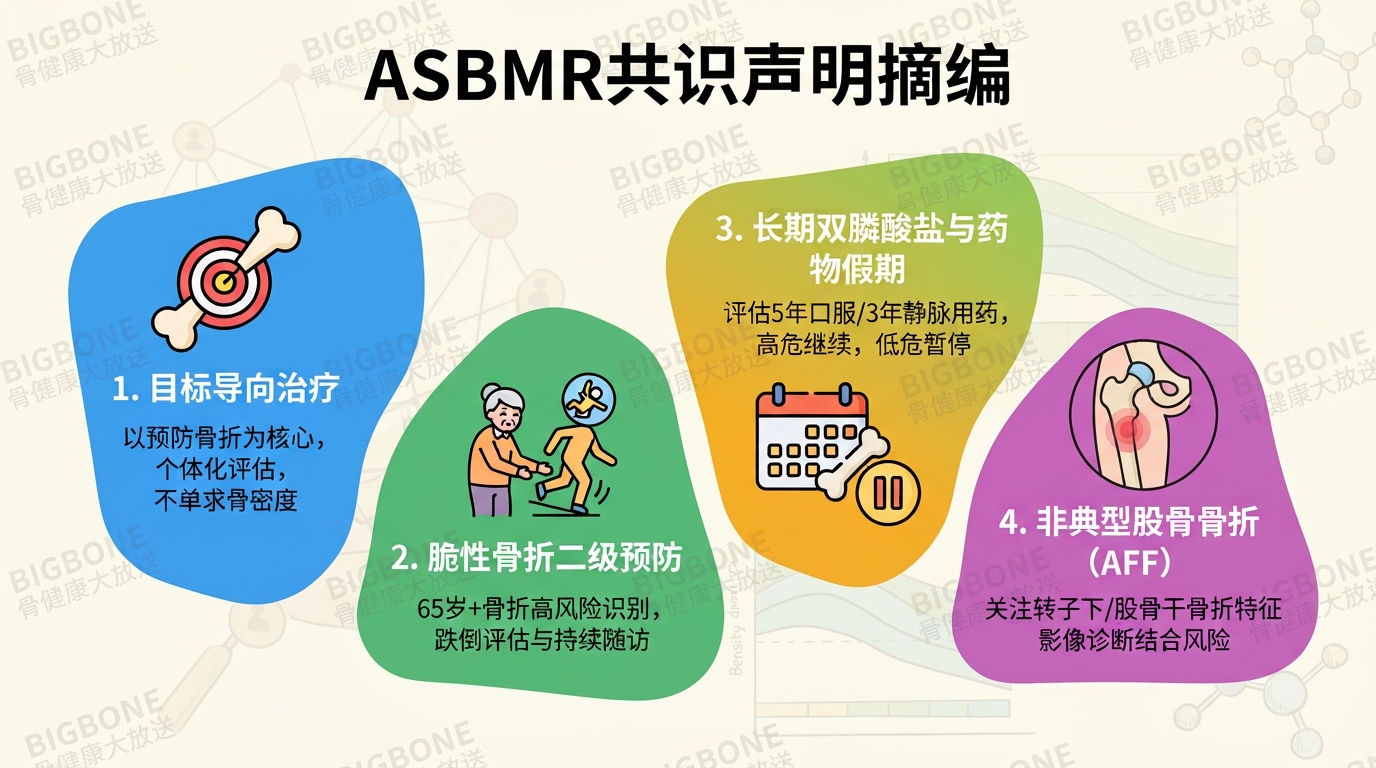
2024年ASBMR与骨健康和骨质疏松基金会(BHOF)联合工作组发表目标导向骨质疏松治疗立场声明,是近年来值得优先阅读的核心文献。该文件强调,骨质疏松治疗的总体目标是预防骨折,并通过临床骨折史、椎体骨折识别、骨密度测量及其他主要危险因素进行综合评估。治疗目标应依据患者的骨折部位、次数、严重程度、发生时间及髋部和腰椎骨密度个体化设定,而非单纯追求某一骨密度数值。
The 2024 ASBMR/BHOF Task Force position statement on goal-directed osteoporosis treatment is a priority reference. It emphasizes fracture prevention as the overarching objective of osteoporosis care. Clinical fracture history, vertebral fracture assessment, bone mineral density (BMD), and other major risk factors should inform treatment selection. Targets should be individualized according to fracture site, number, severity, recency, and BMD at the hip and lumbar spine, rather than defined solely by a numerical BMD threshold.
这一理念对临床路径设计具有直接意义:初始治疗应考虑患者的绝对骨折风险、预期获益、药物安全性及后续治疗衔接;随访则应评价是否达到预设治疗目标,并在出现新发骨折、骨密度变化不符合预期或风险因素改变时重新评估。需要区分的是,治疗目标是指导决策的框架,不代表所有患者均适用统一的骨密度阈值或相同的药物序贯方案。
Clinically, this framework supports treatment selection based on absolute fracture risk, expected benefit, safety, and the feasibility of subsequent therapy. Follow-up should assess whether predefined goals have been achieved and prompt reassessment when fractures occur, BMD changes are unexpected, or risk factors change. Treatment targets are decision-making tools, not universal thresholds or identical drug-sequencing requirements for every patient.
2. 脆性骨折二级预防(Secondary Fracture Prevention)
2019年发表于《Journal of Bone and Mineral Research》的多利益相关方共识建议,是骨折后管理的重要实践参考。该文件由ASBMR组织的多学科联盟制定,针对65岁及以上发生髋部或椎体骨折的人群提出13项建议,包括7项主要建议和6项补充建议。其核心是识别骨折后的高风险患者、改善医患沟通、评估跌倒风险、提供适宜的抗骨质疏松治疗,并建立持续随访机制。
The 2019 multistakeholder consensus recommendations published in the Journal of Bone and Mineral Research are an important practical reference for post-fracture care. Developed by an ASBMR-convened coalition, the document presents 13 recommendations—seven primary and six secondary—for adults aged 65 years and older with hip or vertebral fractures. Its priorities include identifying high-risk patients, improving communication, assessing fall risk, offering appropriate osteoporosis pharmacotherapy, and establishing ongoing follow-up.
临床实施的关键不只是开具药物处方,还包括在骨折急性治疗期间启动骨质疏松评估、检查继发性病因、开展跌倒预防与康复干预,并明确责任科室及复诊时间。骨折联络服务(Fracture Liaison Service,FLS)可作为整合这些环节的管理模式。对于髋部或椎体脆性骨折患者,尤其需要避免因骨折治疗结束而中断骨质疏松管理;具体药物选择和启动时机仍应结合肾功能、钙磷代谢、合并症及手术恢复情况判断。
Implementation requires more than prescribing medication. Osteoporosis assessment, investigation of secondary causes, fall-prevention measures, rehabilitation, and clearly assigned follow-up responsibilities should be integrated into acute fracture care. A Fracture Liaison Service (FLS) can coordinate these components. Management should not stop when fracture treatment ends; drug selection and initiation must still account for renal function, calcium-phosphate metabolism, comorbidities, and postoperative recovery.
3. 双膦酸盐长期治疗与药物假期(Long-Term Bisphosphonate Therapy)
ASBMR工作组2016年报告系统讨论了长期双膦酸盐治疗的获益与风险。对于口服双膦酸盐治疗约5年或静脉唑来膦酸治疗约3年的患者,应重新评估骨折风险、髋部骨密度、既往骨折史及治疗期间是否发生新骨折。高风险患者可能需要延长治疗并定期复评;风险较低者则可在综合评估后考虑药物假期。该报告同时指出,非典型股骨骨折风险随双膦酸盐暴露时间延长而增加,但高风险患者的骨折预防获益仍可能超过这一罕见风险。
The 2016 ASBMR Task Force report addresses the benefit-risk balance of long-term bisphosphonate therapy. After approximately five years of oral treatment or three years of intravenous zoledronic acid, clinicians should reassess fracture risk, hip BMD, prior fracture history, and fractures occurring during treatment. Continued treatment may be appropriate for selected high-risk patients, whereas a drug holiday may be considered for patients whose risk has become sufficiently low. The report also notes that atypical femoral fracture risk increases with longer bisphosphonate exposure, although fracture-prevention benefits may outweigh this rare risk in high-risk patients.
临床应用时,应避免把“治疗满5年”机械地等同于停药指征。药物假期并不意味着永久终止治疗,应根据骨折风险变化、骨密度、临床事件及所用药物的药效持续时间制定监测计划。该报告的证据主要来自绝经后女性接受阿仑膦酸钠和唑来膦酸的延长治疗研究,推广至男性及其他继发性骨质疏松人群时需要结合具体证据。
Clinicians should not interpret five years of treatment as an automatic indication to discontinue therapy. A drug holiday is not permanent cessation; monitoring should reflect changes in fracture risk, BMD, clinical events, and the persistence of the medication's effects. Because the evidence underlying this report largely comes from extension studies of alendronate and zoledronic acid in postmenopausal women, application to men and other forms of secondary osteoporosis requires additional clinical judgment.
4. 非典型股骨骨折(Atypical Femoral Fractures, AFF)
ASBMR关于非典型股骨骨折的2010年报告及2014年第二次报告,是理解抗骨吸收治疗相关骨折风险的重要基础文献。2014年报告修订了影像学诊断特征,强调骨折位于转子下区或股骨骨干、横向或短斜向骨折线,以及局部骨膜反应等特点。双膦酸盐使用与AFF存在关联,但AFF也可发生于未使用相关药物的人群,因此不能仅凭药物暴露史作出诊断。
The 2010 ASBMR report and its 2014 update on atypical femoral fractures are foundational references for understanding fractures associated with antiresorptive therapy. The 2014 report refined the radiographic case definition, highlighting location in the subtrochanteric region or femoral shaft, transverse or short-oblique fracture orientation, and periosteal stress reaction. Although bisphosphonate exposure is associated with AFF, these fractures can also occur without such exposure; medication history alone is therefore insufficient for diagnosis.
对于长期接受抗骨吸收药物治疗且出现持续性大腿或腹股沟疼痛的患者,应提高对不完全性AFF的警惕,并根据临床情况安排双侧股骨影像学检查。确诊或高度怀疑时,应及时进行骨科评估,重新审视抗骨吸收治疗方案及后续骨质疏松管理。由于停药决策、骨折稳定性与后续治疗之间存在复杂权衡,相关处理应个体化,而非采用统一的停药流程。
In patients receiving long-term antiresorptive therapy who develop persistent thigh or groin pain, clinicians should consider incomplete AFF and arrange appropriate imaging of both femurs when indicated. Confirmed or suspected cases warrant orthopedic assessment and a review of the antiresorptive regimen and ongoing osteoporosis management. Because discontinuation decisions, fracture stability, and subsequent treatment involve competing risks, management should be individualized rather than governed by a universal stopping rule.
三、文献检索与证据解读建议
建立ASBMR专题文献库时,建议优先检索学会官方的 Task Force Reports 页面,再通过PubMed、Journal of Bone and Mineral Research(JBMR)及DOI核对正式出版信息。检索关键词可组合使用“ASBMR”“task force report”“consensus recommendations”“position statement”“osteoporosis”“fracture prevention”“bisphosphonate duration”及“atypical femoral fracture”。
For a searchable ASBMR reference library, begin with the official Task Force Reports page, then verify publication details through PubMed, the Journal of Bone and Mineral Research (JBMR), and DOI records. Useful combinations include “ASBMR,” “task force report,” “consensus recommendations,” “position statement,” “osteoporosis,” “fracture prevention,” “bisphosphonate duration,” and “atypical femoral fracture.”
文献管理时,建议为每条记录设置统一字段:主题、文件类型、发表年份、目标人群、核心临床问题、关键建议、证据局限、更新状态、DOI及全文链接。还应将学会工作组报告与其他专业组织的指南区分标记,并记录后续证据是否改变了原有建议。共识文件是临床决策的重要依据,但不能替代最新指南、药品说明书及患者个体化评估。
For consistent indexing, record the topic, document type, publication year, target population, clinical question, key recommendations, evidence limitations, update status, DOI, and full-text link. Distinguish ASBMR task force publications from guidelines issued by other professional organizations, and document whether subsequent evidence has changed earlier recommendations. Consensus documents inform clinical decisions but do not replace current guidelines, prescribing information, or individualized patient assessment.
参考文献(References)
1. Cosman F, et al. Goal-directed osteoporosis treatment: ASBMR/BHOF task force position statement 2024. J Bone Miner Res. 2024;39(10):1393–1405. DOI: 10.1093/jbmr/zjae119.
2. Conley RB, et al. Secondary Fracture Prevention: Consensus Clinical Recommendations from a Multistakeholder Coalition. J Bone Miner Res. 2020;35(1):36–52. DOI: 10.1002/jbmr.3877.
3. Adler RA, et al. Managing Osteoporosis Patients after Long-Term Bisphosphonate Treatment: Report of a Task Force of the American Society for Bone and Mineral Research. J Bone Miner Res. 2016;31(1):16–35. DOI: 10.1002/jbmr.2708.
4. Shane E, et al. Atypical subtrochanteric and diaphyseal femoral fractures: second report of a task force of the American Society for Bone and Mineral Research. J Bone Miner Res. 2014;29(1):1–23. DOI: 10.1002/jbmr.1998.
5. van der Meulen MCH, et al. Atypical subtrochanteric and diaphyseal femoral fractures: report of a task force of the American Society for Bone and Mineral Research. J Bone Miner Res. 2010.
6. Ruggiero SL, et al. American Association of Oral and Maxillofacial Surgeons’ Position Paper on Medication-Related Osteonecrosis of the Jaws—2022 Update. J Oral Maxillofac Surg. 2022;80(5):920–943. DOI: 10.1016/j.joms.2022.02.008。
提示: 以上按临床主题列出优先阅读的代表性文献,兼顾较新的治疗立场声明与经典工作组报告;本文为专题文献导读,并不意味着上述文件均为最新指南或所有建议均适用于每位患者。