关键词: 骨折风险评估;骨质疏松症;FRAX;Garvan;QFracture;OSTA;临床决策
Keywords: Fracture risk assessment; osteoporosis; FRAX; Garvan; QFracture; OSTA; clinical decision-making
一、概述|Overview
骨折风险评估是骨质疏松症筛查、骨密度检查转诊、抗骨质疏松治疗决策及骨折二级预防的重要环节。临床常用工具可分为两类:一类用于初步识别骨质疏松高风险人群,如 OSTA(Osteoporosis Self-Assessment Tool for Asians);另一类用于估算未来一定时间内发生骨折的概率,如 FRAX、Garvan 骨折风险计算器及 QFracture。不同工具的目标人群、预测终点、时间范围和适用地区存在差异,不宜直接互换。
Fracture risk assessment is integral to osteoporosis screening, referral for bone mineral density (BMD) testing, treatment decisions, and secondary fracture prevention. Common tools fall into two broad categories: screening instruments, such as the Osteoporosis Self-Assessment Tool for Asians (OSTA), and fracture probability calculators, such as FRAX, the Garvan Fracture Risk Calculator, and QFracture. Their target populations, outcomes, prediction horizons, and geographic applicability differ, so their results should not be considered interchangeable.
二、常用量表及适用场景|Common Tools and Clinical Applications
1. FRAX®:骨折概率评估的核心工具
FRAX 基于临床危险因素,可结合股骨颈骨密度(BMD)或股骨颈 T 值,估算未来 10 年发生髋部骨折及主要骨质疏松性骨折的概率。主要骨质疏松性骨折包括临床椎体、前臂、髋部和肱骨近端骨折。FRAX 有多个国家和地区模型,临床应选择与患者所处人群相适应的模型。该工具适用于绝经后女性及中老年男性的初步风险评估,但不能替代完整的临床判断。[1–2]
FRAX estimates 10-year probabilities of hip fracture and major osteoporotic fracture using clinical risk factors, with or without femoral neck BMD or T-score. Major osteoporotic fractures comprise clinical vertebral, forearm, hip, and proximal humerus fractures. Multiple country-specific models are available, and the model should match the relevant population. FRAX is useful for initial assessment in postmenopausal women and older men, but it does not replace comprehensive clinical evaluation.
2. Garvan 骨折风险计算器
Garvan 工具主要依据年龄、性别、既往骨折、跌倒次数及骨密度等信息,估算未来 5 年或 10 年发生骨折的风险。其对跌倒史的纳入具有临床价值,尤其适合需要重点评估跌倒相关风险的患者。但其预测模型源于特定人群,应用于其他国家或族群时,应注意外部验证和校准情况。
The Garvan Fracture Risk Calculator uses factors such as age, sex, previous fractures, falls, and BMD to estimate fracture risk over 5 or 10 years. Its explicit inclusion of falls can be useful when fall-related risk is clinically important. However, because the model was developed in a specific population, its external validity and calibration should be considered when applying it to other populations.
3. QFracture:基于临床数据的风险预测
QFracture 利用常规医疗记录中可获得的多种变量预测骨折风险,包括年龄、体重指数、吸烟、既往疾病、药物暴露及跌倒相关因素等。其优势是能够利用较丰富的临床信息,适用于相应模型已验证的医疗人群;但其模型主要针对英国人群开发,不应未经验证便直接用于其他地区。与 FRAX 相比,两者使用的变量、建模人群及预测终点并不完全一致。
QFracture predicts fracture risk using a broader range of routinely available clinical variables, including age, body mass index, smoking, comorbidities, medication exposure, and fall-related factors. It can be useful in healthcare settings where the relevant model has been validated. However, it was developed primarily for the UK population and should not be transferred to other populations without appropriate validation. Its predictors, derivation cohorts, and outcomes differ from those of FRAX.
4. OSTA:亚洲人群初筛工具
OSTA 以年龄和体重构建简易风险指数,常用于绝经后女性骨质疏松风险的初步分层。其计算公式为:OSTA 指数=[体重(kg)-年龄(岁)]×0.2,结果向下取整。指数越低,提示骨质疏松风险越高。常见分层为指数低于 −4、−4 至 −1、以及高于 −1,但实际临界值和后续检查策略应依据当地指南及验证研究。OSTA 是筛查工具,不能直接用于计算骨折概率,也不能替代 DXA 骨密度测量。
OSTA is a simple screening index based on age and body weight, commonly used for preliminary osteoporosis risk stratification in postmenopausal women. It is calculated as: OSTA index = 0.2 × [body weight (kg) − age (years)], rounded down to an integer. Lower values indicate higher osteoporosis risk. Common categories are below −4, −4 to −1, and above −1; however, thresholds and subsequent testing strategies should follow locally validated guidance. OSTA screens for osteoporosis risk rather than estimating fracture probability and cannot replace DXA.
三、量表使用方法与操作步骤|Practical Assessment Workflow
临床应用建议遵循以下步骤,确保评估结果可解释、可复核,并能衔接后续诊疗。
A structured workflow improves interpretability, reproducibility, and integration of fracture risk assessment into clinical care.
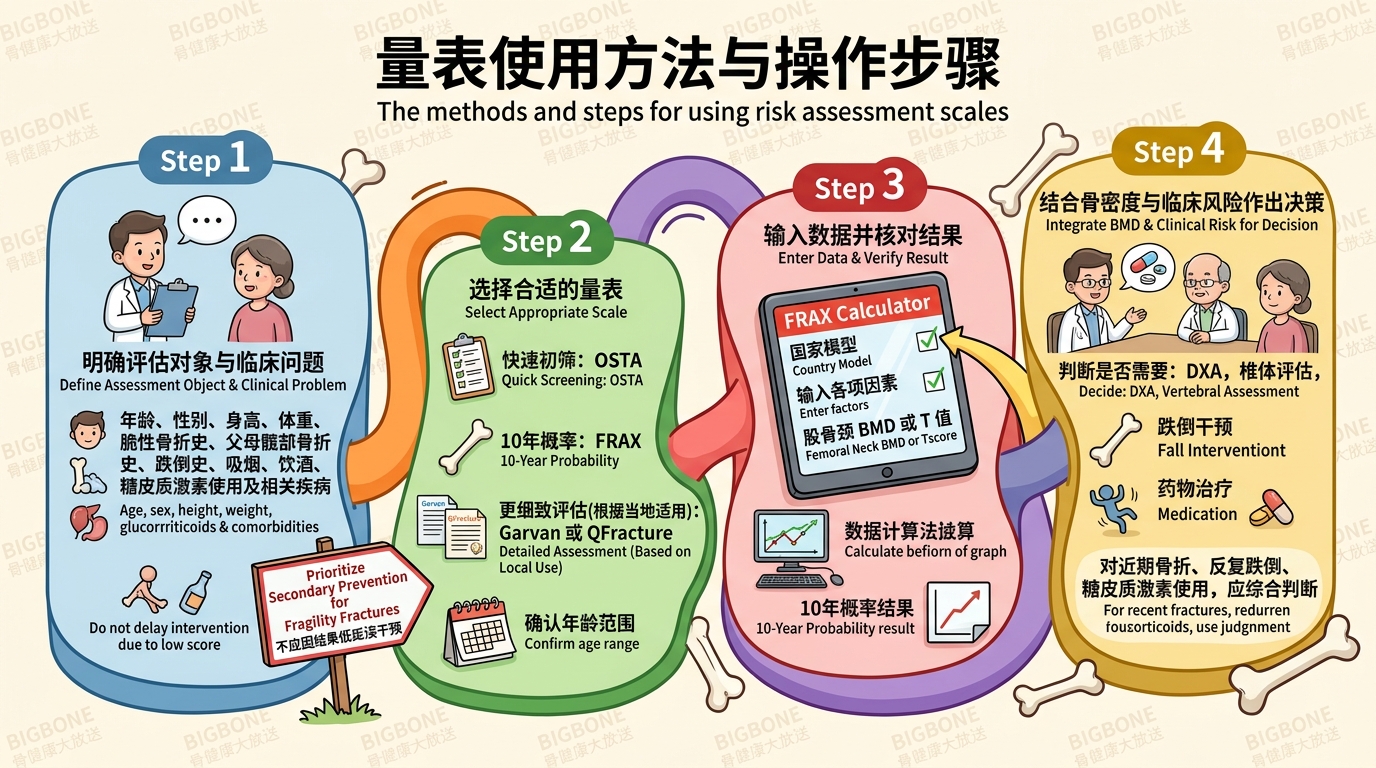
步骤 1:明确评估对象与临床问题
记录年龄、性别、身高、体重、脆性骨折史、父母髋部骨折史、跌倒史、吸烟、饮酒、糖皮质激素使用及相关疾病。对已发生脆性骨折者,应优先进行骨折二级预防评估,不应因量表结果较低而延误干预。
Step 1: Define the clinical question and collect demographic data, fracture history, falls, lifestyle factors, medication exposure, and relevant comorbidities. Prioritize secondary prevention in patients with fragility fractures, regardless of a low calculated score.
步骤 2:选择合适的量表
需要快速初筛时可考虑 OSTA;需要估算 10 年骨折概率时可考虑 FRAX;对跌倒史及多种临床危险因素进行更细致评估时,可根据当地适用性选择 Garvan 或 QFracture。使用前确认年龄范围、目标人群和模型适用地区。
Step 2: Select the appropriate instrument. Consider OSTA for initial screening, FRAX for 10-year fracture probability, and Garvan or QFracture when their additional predictors and validated populations are relevant.
步骤 3:输入数据并核对结果
以 FRAX 为例,打开官方计算器,依次选择国家或地区模型,输入年龄、性别、身高、体重及各项临床危险因素;如有股骨颈 BMD 或 T 值,可按工具要求输入。核实单位、既往骨折定义及药物暴露后,计算髋部骨折和主要骨质疏松性骨折的 10 年概率。
Step 3: Enter the data and verify the output. For FRAX, select the appropriate country model, enter age, sex, height, weight, and clinical risk factors, then add femoral neck BMD or T-score when available and supported. Check units and clinical definitions before calculating both 10-year probabilities.
步骤 4:结合骨密度与临床风险作出决策
根据适用指南判断是否需要 DXA、椎体骨折评估、跌倒风险干预或药物治疗。对近期骨折、反复跌倒、长期糖皮质激素使用、疑似椎体骨折或其他重要风险因素,应进一步综合判断,而不是仅依据单一数值。
Step 4: Integrate the result with BMD, fracture history, and clinical judgment to determine the need for DXA, vertebral fracture assessment, fall prevention, or pharmacological treatment. Recent fractures, recurrent falls, prolonged glucocorticoid exposure, and suspected vertebral fractures warrant additional evaluation.
FRAX 官方工具:选择具体国家或地区模型非常重要;例如,新加坡临床指南特别提醒,使用 FRAX 时需手动确认新加坡模型,而不能直接沿用默认的英国模型。[2–3]
Official calculator: Correct country-model selection is essential. For example, Singapore guidance specifically advises clinicians to select the Singapore model rather than automatically using the default UK model.[2–3]
四、临床解释与局限性|Interpretation and Limitations
骨折风险量表的输出不能脱离患者背景单独解释。FRAX 对跌倒、骨折发生时间、糖尿病及部分剂量相关药物暴露的处理存在局限;Garvan 与 QFracture 也各自受到建模人群、结局定义和外部验证情况的影响。不同工具给出的概率可能不一致,不能简单取平均值。对于接受抗骨质疏松治疗的患者、近期发生骨折者以及存在显著临床风险与量表结果不一致者,应结合病史、DXA、影像学检查及相关指南综合判断。
Fracture risk estimates must be interpreted in clinical context. FRAX has limitations in accounting for falls, fracture recency, diabetes, and some dose-dependent medication effects. Garvan and QFracture are likewise influenced by their derivation populations, outcome definitions, and external validation. Estimates from different tools may disagree and should not simply be averaged. In patients receiving osteoporosis treatment, those with recent fractures, or those whose clinical risk appears inconsistent with the calculated score, integrate history, DXA, imaging, and relevant guidelines.
临床记录建议至少包括:量表名称及版本、计算日期、使用的国家或地区模型、输入的 BMD 信息、髋部骨折概率、主要骨质疏松性骨折概率、临床判断及后续计划。这一记录方式也有利于骨健康资料库进行纵向随访和质量控制。
For clinical documentation, record at least the instrument and version, assessment date, country or regional model, BMD input, hip fracture probability, major osteoporotic fracture probability, clinical interpretation, and follow-up plan. This format also supports longitudinal monitoring and quality assurance in a bone health database.
参考文献|References
1. Kanis JA, et al. FRAX and the assessment of fracture probability in men and women from the UK. Osteoporosis International. 2008;19:385–397.
2. University of Sheffield. FRAX® / FRAXplus® Fracture Risk Assessment Tool. 官方在线计算器及各地区模型。
3. Agency for Care Effectiveness, Singapore. Osteoporosis: Diagnosis and Management. 临床指南,包含 OSTA 与 FRAX 的应用建议。
4. Hippisley-Cox J, Coupland C. Predicting risk of osteoporotic fracture in men and women in England and Wales: prospective derivation and validation of QFractureScores. BMJ. 2009;339:b4229.
5. Hippisley-Cox J, Coupland C. Derivation and validation of updated QFracture algorithm to predict risk of osteoporotic fracture in primary care in the United Kingdom: prospective open cohort study. BMJ. 2012;344:e3427.
6. External Validation of the Garvan Nomograms for Predicting Absolute Fracture Risk: The Tromsø Study.
7. Kahwati LC, Kistler CE, Booth G, et al. Screening for Osteoporosis to Prevent Fractures: An Evidence Review for the U.S. Preventive Services Task Force. AHRQ; 2025.
资料库说明: 本文用于专业资料检索与临床工具导航。具体筛查阈值、治疗阈值和量表使用条件,应以所在地区最新指南及工具官方说明为准。