一、国内指南体系与总体定位
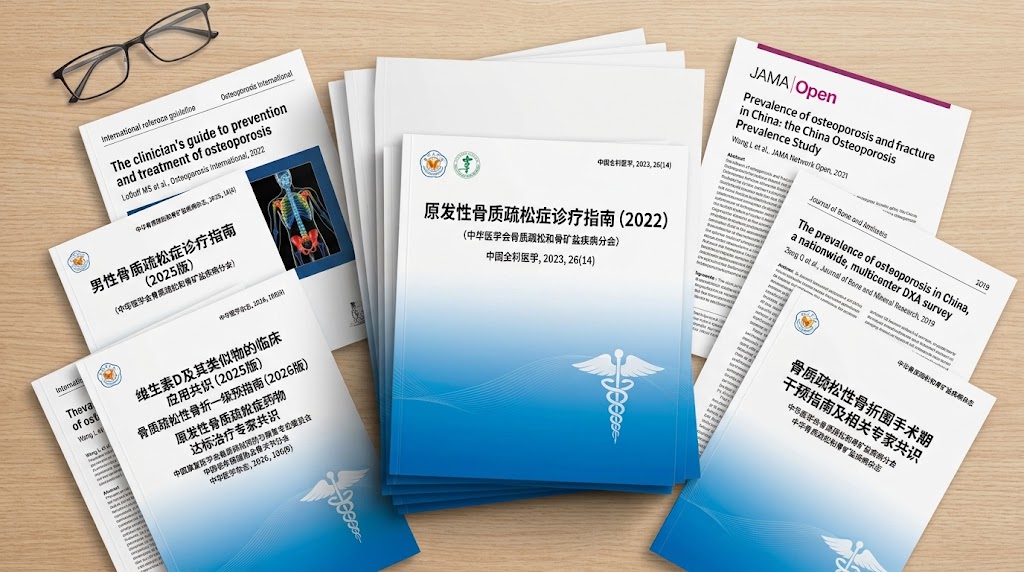
我国骨质疏松症临床诊疗目前以中华医学会骨质疏松和骨矿盐疾病分会发布的《原发性骨质疏松症诊疗指南(2022)》为核心框架。该指南系统覆盖疾病定义与分类、流行病学、危险因素、筛查、诊断、鉴别诊断、骨折风险评估、非药物治疗、药物治疗、疗程管理、骨质疏松性骨折以及分级诊疗等内容,是国内临床实践和专业检索中最重要的基础性文件。需要注意的是,指南名称中的“2022”代表指南版本,而正式发表时间为2023年。
China’s current osteoporosis guidance system is centered on the Guidelines for the Diagnosis and Treatment of Primary Osteoporosis (2022) issued by the Chinese Society of Osteoporosis and Bone Mineral Research. The guideline provides a comprehensive framework covering disease classification, epidemiology, risk factors, screening, diagnosis, differential diagnosis, fracture-risk assessment, non-pharmacological management, pharmacotherapy, treatment duration, osteoporotic fractures, and hierarchical medical care. It remains the principal reference document for routine clinical practice in China, while more recent disease-specific guidelines and expert consensuses provide important updates and extensions.
二、疾病定义与临床分类
骨质疏松症是一种以骨量降低、骨组织微结构破坏、骨强度下降和骨折风险增加为主要特征的全身性骨骼疾病。国内指南将其分为原发性和继发性两大类。原发性骨质疏松症主要包括绝经后骨质疏松症、老年性骨质疏松症和特发性骨质疏松症;继发性骨质疏松症则由内分泌、代谢、消化、肾脏、风湿免疫、血液系统疾病以及药物等因素导致。
Osteoporosis is defined as a systemic skeletal disorder characterized by reduced bone mass, deterioration of bone microarchitecture, impaired bone strength, and increased fracture susceptibility. The Chinese guideline distinguishes primary from secondary osteoporosis. Primary osteoporosis includes postmenopausal osteoporosis, age-related osteoporosis, and idiopathic osteoporosis, whereas secondary osteoporosis results from endocrine, metabolic, gastrointestinal, renal, rheumatologic, hematologic, malignant, medication-related, or other identifiable causes.
三、流行病学与重点人群
我国全国性DXA调查显示,骨质疏松症已经成为重要的公共卫生问题。2022版指南引用的全国流行病学调查显示,50岁以上人群骨质疏松症患病率约为19.2%,其中女性明显高于男性;65岁以上人群患病率进一步升高。近年来的人口老龄化使疾病负担持续增加,因此临床重点已经从单纯治疗骨密度降低,逐步转向识别高危人群、预防首次骨折和减少再骨折。
National DXA-based surveys have demonstrated that osteoporosis represents a substantial public-health burden in China. The epidemiological data cited in the 2022 guideline indicate that osteoporosis affects approximately 19.2% of Chinese adults aged 50 years and older, with substantially higher prevalence among women and increasing prevalence with age. With rapid population aging, clinical management has increasingly shifted from simply treating low BMD toward identifying high-risk individuals, preventing the first fragility fracture, and reducing subsequent fractures.
四、筛查、危险因素与初步评估
临床评估应首先结合年龄、性别、既往脆性骨折、父母髋部骨折史、体重、身高变化、吸烟、过量饮酒、运动不足、营养状况、绝经状态以及糖皮质激素等药物暴露进行综合判断。对于存在危险因素者,可使用OSTA等工具进行初筛,并进一步采用DXA进行骨密度评价。对于已经发生脆性骨折的患者,即使BMD并未达到典型的骨质疏松范围,也应高度重视其未来骨折风险。
Initial assessment should integrate age, sex, previous fragility fractures, parental hip fracture, body weight, height loss, smoking, excessive alcohol intake, physical inactivity, nutritional status, menopausal status, and exposure to medications such as glucocorticoids. Screening tools such as OSTA may be used for initial risk identification, followed by DXA when appropriate. A prior fragility fracture is an important clinical signal even when BMD does not meet the conventional densitometric definition of osteoporosis.
五、DXA与骨质疏松症诊断
DXA仍是临床诊断骨质疏松症和评价治疗反应的核心技术。根据国内2022版指南,绝经后女性和50岁以上男性可采用T值进行诊断;腰椎、股骨颈、全髋及桡骨远端1/3均可作为评价部位。T值≤−2.5可诊断骨质疏松症;髋部或椎体脆性骨折,即使没有DXA结果,也可以临床诊断骨质疏松症。对于绝经前女性、儿童及50岁以下男性,则更强调Z值评价,Z值≤−2.0通常定义为低于同年龄预期范围。
DXA remains the principal technology for diagnosing osteoporosis and monitoring treatment response. Under the 2022 Chinese guideline, T-scores are used for postmenopausal women and men aged 50 years or older, with the lumbar spine, femoral neck, total hip, and one-third radius serving as relevant measurement sites. A T-score of ≤−2.5 meets the densitometric definition of osteoporosis. Hip or vertebral fragility fractures may establish the diagnosis regardless of BMD. In premenopausal women, children, and men younger than 50 years, Z-scores are preferred, with a Z-score ≤−2.0 generally considered below the expected range for age.
六、椎体骨折与影像学评估
临床实践中应特别警惕无症状或轻症椎体骨折。2022版指南提出,对于特定年龄、BMD水平、身高下降、既往非暴力性骨折以及长期糖皮质激素使用者,应考虑胸腰椎侧位X线或DXA椎体骨折评估(VFA)。X线仍是发现椎体压缩性骨折的重要方法;CT和MRI则更适用于复杂骨折、鉴别肿瘤以及评价骨髓和软组织异常。
Clinicians should actively consider asymptomatic or minimally symptomatic vertebral fractures. The 2022 guideline recommends vertebral imaging using lateral thoracolumbar radiography or DXA-based vertebral fracture assessment in selected patients according to age, BMD, height loss, previous non-traumatic fracture, and long-term glucocorticoid exposure. Conventional radiography remains important for vertebral compression fractures, whereas CT and MRI are particularly useful for complex fractures, differential diagnosis of malignancy, and assessment of bone marrow or soft-tissue abnormalities.
七、骨折风险评估与FRAX
对于骨量减少但尚未达到DXA骨质疏松诊断标准的患者,FRAX是国内指南推荐的重要风险评估工具。2022版指南采用的治疗参考阈值为:未来10年髋部骨折风险≥3%,或主要骨质疏松性骨折风险≥20%。同时应认识到FRAX存在局限,例如对跌倒、糖尿病、既往多次骨折、骨折近期发生以及某些药物暴露的反映不足,因此不能替代完整的临床判断。
For patients with low bone mass who do not meet the densitometric definition of osteoporosis, FRAX is an important risk-assessment tool. The 2022 Chinese guideline uses a 10-year hip-fracture probability of ≥3% or a major osteoporotic fracture probability of ≥20% as reference thresholds for pharmacological intervention. However, FRAX has limitations, including incomplete representation of falls, diabetes, multiple or recent fractures, dose-dependent glucocorticoid exposure, and other medication-related risks. Therefore, FRAX should complement rather than replace clinical judgment.
八、基础治疗与生活方式干预
基础治疗贯穿骨质疏松症管理全过程,包括合理钙摄入、维生素D营养状态维护、规律负重和抗阻运动、戒烟、限制过量饮酒以及跌倒风险管理。2025年中华医学会骨质疏松和骨矿盐疾病分会进一步发布《维生素D及其类似物的临床应用共识(2025版)》,对25-羟维生素D检测、维生素D补充以及活性维生素D类似物的临床应用进行了更新,为国内相关治疗提供了新的专业依据。
Basic management should continue throughout osteoporosis care and includes adequate calcium intake, maintenance of vitamin D sufficiency, weight-bearing and resistance exercise, smoking cessation, avoidance of excessive alcohol consumption, and fall prevention. In 2025, the Chinese Society of Osteoporosis and Bone Mineral Research published an updated consensus on vitamin D and its analogues, addressing assessment of 25-hydroxyvitamin D, vitamin D supplementation, and the clinical use of active vitamin D analogues. This document provides an important contemporary supplement to the broader osteoporosis guideline.
九、抗骨质疏松药物治疗
国内指南强调根据骨折风险进行分层治疗。对于高骨折风险患者,可考虑口服双膦酸盐;不能耐受口服治疗者可考虑静脉唑来膦酸或地舒单抗。对于极高骨折风险患者,可根据具体情况选择特立帕肽、唑来膦酸、地舒单抗或罗莫佐单抗等。治疗方案应综合既往骨折、骨密度、年龄、肾功能、合并症、依从性、给药途径及经济因素进行个体化选择。
Pharmacological treatment should be guided by fracture-risk stratification. For patients at high fracture risk, oral bisphosphonates are commonly considered first-line options, while intravenous zoledronic acid or denosumab may be considered when oral therapy is unsuitable. In patients at very high fracture risk, options may include teriparatide, zoledronic acid, denosumab, or romosozumab, depending on the clinical context. Treatment selection should incorporate fracture history, BMD, age, renal function, comorbidities, adherence, route of administration, and cost.
十、疗程、序贯治疗与长期管理
骨质疏松症属于需要长期管理的慢性疾病。2022版指南强调药物疗程应个体化,并特别讨论了双膦酸盐“药物假期”、地舒单抗停药后的序贯治疗以及促骨形成药物之后的抗骨吸收治疗。对于双膦酸盐患者,是否进入药物假期取决于治疗时间、BMD、既往及治疗期间骨折情况和总体风险,而不是机械执行固定停药时间。
Osteoporosis requires long-term management rather than a short therapeutic course. The 2022 guideline emphasizes individualized treatment duration and addresses bisphosphonate drug holidays, sequential therapy after discontinuation of denosumab, and antiresorptive therapy following anabolic treatment. A bisphosphonate holiday should be considered according to treatment duration, BMD, fracture history, and overall fracture risk rather than applied automatically after a predetermined period.
十一、男性骨质疏松症与特殊人群
男性骨质疏松症长期以来容易被低估。中华医学会骨质疏松和骨矿盐疾病分会已于2025年发布《男性骨质疏松症诊疗指南(2025版)》,更新了男性骨质疏松症的流行趋势、危险因素、诊断、骨折风险评估、药物治疗和长期管理内容。该指南应作为男性患者诊疗的重要补充。
Male osteoporosis has historically received less clinical attention than postmenopausal osteoporosis. The Chinese Society of Osteoporosis and Bone Mineral Research published the Guideline for Diagnosis and Treatment of Osteoporosis in Men (2025), updating epidemiology, risk factors, diagnosis, fracture-risk assessment, pharmacological treatment, and long-term management. This guideline should be considered an important companion document when managing male patients.
十二、骨质疏松性骨折:从治疗疾病转向防止再骨折
发生髋部、椎体等脆性骨折后,临床目标不应局限于骨折局部治疗,而应同步启动骨质疏松评估和再骨折预防。国内相关指南和共识已逐步形成包括骨折识别、围手术期管理、抗骨质疏松药物、营养、康复、跌倒预防及长期随访在内的综合管理体系。2026年发布的《骨质疏松性骨折一级预防指南(2026版)》进一步将风险人群识别、风险评估、教育、跌倒预防以及骨质疏松症评估和治疗纳入一级预防框架。
After a fragility fracture, particularly a hip or vertebral fracture, management should extend beyond local fracture treatment to osteoporosis assessment and secondary fracture prevention. Chinese guidelines and expert consensuses increasingly emphasize integrated care encompassing fracture identification, perioperative management, anti-osteoporosis medication, nutrition, rehabilitation, fall prevention, and long-term follow-up. The 2026 Guideline for Primary Prevention of Osteoporotic Fractures further incorporates risk identification, fracture-risk assessment, patient education, fall prevention, and osteoporosis assessment and treatment into a primary-prevention framework.
十三、继发性骨质疏松与特殊疾病
在确诊原发性骨质疏松症之前,应系统排除继发性原因。重点包括甲状旁腺、甲状腺、肾上腺及性腺疾病,慢性肾脏病,乳糜泻和其他吸收不良疾病,类风湿关节炎等炎症性疾病,多发性骨髓瘤等血液系统疾病,以及糖皮质激素、芳香化酶抑制剂、抗癫痫药等药物因素。继发性因素的识别可能直接改变治疗策略,因此是骨质疏松诊疗的重要环节。
Before labeling osteoporosis as primary, clinicians should systematically consider secondary causes. Important categories include parathyroid, thyroid, adrenal and gonadal disorders; chronic kidney disease; celiac disease and other malabsorptive conditions; inflammatory diseases such as rheumatoid arthritis; hematologic malignancies such as multiple myeloma; and medication-related causes including glucocorticoids, aromatase inhibitors, and antiseizure drugs. Identifying a secondary cause may substantially modify treatment and is therefore an essential component of osteoporosis evaluation.
十四、从指南到“达标治疗”
国内骨质疏松管理正在由“是否使用药物”进一步转向“是否达到治疗目标”。2026年《原发性骨质疏松症药物达标治疗专家共识》提出以治疗目标、疗效评价和动态调整为核心的管理思路,关注骨折事件、BMD和骨转换标志物等指标,并强调依从性、继发性病因以及序贯治疗策略。这意味着未来国内骨质疏松管理将更加重视治疗全过程的动态评价,而不仅是初始处方。
Chinese osteoporosis management is increasingly moving from the question of whether a patient receives medication toward whether treatment achieves predefined clinical goals. The 2026 expert consensus on treat-to-target pharmacotherapy emphasizes treatment objectives, efficacy assessment, dynamic treatment adjustment, fracture outcomes, BMD, and bone-turnover markers, while also highlighting adherence, secondary causes, and sequential therapy. This represents a shift toward longitudinal, target-oriented disease management rather than prescription-based care alone.
十五、国内指南检索框架
对于临床专业人员而言,可将国内骨质疏松指南体系按以下层级进行检索:第一层为《原发性骨质疏松症诊疗指南(2022)》;第二层为男性骨质疏松、维生素D及其类似物、骨质疏松性骨折等专题指南和共识;第三层为药物达标治疗、一级预防、围手术期管理及特定疾病相关骨质疏松文件。实际临床决策时,应优先查阅最新版本,并结合药品说明书、国家药品监管要求以及患者具体风险进行个体化判断。
For clinical retrieval, the Chinese guideline system can therefore be organized into three levels: the core Guidelines for the Diagnosis and Treatment of Primary Osteoporosis (2022); disease- or population-specific documents addressing male osteoporosis, vitamin D, and osteoporotic fractures; and newer documents addressing treat-to-target therapy, primary fracture prevention, perioperative management, and disease-specific osteoporosis. In clinical practice, the latest applicable document should be consulted together with current prescribing information, regulatory requirements, and individual patient risk.
参考文献|References
1. 中华医学会骨质疏松和骨矿盐疾病分会. 原发性骨质疏松症诊疗指南(2022)[J]. 中国全科医学, 2023, 26(14):1671-1691. DOI:10.12114/j.issn.1007-9572.2023.0121.
2. 中华医学会骨质疏松和骨矿盐疾病分会. 男性骨质疏松症诊疗指南(2025版)[J]. 中华骨质疏松和骨矿盐疾病杂志, 2025, 18(6):647-668.
3. 中华医学会骨质疏松和骨矿盐疾病分会. 维生素D及其类似物的临床应用共识(2025版)[J]. 中华骨质疏松和骨矿盐疾病杂志, 2025, 18(5):497-517. DOI:10.3969/j.issn.1674-2591.2025.05.001.
4. 中华医学会骨质疏松和骨矿盐疾病分会. 原发性骨质疏松症药物达标治疗专家共识[J]. 中华骨质疏松和骨矿盐疾病杂志, 2026, 19(3):279-291.
5. 中国康复医学会骨质疏松预防与康复专业委员会, 中国老年保健协会骨关节分会. 骨质疏松性骨折一级预防指南(2026版)[J]. 中华医学杂志, 2026, 106(9). DOI:10.3760/cma.j.cn112137-20250812-02059.
6. LeBoff MS, Greenspan SL, Insogna KL, et al. The clinician’s guide to prevention and treatment of osteoporosis. Osteoporosis International. 2022;33:2049-2102. DOI:10.1007/s00198-021-05900-y.
7. Wang L, Yu W, Yin X, et al. Prevalence of osteoporosis and fracture in China: the China Osteoporosis Prevalence Study. JAMA Network Open. 2021;4.
8. Zeng Q, Li N, Wang Q, et al. The prevalence of osteoporosis in China, a nationwide, multicenter DXA survey. Journal of Bone and Mineral Research. 2019;34:1789-1797.
9. Cosman F, de Beur SJ, LeBoff MS, et al. Clinician’s Guide to Prevention and Treatment of Osteoporosis. Osteoporosis International. 2014;25:2359-2381.
10.中华医学会骨质疏松和骨矿盐疾病分会. 骨质疏松性骨折围手术期干预指南及相关专家共识. 中华骨质疏松和骨矿盐疾病杂志.