一、围手术期骨健康管理的临床意义
围手术期骨健康管理并不局限于骨折患者,而是适用于接受骨科、脊柱及部分其他大型手术、同时存在骨量减少、骨质疏松或骨折高风险的患者。骨质疏松可增加术中骨折、内固定失败、螺钉松动、假关节、邻近椎体骨折以及术后功能恢复不良等风险。尤其在脊柱内固定和融合手术中,低骨密度与机械并发症之间存在明确关联。因此,围手术期管理的目标应从单纯“完成手术”扩展为优化骨骼条件、降低手术相关骨性并发症,并预防后续脆性骨折。2024年的系统综述指出,骨质疏松在脊柱手术人群中仍存在明显漏诊和治疗不足。
Perioperative bone health management extends beyond patients presenting with fractures. It is relevant to individuals undergoing orthopedic, spinal, and other major surgical procedures who have low bone mass, osteoporosis, or elevated fracture risk. Osteoporosis may increase the risk of intraoperative fracture, fixation failure, screw loosening, pseudarthrosis, adjacent vertebral fracture, and impaired postoperative recovery. This is particularly important in spinal instrumentation and fusion, where low bone density is associated with mechanical complications. Therefore, perioperative management should move beyond simply completing the operation toward optimizing skeletal quality, reducing bone-related surgical complications, and preventing subsequent fragility fractures. A 2024 systematic review highlighted persistent underdiagnosis and undertreatment of osteoporosis among patients undergoing spine surgery.
二、术前筛查:将骨健康纳入手术风险评估
术前评估应尽可能识别未诊断的骨质疏松及继发性骨质疏松。基本评估包括既往脆性骨折史、年龄、身高和体重变化、长期糖皮质激素或其他影响骨代谢药物使用、跌倒史及家族史。对于具有风险因素的患者,可进一步进行DXA检查,并结合椎体影像学、机会性CT骨密度指标等进行风险分层。实验室检查应根据患者情况评估血钙、白蛋白、肌酐/eGFR、25-羟维生素D,并在怀疑继发性骨质疏松时进一步检测甲状旁腺激素、甲状腺功能及其他相关指标。脊柱手术患者的循证指南指出,DXA T值<−2.5、CT Hounsfield单位降低以及维生素D缺乏均可提示术后骨相关不良事件风险增加。
Preoperative assessment should actively identify previously undiagnosed osteoporosis and secondary causes of bone loss. Core evaluation includes prior fragility fractures, age, changes in height or body weight, long-term glucocorticoid or other bone-active medication exposure, falls, and family history. In patients with relevant risk factors, DXA should be considered, supplemented when appropriate by vertebral imaging and opportunistic CT-based bone density assessment. Laboratory testing may include serum calcium, albumin, creatinine/eGFR, and 25-hydroxyvitamin D, with parathyroid hormone, thyroid function, and other investigations when secondary osteoporosis is suspected. Evidence-based guidance for spine surgery indicates that a DXA T-score below −2.5, low CT Hounsfield units, and vitamin D deficiency are associated with increased risks of osteoporosis-related postoperative adverse events.
三、术前优化:营养、维生素D与跌倒风险同样重要
对于存在营养不良、低体重、维生素D缺乏或低钙摄入的患者,应在围术期及时纠正可干预因素。钙摄入应优先通过膳食满足,不足时再考虑补充;维生素D缺乏者应进行相应的纠正和维持治疗。与此同时,应评估肌少症、步态和平衡障碍及跌倒风险。对于高龄髋部骨折患者,AAOS的围术期二次骨折预防清单建议关注钙、维生素D、骨质疏松药物治疗、跌倒预防及体力活动等多个环节,而不是将骨健康处理简单归结为一次DXA检查。
Patients with malnutrition, low body weight, vitamin D deficiency, or inadequate calcium intake should have modifiable factors addressed during the perioperative period. Dietary calcium should generally be prioritized, with supplementation when dietary intake is insufficient; vitamin D deficiency should be appropriately corrected and maintained. Assessment should also include sarcopenia, gait and balance impairment, and fall risk. The AAOS perioperative checklist for prevention of future fractures after hip fracture emphasizes calcium, vitamin D, osteoporosis pharmacotherapy, fall prevention, and maintenance of physical activity, rather than treating bone health as a single DXA measurement.
四、抗骨质疏松药物:不应因手术而无原则延迟
临床实践中常见的问题是担心抗骨吸收药物影响骨折愈合,从而延迟双膦酸盐或其他治疗。现有证据并不支持对所有患者进行长时间等待。针对近端股骨骨折内固定患者的系统综述和Meta分析显示,术后1个月内启动双膦酸盐并不会显著增加延迟愈合或不愈合风险;相关综述也认为,在适当患者中,双膦酸盐甚至可在骨折后较早阶段启动。
A common clinical concern is that antiresorptive therapy may interfere with fracture healing, leading clinicians to delay bisphosphonate or other treatment unnecessarily. Current evidence does not support prolonged withholding of therapy in all patients. A systematic review and meta-analysis of patients undergoing fixation of proximal femoral fractures found that initiating bisphosphonates within one month after surgery did not significantly increase delayed healing or nonunion. Other reviews similarly suggest that osteoporosis treatment can be initiated relatively early after fracture in appropriately selected patients.
五、不同手术类型需要不同的骨健康策略
围术期骨健康管理不能采用完全统一的药物方案。对于普通脆性骨折患者,重点通常是尽早完成骨质疏松诊断和二级预防;对于脊柱融合、长节段内固定或既往存在椎体骨折的极高风险患者,则需要更加重视骨质量对内固定稳定性和融合率的影响。部分研究提示,围术期特立帕肽治疗可能改善脊柱融合相关影像学结局并降低部分机械并发症。2026年发表的Meta分析纳入20项研究、2543例患者,发现围术期特立帕肽与较低的近端交界性后凸及影像学不愈合风险相关,但不同研究之间存在异质性,因此仍应结合患者风险及当地适应证进行个体化决策。
Perioperative bone health strategies should therefore be procedure-specific. In routine fragility fracture patients, the priority is early diagnosis and secondary fracture prevention. In patients undergoing spinal fusion, long-segment instrumentation, or surgery in the setting of severe vertebral osteoporosis, greater attention should be paid to bone quality and its effects on fixation stability and fusion. Studies suggest that perioperative teriparatide may improve radiographic outcomes related to spinal fusion and reduce selected mechanical complications. A 2026 meta-analysis including 20 studies and 2,543 patients found associations between perioperative teriparatide use and lower rates of proximal junctional kyphosis and radiographic nonunion, although substantial heterogeneity remains and treatment should be individualized according to patient risk and approved indications.
六、术后管理:从“伤口愈合”延伸到“骨折预防”
术后阶段应尽早恢复安全活动、进行肌力和平衡训练,并根据手术类型制定负重和康复计划。对于发生脆性骨折的患者,住院期间即应启动骨质疏松评估和治疗转诊,而不应等到骨折完全愈合后再处理骨质疏松。FLS(Fracture Liaison Service,骨折联络服务)可以成为连接骨科手术、骨代谢评估、药物治疗和长期随访的重要平台。对于接受地舒单抗治疗者,还应特别避免无计划停药,因为治疗中断可能导致快速骨转换及椎体骨折风险反弹;后续治疗应按照规范的序贯策略进行。现有研究显示,地舒单抗在骨折发生前后使用并未显示出延迟骨折愈合的信号。
Postoperative management should extend beyond wound healing to restoration of mobility, muscle strength, balance, and prevention of future fractures. In patients sustaining fragility fractures, osteoporosis assessment and referral should begin during the index episode of care rather than being postponed until complete fracture healing. An FLS can provide an effective bridge between orthopedic surgery, metabolic bone assessment, pharmacological treatment, and longitudinal follow-up. For patients receiving denosumab, unplanned discontinuation should be avoided because treatment interruption can result in rebound bone turnover and increased vertebral fracture risk; subsequent therapy should follow an appropriate sequential treatment strategy. Available evidence has not demonstrated a clinically important signal of delayed fracture healing when denosumab is administered around the time of fracture.
七、建立多学科、可量化的围术期骨健康路径
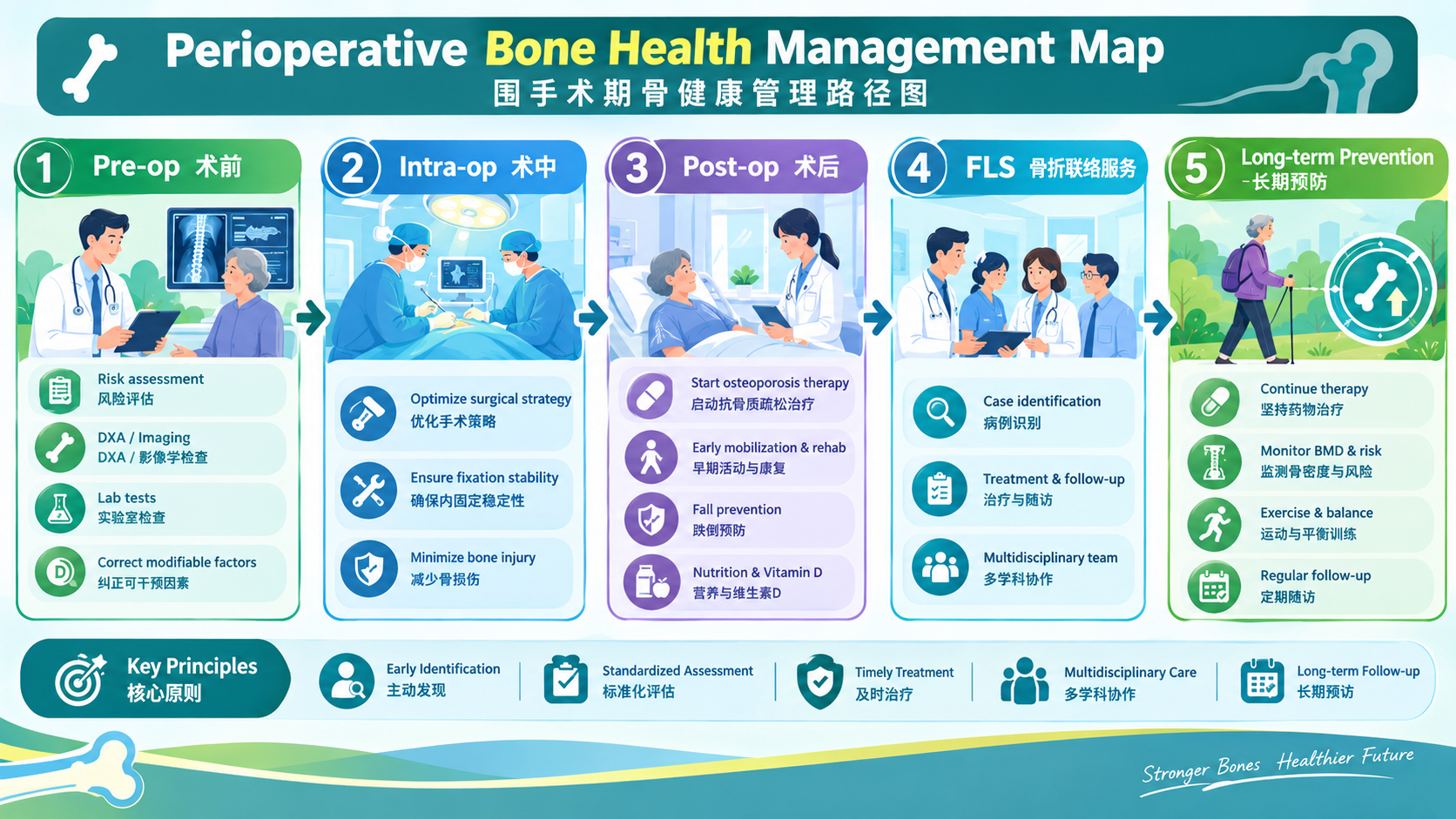
理想的围术期骨健康管理应形成标准化临床路径:术前筛查 → 骨折及骨质量风险分层 → 营养与维生素D优化 → 手术策略调整 → 适时启动抗骨质疏松治疗 → 早期康复 → FLS转介与长期随访。骨科医生负责识别和启动流程,内分泌/代谢骨病或老年医学团队负责骨质疏松诊断和药物决策,麻醉及围术期团队负责全身风险优化,康复团队负责活动能力和跌倒风险管理。医院还应建立DXA完成率、治疗启动率、药物持续率、新发骨折率、再入院率和功能恢复等质量指标。这样才能使“骨健康”从围术期附加项目转变为手术质量和长期结局的重要组成部分。
An effective perioperative bone health pathway can therefore be structured as: preoperative screening → fracture and bone-quality risk stratification → nutritional and vitamin D optimization → surgical strategy adjustment → timely osteoporosis pharmacotherapy → early rehabilitation → FLS referral and long-term follow-up. Orthopedic surgeons can initiate the pathway; endocrinology, metabolic bone disease, or geriatric teams can provide osteoporosis diagnosis and pharmacological management; perioperative teams can optimize systemic risk; and rehabilitation specialists can address mobility and fall prevention. Hospitals should monitor measurable quality indicators, including DXA completion, treatment initiation, medication persistence, subsequent fracture, readmission, and functional recovery. In this model, bone health becomes an integral component of surgical quality and long-term outcomes rather than an optional perioperative add-on.
结语 Conclusion
围手术期骨健康管理的核心并不是在手术前后简单增加一项骨密度检查,而是识别“骨骼脆弱性”对手术结局和长期健康的影响,并将骨质量优化、抗骨质疏松治疗、康复和二次骨折预防纳入同一临床闭环。对于脆性骨折和高风险脊柱手术患者,这种模式尤其具有价值。现有证据支持在合适患者中尽早启动骨质疏松治疗,同时强调药物选择、手术类型、肾功能、骨折类型及整体风险的个体化权衡。
The essence of perioperative bone health management is not simply adding a BMD measurement before or after surgery. It is the recognition that skeletal fragility can directly influence surgical outcomes and long-term health, and that bone-quality optimization, osteoporosis pharmacotherapy, rehabilitation, and secondary fracture prevention should form a single clinical pathway. This approach is particularly valuable for patients with fragility fractures and those undergoing high-risk spinal procedures. Current evidence supports timely initiation of osteoporosis therapy in appropriately selected patients while emphasizing individualized decisions based on the procedure, fracture characteristics, renal function, skeletal risk, and overall clinical context.
参考文献 References
1. Filley A, Baldwin A, Ben-Natan AR, et al. The influence of osteoporosis on mechanical complications in lumbar fusion surgery: a systematic review. North American Spine Society Journal. 2024;18:100327. doi:10.1016/j.xnsj.2024.100327.
2. Le HV, Van BW, Shahzad H, et al. Fracture liaison service—a multidisciplinary approach to osteoporosis management. Osteoporosis International. 2024;35(10):1719-1727. doi:10.1007/s00198-024-07181-7.
3. Tong YYF, Holmes S, Sefton A. Early bisphosphonate therapy post proximal femoral fracture fixation does not impact fracture healing: a systematic review and meta-analysis. ANZ Journal of Surgery. 2022;92(11):2840-2848. doi:10.1111/ans.17792.
4. Adami S, Libanati C, Boonen S, et al. Denosumab treatment in postmenopausal women with osteoporosis does not interfere with fracture-healing: results from the FREEDOM trial. Journal of Bone and Joint Surgery American. 2012;94(23):2113-2119. doi:10.2106/JBJS.K.00774.
5. Congress of Neurological Surgeons. Systematic review and evidence-based guidelines for perioperative spine: preoperative osteoporosis assessment. Neurosurgery. 2021.
6. American Academy of Orthopaedic Surgeons. Management of Hip Fractures in Older Adults: Clinical Practice Guideline. AAOS; 2021.
7. Association of Perioperative Teriparatide Use with Postoperative Complications in Spinal Fusion Surgery: A Systematic Review and Meta-Analysis. 2026.
8. Qaseem A, et al. Timing of osteoporosis therapies following fracture: the current status. Journal of Clinical and Translational Endocrinology. 2022.
9. International Osteoporosis Foundation. Treatment and surgery of fragility fractures.