一、为什么必须识别继发性骨质疏松
继发性骨质疏松(secondary osteoporosis)是由明确的基础疾病、药物暴露、营养缺陷或内分泌及代谢异常所导致的骨量下降和骨脆性增加。与绝经后骨质疏松或老年性骨质疏松不同,继发性骨质疏松的识别不仅关系到骨折风险评估,更可能直接改变治疗策略。研究显示,继发性因素在男性、绝经前女性以及年轻骨量显著降低者中尤其常见;即使在绝经后女性中,也可能存在未被识别的继发性因素。[1]
Secondary osteoporosis results from an identifiable underlying disease, medication exposure, nutritional deficiency, or endocrine/metabolic disorder that adversely affects bone mass and skeletal strength. Unlike postmenopausal or age-related osteoporosis, identifying a secondary cause can substantially alter management because treatment of the underlying disorder may improve skeletal health and sometimes reduce the need for osteoporosis-specific therapy. Secondary causes are particularly prevalent in men, premenopausal women, and patients with unexpectedly severe bone loss, but they can also occur in postmenopausal women.[1]
二、哪些患者应该高度怀疑继发性病因
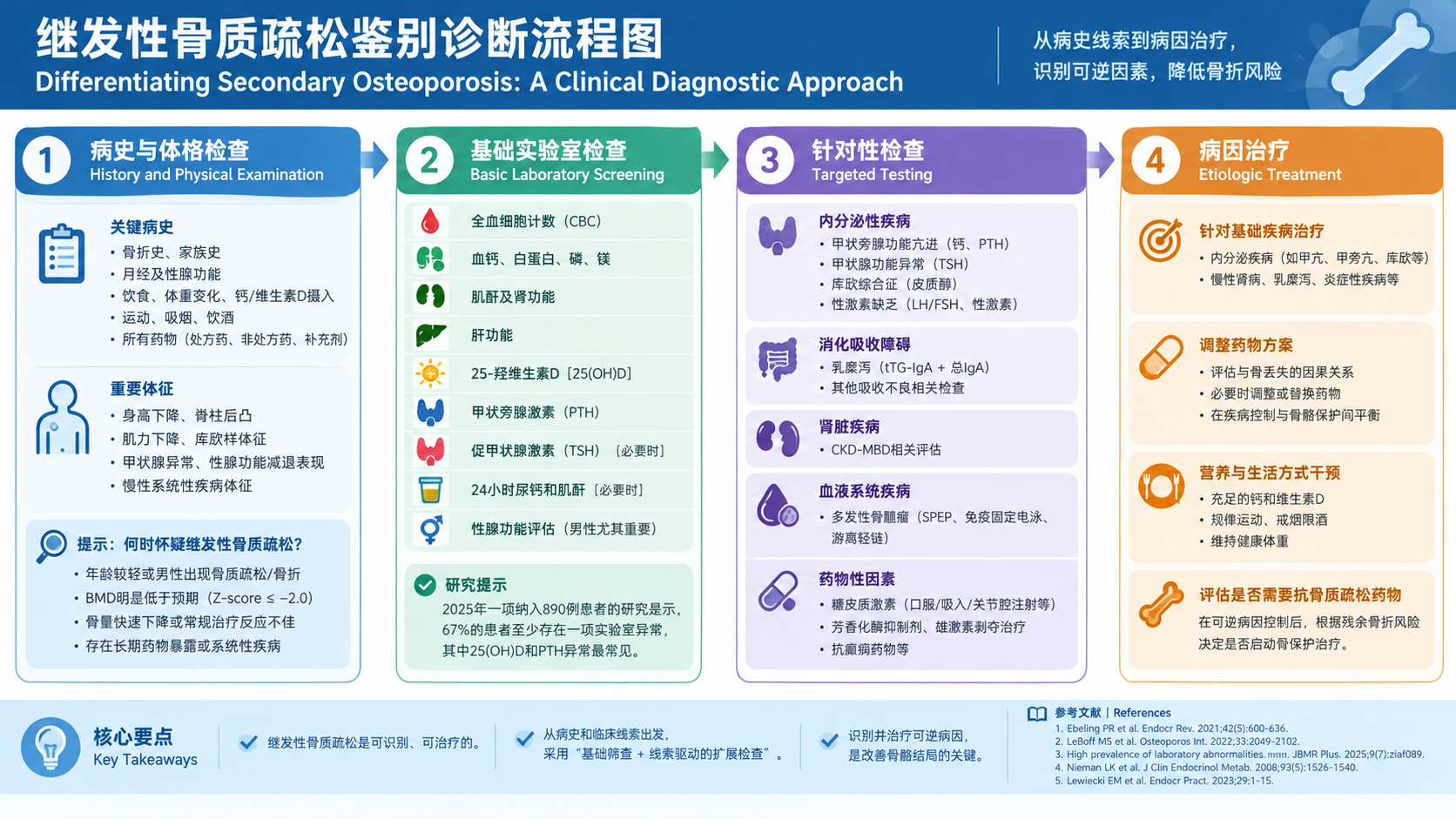
临床上应特别关注以下“红旗信号”:年龄较轻却出现脆性骨折;骨密度(BMD)明显低于预期;Z-score ≤ −2.0;骨量在短期内快速下降;男性发生骨质疏松;绝经前女性出现低骨量或骨折;常规抗骨质疏松治疗反应不佳;以及存在长期糖皮质激素、芳香化酶抑制剂、雄激素剥夺治疗、抗癫痫药物等暴露。此外,体重明显下降、慢性腹泻、闭经、甲状腺或甲状旁腺疾病、肾脏疾病、慢性炎症性疾病及恶性肿瘤病史,都应提高对继发性病因的警惕。[1,2]
Clinicians should suspect secondary osteoporosis when fractures or bone loss appear disproportionate to the patient’s age or conventional risk factors. Important warning signs include fragility fractures at a young age, very low BMD, a Z-score ≤ −2.0, unexpectedly rapid bone loss, osteoporosis in men, low BMD or fractures in premenopausal women, and an inadequate response to conventional osteoporosis therapy. Medication exposure—including glucocorticoids, aromatase inhibitors, and androgen-deprivation therapy—should be reviewed carefully. Unintentional weight loss, chronic diarrhea, amenorrhea, endocrine disorders, kidney disease, inflammatory disorders, and malignancy are additional clinical clues.[1,2]
三、首先从病史和体格检查建立“病因地图”
继发性骨质疏松的鉴别不能仅依赖实验室检查。完整的病史应包括既往骨折史、家族史、月经及性腺功能、饮食和体重变化、钙和维生素D摄入、运动模式、吸烟和酒精使用,以及所有处方药、非处方药和补充剂。体格检查则应关注身高下降、脊柱后凸、肌力下降、库欣样体征、甲状腺异常、性腺功能减退表现以及慢性系统性疾病的体征。病史和体征决定后续检查的“深度”,而不是对所有患者进行无限扩展的实验室筛查。
The diagnostic process should begin with a structured history and physical examination rather than indiscriminate laboratory testing. Relevant domains include previous fractures, family history, menstrual and gonadal function, dietary intake, weight change, calcium and vitamin D exposure, physical activity, smoking, alcohol consumption, and all prescription and nonprescription medications. Physical examination should assess height loss, kyphosis, muscle weakness, Cushingoid features, thyroid abnormalities, hypogonadism, and evidence of chronic systemic disease. Clinical context should determine the extent of subsequent laboratory investigation.
四、首轮实验室检查:寻找最常见且可治疗的病因
对于已经确诊骨质疏松或存在明显骨脆性的患者,基础筛查通常包括全血细胞计数(CBC)、血清钙、白蛋白、磷、镁、肌酐及肾功能、肝功能、25-羟维生素D[25(OH)D]、甲状旁腺激素(PTH)以及必要时的促甲状腺激素(TSH)。部分患者还应进行24小时尿钙和肌酐检测。男性患者尤其需要考虑性腺功能评估。2025年的一项大型临床研究纳入890例低骨密度或骨折患者,发现67%的患者至少存在一项实验室异常,其中25(OH)D和PTH异常最常见,提示系统性筛查具有较高的临床价值。[3]
An initial laboratory panel should generally include a complete blood count, serum calcium and albumin, phosphorus, magnesium, creatinine and renal function, liver function tests, 25-hydroxyvitamin D, and parathyroid hormone. Thyroid-stimulating hormone is appropriate when clinically indicated, and 24-hour urinary calcium and creatinine can provide additional information. Assessment of gonadal function is particularly relevant in men with osteoporosis. A 2025 study of 890 patients referred for low bone density or fracture found that 67% had at least one laboratory abnormality, with abnormalities in 25(OH)D and PTH among the most frequent findings, supporting systematic but targeted laboratory evaluation.[3]
五、内分泌性继发性骨质疏松:最容易被漏诊的领域
内分泌疾病是继发性骨质疏松的重要来源。原发性甲状旁腺功能亢进通常表现为高钙血症伴PTH不适当升高;而维生素D缺乏、低钙摄入或慢性肾病则可能出现继发性甲状旁腺功能亢进。甲状腺功能亢进可加速骨转换并增加骨丢失。对于存在高血压、糖尿病、向心性肥胖、皮肤紫纹或肌无力等特征的患者,应考虑库欣综合征;对于月经异常、性腺功能减退或长期低能量摄入者,则应评估性激素缺乏。必要时应根据临床概率选择皮质醇、性激素、泌乳素等进一步检查。[1,4]
Endocrine disorders represent a major and potentially treatable category of secondary osteoporosis. Primary hyperparathyroidism is typically characterized by hypercalcemia with an inappropriately elevated or nonsuppressed PTH level, whereas vitamin D deficiency, inadequate calcium intake, and chronic kidney disease may produce secondary hyperparathyroidism. Hyperthyroidism accelerates bone turnover and may promote bone loss. Cushing syndrome should be considered when osteoporosis occurs together with hypertension, diabetes, central adiposity, purple striae, or muscle weakness. Hypogonadism should be evaluated in patients with amenorrhea, reproductive dysfunction, or other clinical evidence of sex-hormone deficiency.[1,4]
六、消化吸收障碍、肾脏疾病和血液系统疾病
当患者存在慢性腹泻、腹胀、缺铁性贫血、体重下降或不明原因的营养缺乏时,应考虑乳糜泻及其他吸收不良综合征,可选择组织型谷氨酰胺转移酶抗体(tTG-IgA)并结合总IgA进行筛查。慢性肾脏病患者的骨异常则可能属于CKD-MBD谱系,不能简单按照普通原发性骨质疏松处理。对于年龄较大、骨痛明显、贫血、肾功能异常或骨量下降程度与年龄不符的患者,应考虑多发性骨髓瘤,并根据临床情况进行血清蛋白电泳、免疫固定电泳及游离轻链检测。[2,5]
Malabsorption should be considered in patients with chronic diarrhea, bloating, iron-deficiency anemia, weight loss, or unexplained nutritional deficiencies. Screening for celiac disease can include tissue transglutaminase IgA together with total IgA. Skeletal abnormalities associated with chronic kidney disease may fall within the spectrum of CKD-mineral and bone disorder and should not simply be managed as conventional primary osteoporosis. Multiple myeloma should be considered in older patients with bone pain, anemia, renal impairment, hypercalcemia, or disproportionately severe bone loss; serum protein electrophoresis, immunofixation, and serum free light-chain testing may be appropriate when clinically indicated.[2,5]
七、药物性骨质疏松必须进行“用药史重建”
药物是继发性骨质疏松中最容易通过病史发现、却也最容易遗漏的原因之一。长期或累积性糖皮质激素暴露最为典型,但临床评估不能局限于口服泼尼松。还应关注吸入、关节腔注射及其他途径的糖皮质激素暴露,并评估芳香化酶抑制剂、雄激素剥夺治疗、部分抗癫痫药物以及其他可能影响骨代谢的治疗。关键并非简单地停药,而是判断药物与骨丢失之间的因果关系,并在疾病控制与骨骼保护之间进行风险—获益平衡。[1,2]
Medication-induced osteoporosis requires reconstruction of the patient’s cumulative medication exposure. Glucocorticoids are the classic example, but assessment should include not only oral prednisone-equivalent therapy but also inhaled, intra-articular, and other corticosteroid exposure. Aromatase inhibitors, androgen-deprivation therapy, certain antiseizure medications, and other therapies may also adversely affect skeletal health. The clinical goal is not simply to discontinue a suspected drug, but to determine causality and balance the necessity of the underlying treatment against fracture prevention.
八、从“发现低骨密度”转向“解释为什么低”
继发性骨质疏松的核心诊断思维不是简单回答“患者是否骨质疏松”,而是进一步回答“为什么会发生骨脆性”。DXA提供的是骨矿物密度信息,但某些疾病,如糖尿病、慢性肾病和糖皮质激素暴露,可能使骨折风险与BMD下降程度并不完全匹配。因此,临床决策应综合骨折史、DXA、椎体影像、实验室结果、药物暴露和基础疾病。对于明确存在可逆病因的患者,应优先控制基础疾病、纠正营养和代谢异常,再根据残余骨折风险决定是否需要抗骨质疏松药物治疗。[1,2]
The central diagnostic question is therefore not merely whether osteoporosis is present, but why skeletal fragility has developed. DXA provides important information about bone mineral density, but fracture risk may be underestimated by BMD alone in conditions such as diabetes, chronic kidney disease, and glucocorticoid exposure. Clinical decisions should integrate fracture history, DXA findings, vertebral imaging, laboratory abnormalities, medication exposure, and underlying disease. When a reversible secondary cause is identified, treatment should address the underlying disorder and correct nutritional or metabolic abnormalities before determining whether additional osteoporosis-specific pharmacotherapy is required.[1,2]
结语|Conclusion
继发性骨质疏松的鉴别诊断本质上是一种“病因学思维”。对于年轻患者、男性、严重或快速进展的骨量丢失、非典型脆性骨折以及存在系统性疾病或特殊药物暴露者,应主动寻找继发性原因。当前证据支持采用“基础筛查+临床线索驱动的扩展检查”模式,而不是对所有患者进行无差别的大规模检测。尤其值得注意的是,2025年的研究进一步显示,系统性实验室评估能够发现相当比例的潜在异常。因此,在开始长期抗骨质疏松治疗前识别可逆病因,是提高治疗精准度、避免漏诊并改善长期骨骼结局的重要环节。[3]
Differentiating secondary osteoporosis is fundamentally an etiologic exercise. Secondary causes should be actively investigated in younger patients, men, individuals with severe or rapidly progressive bone loss, atypical fragility fractures, systemic disease, or relevant medication exposure. Current evidence supports a strategy of baseline screening followed by clinical clue–directed investigations rather than indiscriminate extensive testing. The emerging evidence, including the 2025 laboratory study, reinforces the value of systematic evaluation before committing patients to long-term osteoporosis therapy. Identifying and treating a reversible cause may be as important as selecting the appropriate bone-active medication.
参考文献|References
1. Ebeling PR, Nguyen HH, Aleksova J, Vincent AJ, Wong P, Milat F. Secondary Osteoporosis. Endocrine Reviews. 2021;42(5):600-636. doi:10.1210/endrev/bnab028.
2. LeBoff MS, Greenspan SL, Insogna KL, et al. The clinician’s guide to prevention and treatment of osteoporosis. Osteoporosis International. 2022;33:2049-2102.
3. High prevalence of laboratory abnormalities indicative of secondary osteoporosis detected by systematic testing. Journal of Bone and Mineral Research Plus. 2025;9(7). doi:10.1093/jbmrpl/ziaf089.
4. Nieman LK, Biller BMK, Findling JW, et al. The diagnosis of Cushing’s syndrome: an Endocrine Society Clinical Practice Guideline. Journal of Clinical Endocrinology & Metabolism. 2008;93(5):1526-1540.
5. Lewiecki EM, Binkley N, Morgan SL, et al. Osteoporosis: An Update on Screening, Diagnosis, Evaluation, and Treatment. Endocrine Practice. 2023;29:1-15.