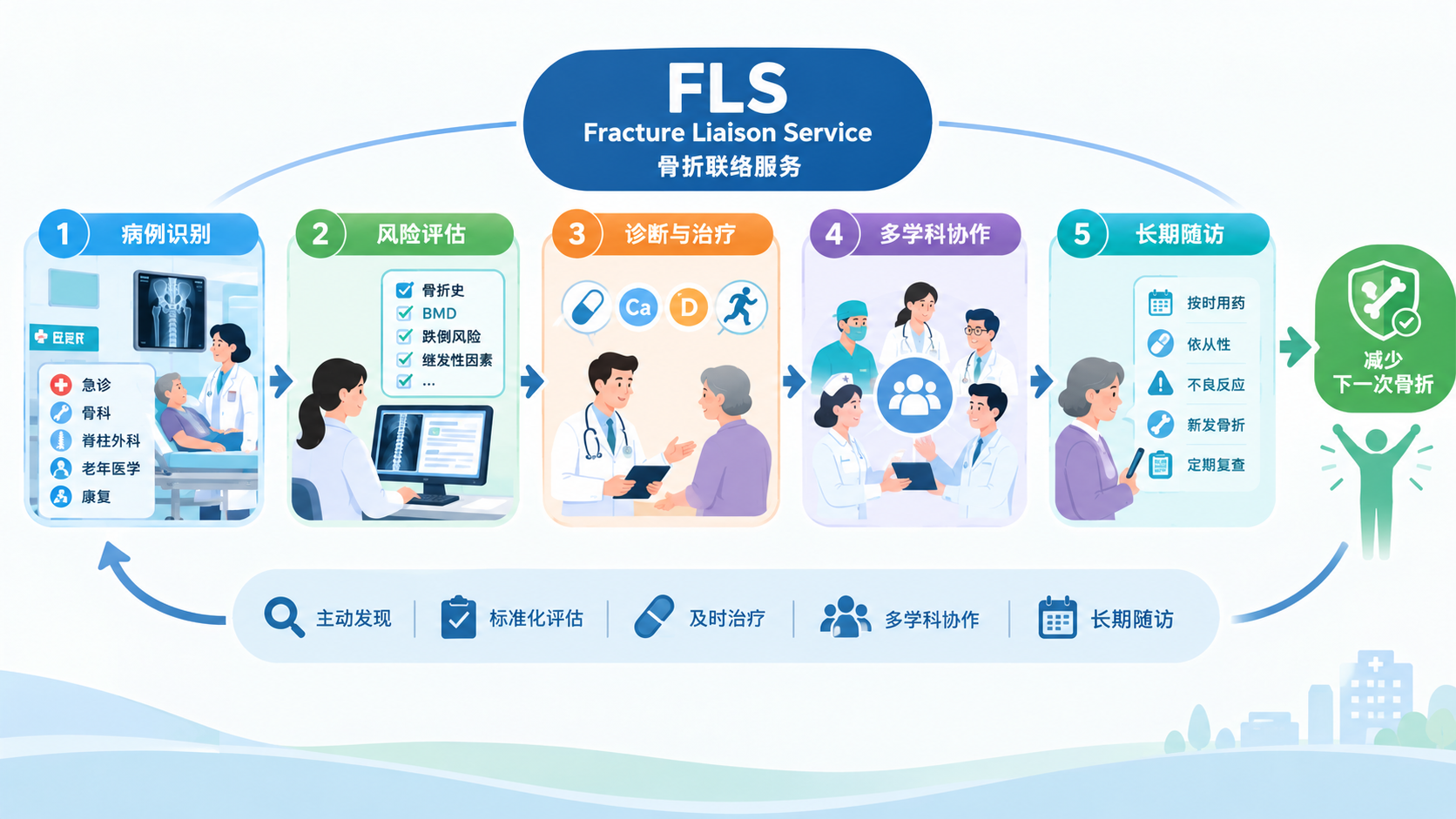
一、FLS的临床定位:从“治疗骨折”转向“预防下一次骨折”
骨折联络服务(Fracture Liaison Service,FLS)是一种以脆性骨折患者为入口、以继发性骨折预防为核心的多学科协同管理模式。其基本理念并不是单纯增加一次骨密度(BMD)检查或开具抗骨质疏松药物,而是将“发生一次脆性骨折”视为未来骨折风险显著升高的临床预警信号,并建立从病例识别、骨折风险评估、病因筛查、治疗决策到长期随访的连续管理路径。2024年的系统综述与Meta分析显示,FLS可降低50岁及以上人群的继发性脆性骨折风险,尤其在随访≥2年的研究中,风险降低证据达到中等确定性。
Fracture Liaison Service (FLS) is a coordinated, multidisciplinary model of care designed to prevent subsequent fractures after a fragility fracture. Its purpose goes beyond ordering a bone mineral density (BMD) test or prescribing an osteoporosis medication. A fragility fracture should be regarded as a clinical warning signal indicating substantially increased future fracture risk. An effective FLS therefore creates a continuous pathway encompassing case identification, fracture-risk assessment, evaluation of secondary causes, treatment initiation, and long-term follow-up. A 2024 systematic review and meta-analysis found that FLS was associated with a lower risk of subsequent fragility fractures, with moderate-certainty evidence supporting benefit at two years or longer.
二、病例识别是FLS成功的第一环节
FLS建设首先要解决的问题是“谁应该进入FLS”。理想模式不是等待患者主动到骨质疏松门诊,而是在急诊、创伤骨科、脊柱外科、老年医学及康复等临床场景中主动识别符合条件的患者。重点人群通常包括50岁以上发生低能量骨折者,尤其是髋部、椎体、桡骨远端及肱骨近端骨折患者。医院应建立自动化或半自动化病例捕获机制,例如利用影像、诊断编码、手术记录和出院诊断进行筛查,并由FLS协调人员进行人工确认。2024年的FLS框架研究强调,病例发现、转诊、评估、治疗和随访之间的流程衔接,是FLS实施的重要组成部分。
Case identification is the first critical component of an effective FLS. Rather than relying on patients to seek osteoporosis care independently, hospitals should actively identify eligible patients in emergency departments, trauma and orthopedic units, spine services, geriatric medicine, and rehabilitation settings. Priority populations generally include adults aged 50 years or older who sustain low-trauma fractures, particularly fractures of the hip, vertebrae, distal radius, and proximal humerus. Hospitals should establish automated or semi-automated case-finding mechanisms using imaging records, diagnostic codes, operative reports, and discharge diagnoses, followed by confirmation by an FLS coordinator. Evidence from recent framework research emphasizes that integration of case finding, referral, assessment, treatment, and follow-up is fundamental to successful implementation.
三、评估不能局限于BMD
进入FLS后,应进行标准化的综合骨折风险评估。除DXA测量腰椎和髋部BMD外,还应系统记录既往骨折史、骨折部位与近期性、年龄、跌倒风险、糖皮质激素使用、吸烟和饮酒、体重、家族史以及可能导致继发性骨质疏松的疾病和药物。必要时进行椎体影像学评估,以识别临床未诊断的椎体骨折。FRAX等工具可用于辅助评估10年主要骨质疏松性骨折及髋部骨折风险,但不能替代临床判断。2024年ASBMR/BHOF立场声明进一步强调,应根据既往骨折的时间、部位、数量和严重程度以及BMD等因素制定个体化治疗目标。
Assessment within an FLS should therefore be comprehensive rather than BMD-centered. In addition to DXA measurement of the lumbar spine and hip, clinicians should systematically evaluate previous fractures, fracture site and recency, age, fall risk, glucocorticoid exposure, smoking, alcohol intake, body weight, family history, and potential secondary causes of osteoporosis. Vertebral imaging should be considered when clinically appropriate to detect previously unrecognized vertebral fractures. FRAX may support estimation of 10-year fracture probability, but it should not replace clinical judgment. The 2024 ASBMR/BHOF position statement recommends individualized treatment goals based on fracture recency, site, number and severity, together with BMD and other major clinical risk factors.
四、治疗决策应从“是否治疗”转向“如何达到风险目标”
FLS的核心价值最终体现在治疗落实,而不是评估本身。对于明确存在骨质疏松或高骨折风险的患者,应依据患者年龄、骨折类型、既往骨折史、BMD、肾功能、胃肠道情况以及其他临床因素选择抗骨质疏松治疗。部分极高风险患者可能需要优先考虑具有较强骨形成作用的治疗策略,并进一步进行序贯抗骨吸收治疗。与此同时,应同步处理钙和维生素D摄入不足、跌倒风险、肌力与平衡能力下降等问题。FLS最好由骨科、内分泌/代谢骨病、老年医学、康复、护理、药学及基层医疗共同参与,使治疗建议能够真正转化为处方、用药和随访行为。
The ultimate value of an FLS lies in treatment implementation rather than assessment alone. Patients with osteoporosis or high fracture risk should receive individualized pharmacological treatment based on age, fracture characteristics, previous fracture history, BMD, renal function, gastrointestinal considerations, and other clinical factors. In patients at very high fracture risk, an anabolic-first strategy followed by antiresorptive therapy may be appropriate when clinically indicated. Management should also address inadequate calcium or vitamin D intake, fall prevention, muscle strength, and balance. Ideally, FLS care should integrate orthopedics, endocrinology or metabolic bone disease, geriatrics, rehabilitation, nursing, pharmacy, and primary care so that treatment recommendations are translated into actual prescriptions, medication use, and follow-up.
五、随访是区分“真正FLS”和“转诊项目”的关键
仅仅完成一次DXA或开出一次处方,并不能构成完整的FLS。患者出院后的治疗启动、药物依从性、不良反应、治疗持续性、跌倒事件、新发骨折以及必要时的BMD变化,都应进入随访体系。对于注射或静脉治疗,还应建立明确的下一次给药提醒机制;对于口服药物,则需要评估依从性及停药原因。FLS还应建立质量指标,例如病例识别率、骨密度检查完成率、治疗启动率、治疗持续率、随访完成率以及继发性骨折发生率。2024年研究显示,部分FLS模式不仅具有临床价值,也可能具有较高的卫生经济学价值;一项系统综述报告的平均投资回报率约为10.49。
Follow-up is what distinguishes a true FLS from a simple referral program. Completing a DXA scan or issuing a single prescription does not constitute longitudinal fracture prevention. Treatment initiation after discharge, medication adherence, adverse events, persistence, falls, new fractures, and, when appropriate, changes in BMD should be incorporated into a structured follow-up pathway. For injectable or intravenous therapies, systems should ensure timely subsequent dosing; for oral therapies, adherence and reasons for discontinuation should be actively assessed. FLS programs should also monitor quality indicators such as case-finding rate, DXA completion, treatment initiation, treatment persistence, follow-up completion, and subsequent fracture incidence. Importantly, recent evidence suggests that FLS may provide substantial economic value in addition to clinical benefit, with one 2024 systematic review reporting a mean return on investment of approximately 10.49-fold.
六、结语:FLS本质上是一个“系统”,而不是一个门诊
高质量FLS的建设重点可以概括为:主动发现患者、标准化评估、及时治疗、多学科协作和长期随访。其真正目标不是提高某一项检查率,而是缩短“骨折发生—风险识别—治疗启动”之间的时间,并最终减少下一次骨折。现有研究总体支持FLS能够降低继发性骨折风险,但不同中心的人员配置、病例来源、干预强度和随访模式存在明显差异,因此医院在实施FLS时,应结合自身患者结构和资源条件建立可执行的本地化路径,并通过持续质量改进不断优化。2024—2025年的研究进一步支持FLS在继发骨折预防中的临床价值,但其长期效果仍需要更多高质量、标准化研究加以验证。
In summary, the essential elements of a high-quality FLS can be condensed into five principles: proactive case finding, standardized assessment, timely treatment, multidisciplinary coordination, and long-term follow-up. The objective is not simply to increase the rate of a particular investigation, but to shorten the interval between fracture, risk recognition, and treatment initiation—and ultimately prevent the next fracture. Current evidence generally supports FLS as an effective strategy for secondary fracture prevention, although substantial variation exists in staffing, case-finding mechanisms, intervention intensity, and follow-up models. Hospitals should therefore develop locally feasible pathways and continuously improve them using measurable quality indicators. Recent evidence from 2024–2025 further supports the clinical value of FLS, while highlighting the need for more rigorous and standardized long-term evaluations.
参考文献 References
- Danazumi MS, Lightbody N, Dermody G. Effectiveness of fracture liaison service in reducing the risk of secondary fragility fractures in adults aged 50 and older: a systematic review and meta-analysis. Osteoporosis International. 2024;35(7):1133-1151. doi:10.1007/s00198-024-07052-1.
- Le HV, Van BW, Shahzad H, et al. Fracture liaison service—a multidisciplinary approach to osteoporosis management. Osteoporosis International. 2024;35(10):1719-1727. doi:10.1007/s00198-024-07181-7.
- Xu L, Zhao T, Perry L, et al. Return on investment of fracture liaison services: a systematic review and analysis. Osteoporosis International. 2024;35(6):951-969. doi:10.1007/s00198-024-07027-2.
- Li N, et al. The impact of fracture liaison services on subsequent fractures and mortality: a systematic literature review and meta-analysis. Osteoporosis International. 2021.
- ASBMR/BHOF Task Force. Goal-directed osteoporosis treatment: ASBMR/BHOF task force position statement 2024.
- González-Quevedo D, Rubia-Ortega C, Sánchez-Delgado A, et al. Secondary osteoporosis prevention: three-year outcomes from a Fracture Liaison Service in elderly hip fracture patients. Aging Clinical and Experimental Research. 2024;36:103. doi:10.1007/s40520-024-02761-3.
- The effectiveness of fracture liaison services in patients with hip fractures: A systematic review and meta-analysis of randomized controlled trials. 2023.