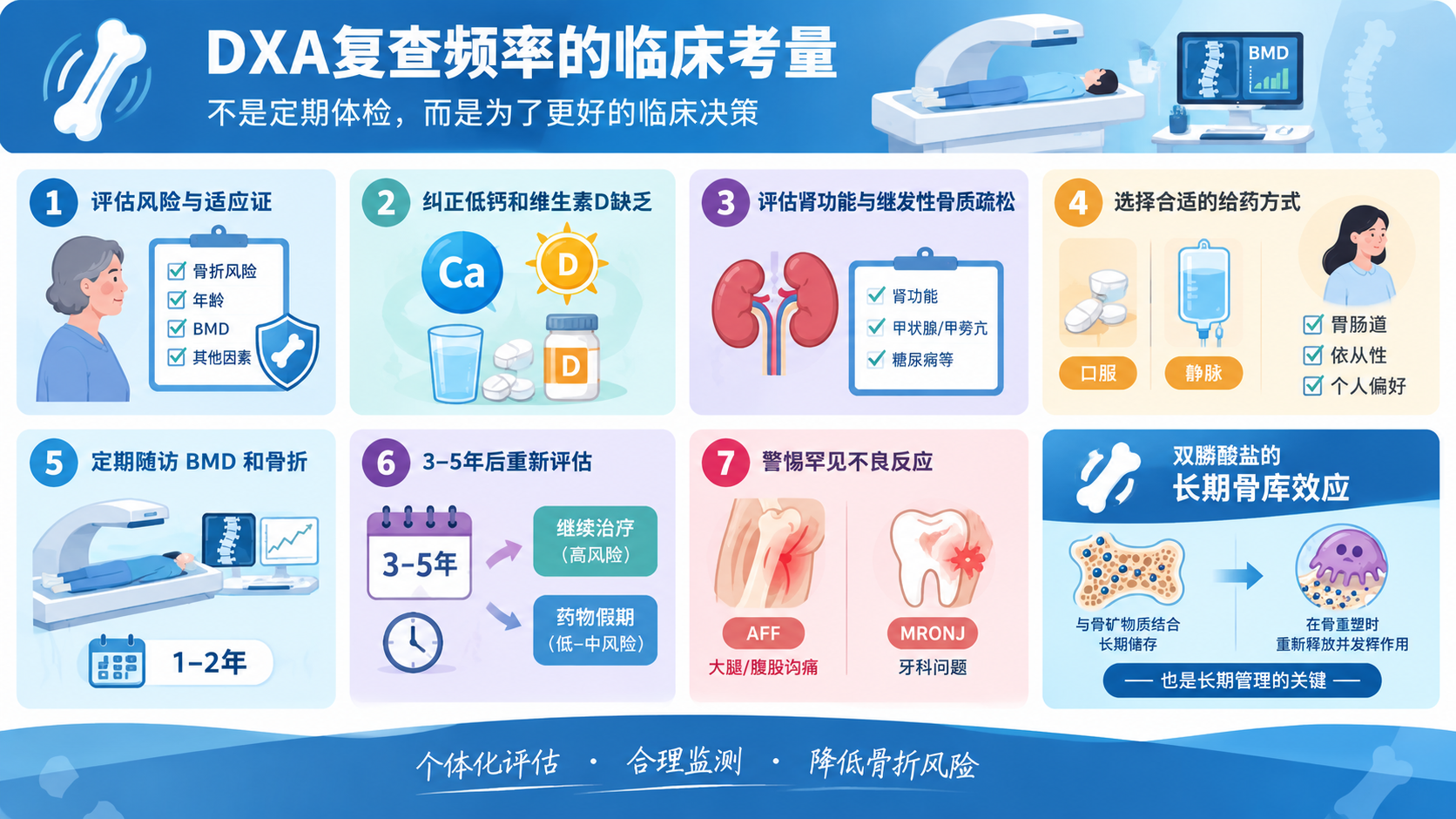
DXA复查不是“定期体检”,而是临床决策工具|DXA Follow-up Is a Clinical Decision Tool, Not Simply Routine Screening
双能X线吸收法(dual-energy X-ray absorptiometry,DXA)是诊断骨质疏松、评估骨折风险和监测治疗反应的重要工具,但“多久复查一次”并不存在适用于所有患者的统一答案。国际骨密度学会(ISCD)2023年官方立场明确指出,复查DXA应具有预先定义的临床目的,并且检查结果应有可能改变患者管理;复查间隔应根据年龄、基线BMD、治疗方案和骨丢失相关危险因素进行个体化。
Dual-energy X-ray absorptiometry (DXA) is an important tool for diagnosing osteoporosis, assessing fracture risk, and monitoring treatment response. However, there is no single interval appropriate for every patient. The 2023 International Society for Clinical Densitometry (ISCD) Official Positions emphasize that follow-up DXA should have a predefined clinical objective and should be performed when the result is likely to influence management. The interval should be individualized according to age, baseline BMD, treatment type, and factors associated with bone loss.
1. 未接受治疗者:正常BMD不需要频繁复查|Untreated Individuals: Normal BMD Does Not Require Frequent Rescanning
对于没有接受抗骨质疏松治疗、基线骨折风险较低且BMD正常的人群,重复DXA的必要性通常较低。经典的Gourlay等研究显示,在≥67岁女性中,基线BMD正常者从正常状态进展至骨质疏松的速度相对缓慢,估算约需16.8年才有10%的人进入骨质疏松范围;轻度骨量减少者约17.3年,而中度骨量减少者约4.7年,重度骨量减少者则约1.1年。
For untreated individuals with normal BMD and relatively low fracture risk,
frequent repeat DXA is generally unnecessary. In the landmark study by Gourlay
et al., among women aged 67 years or older, the estimated interval required for
10% of participants to transition to osteoporosis was approximately 16.8 years
for those with normal BMD, 17.3 years for mild osteopenia, 4.7 years for
moderate osteopenia, and only 1.1 years for advanced osteopenia.
2. 不能简单地说“骨量减少每两年复查一次” |“Repeat Every Two Years for Osteopenia” Is an Oversimplification
骨量减少(osteopenia)患者的复查间隔尤其容易被过度标准化。T-score接近−1.0的患者与接近−2.5的患者,其未来进展速度和骨折风险显然不同。因此,更合理的策略是根据T-score严重程度、年龄、既往脆性骨折、FRAX结果以及是否存在持续性骨丢失因素进行分层。2025年的亚洲老年人研究同样提示,低风险人群不需要常规高频复查,而中重度骨量减少以及高龄人群更值得密切监测。
The follow-up interval for osteopenia is particularly prone to
over-standardization. A patient with a T-score close to −1.0 has a very
different progression risk from one with a T-score approaching −2.5. A more
rational strategy is to integrate the degree of osteopenia with age, previous
fragility fractures, FRAX probability, and ongoing factors associated with bone
loss. A recent study in older Asian adults similarly suggested that routine
frequent retesting is unnecessary in low-risk individuals, whereas closer
monitoring is more appropriate in older adults with moderate-to-severe
osteopenia.
3. 开始药物治疗后:1–2年是常用的评估窗口|After Starting Pharmacotherapy: 1–2 Years Is a Practical Assessment
Window
对于已经开始抗骨质疏松药物治疗的患者,DXA复查的目的主要是判断BMD是否朝预期方向变化,并结合新发骨折、依从性和其他临床危险因素评价治疗反应。2026年发表的《新加坡骨质疏松管理共识》建议,药物治疗开始后通常在1–2年进行随访BMD检测,并根据年龄、基线BMD、药物种类和骨折风险进行调整;对于糖皮质激素、芳香化酶抑制剂等导致快速骨丢失的情况,可以考虑更短间隔。
After initiation of osteoporosis pharmacotherapy, the principal purpose of repeat DXA is to determine whether BMD is changing in the expected direction and to integrate this information with incident fractures, adherence, and other clinical risk factors. The 2026 Singapore consensus recommends follow-up BMD generally at 1–2 years after treatment initiation, with the interval individualized according to age, baseline BMD, treatment type, and fracture risk. Shorter intervals may be appropriate when rapid bone loss is expected, such as during glucocorticoid or aromatase-inhibitor therapy.
4. 为什么不能一年一次?——要考虑LSC| Why Not Scan Every Year? Consider the Least Significant Change
DXA的一个重要概念是最小显著变化(least significant change,LSC)。BMD即使出现1%–2%的变化,也可能只是检测精密度误差,而不是真实骨量变化。只有超过检测中心自身建立的LSC,才能较有把握地认为BMD发生了具有统计学意义的改变。ISCD要求DXA机构建立自身的精密度误差和LSC,因此复查间隔过短不仅增加检查成本,也可能产生大量临床上无法解释的“假变化”。
A critical concept in serial DXA interpretation is the least significant change (LSC). A 1%–2% difference in BMD may simply reflect measurement precision rather than true skeletal change. A change should be regarded as statistically significant only when it exceeds the LSC established by the individual DXA facility. ISCD therefore requires facilities to establish their own precision error and LSC. Excessively short testing intervals can increase cost while generating changes that are too small to interpret reliably.
5. “一年后BMD下降”不等于治疗失败|“BMD Decreased at One Year” Does Not Automatically Mean Treatment Failure
这是临床非常常见的误区。治疗第一年BMD轻度下降,如果没有超过LSC,通常不能直接判定治疗失败。更早期的随机试验分析已经发现,即使部分接受阿仑膦酸治疗的患者第一年出现明显BMD下降,继续治疗后第二年仍可能出现BMD回升,提示“回归均值”(regression to the mean)等统计现象。因此,治疗决策不应仅根据一次早期DXA变化作出。
This is a common clinical misconception. A modest BMD decline during the first year of treatment should not automatically be interpreted as treatment failure, particularly when the change does not exceed the facility-specific LSC. Earlier randomized trial analyses demonstrated that some women receiving alendronate who experienced substantial BMD loss during the first year subsequently gained BMD during the second year, illustrating regression to the mean. Treatment should therefore not be changed solely because of an isolated early DXA decline.
6. 发生新骨折时,不要等待下一次DXA|Do Not Wait for the Next DXA After an Incident Fracture
如果患者在治疗期间发生新的脆性骨折,临床上不应机械等待原定DXA复查时间。ISCD明确指出,发生骨折或出现新的危险因素时可以进行随访BMD,但不应为了等待DXA而延迟二级骨折预防治疗。这意味着“临床事件”在治疗监测中的优先级高于“下一张DXA报告”。
If a patient sustains a new fragility fracture during treatment, clinicians should not simply wait until the originally scheduled DXA date. ISCD states that follow-up BMD may be appropriate after an incident fracture or development of new risk factors, but DXA should not delay secondary fracture prevention. In other words, a clinically important fracture event takes priority over waiting for the next scheduled BMD measurement.
7. 双膦酸盐“药物假期”前后尤其需要DXA|DXA Is Particularly Relevant Before and During a Bisphosphonate Holiday
双膦酸盐具有较长的骨组织滞留时间,因此部分低至中等风险患者经过一定疗程后可以考虑暂时停药。DXA在这种情况下具有特殊价值:停药前可用于确认当前BMD及风险状态,药物假期期间则可帮助发现髋部或其他关键部位BMD下降。如果发生新的脆性骨折或BMD出现具有临床意义的下降,应重新评估是否恢复抗骨质疏松治疗。ISCD明确建议,在双膦酸盐暂时停药前以及停药期间进行适当的重复BMD评估。
Because bisphosphonates have prolonged skeletal retention, selected patients at low-to-moderate fracture risk may be considered for a temporary treatment interruption. DXA has particular value in this setting: it can document BMD and risk status before a holiday and help identify clinically meaningful bone loss during the interruption. A new fragility fracture or significant BMD decline should prompt reassessment of whether antiosteoporosis treatment should be restarted. ISCD specifically recommends repeat BMD assessment before and during a planned bisphosphonate interruption.
8. 高危快速骨丢失患者:复查可以更密集|High-Risk Patients With Rapid Bone Loss May Need Shorter Intervals
对于预计骨量快速下降的人群,常规间隔可能不足。例如长期糖皮质激素治疗、芳香化酶抑制剂治疗、雄激素剥夺治疗、严重炎症性疾病、吸收不良、减重手术、长期制动以及部分绝经相关情况,都可能需要缩短DXA复查间隔。ISCD特别强调,这类患者应根据预期骨量变化速度以及检查结果是否会改变治疗决策来确定时间,而不是机械执行固定周期。
Patients expected to experience rapid bone loss may require shorter DXA intervals. Examples include prolonged glucocorticoid therapy, aromatase inhibitors, androgen-deprivation therapy, severe systemic inflammatory disease, malabsorption, bariatric surgery, prolonged immobilization, and selected cases of surgical menopause. ISCD emphasizes that the interval should reflect the expected rate of BMD change and whether the result is likely to alter management, rather than following a rigid schedule.
9. 复查一定要尽量使用同一台DXA设备|Use the Same DXA System Whenever Possible
纵向BMD比较不仅是“患者前后两张报告的数字相减”。如果患者更换了DXA设备、厂商或型号,在没有完成适当交叉校准的情况下,不能直接把两次BMD进行定量比较。ISCD建议尽可能使用同一台设备,并要求报告明确说明比较所依据的基线检查、ROI和LSC。2026年新加坡共识也强调,同一设备随访对于长期管理具有重要价值。
Longitudinal BMD assessment is more than simply subtracting the values from two reports. When the patient changes DXA systems, manufacturers, or models, quantitative comparison is not valid unless appropriate cross-calibration has been performed. ISCD recommends using the same DXA system whenever possible and documenting the baseline study, ROI, and facility-specific LSC. The 2026 Singapore consensus similarly emphasizes continuity of DXA equipment for longitudinal monitoring.
10. 临床常见问题|Common Clinical Questions
问题一:所有骨质疏松患者都应该每年DXA吗? 不应该。高危或快速骨丢失患者可能需要约1年复查,但稳定治疗患者可采用更长间隔;最终取决于检查结果是否会改变治疗。
问题二:DXA正常,是不是以后就不用复查? 也不是。年龄增长、新发脆性骨折、糖皮质激素等新危险因素出现,都可能重新产生检查指征。
问题三:FRAX每年都要重新计算吗? FRAX适用于风险评估,但不应作为抗骨质疏松药物疗效监测指标。
问题四:BMD增加就代表治疗成功吗? 不完全是。还应关注是否出现新发骨折、BMD变化是否超过LSC以及患者总体骨折风险是否下降。
Question 1: Should every patient with
osteoporosis have annual DXA? No. Patients at high
risk or with rapid bone loss may warrant approximately annual assessment,
whereas stable patients may require longer intervals; the key question is
whether the result will change management.
Question 2: If DXA is normal, is repeat testing unnecessary forever? No.
Increasing age, a new fragility fracture, or new exposure to glucocorticoids or
other bone-harming factors may create a new indication.
Question 3: Should FRAX be recalculated every year? FRAX is useful for
risk assessment but should not be used as a treatment-response monitoring
endpoint.
Question 4: Does increasing BMD automatically mean treatment success?
Not necessarily. Incident fractures, whether BMD change exceeds LSC, and
overall fracture risk must also be considered.
一个实用的复查框架|A Practical Follow-up Framework
临床上可以采用一个简单框架:**低风险、未治疗、BMD正常或轻度骨量减少——延长复查间隔;中高风险或开始药物治疗——通常1–2年复查;快速骨丢失风险——考虑约1年甚至更短;发生新骨折或新的重大危险因素——提前重新评估;双膦酸盐药物假期——停药前及停药期间根据风险进行监测。**无论选择何种时间间隔,都应保证检测质量、使用同一设备,并以机构自身LSC解释变化。
A practical framework is: low-risk untreated individuals with normal BMD or mild osteopenia—use longer intervals; moderate-to-high-risk patients or those starting pharmacotherapy—typically reassess within 1–2 years; patients with rapid bone loss—consider approximately annual or shorter assessment; new fracture or major new risk factor—reassess earlier; bisphosphonate holiday—monitor before and during treatment interruption according to risk. Regardless of the interval, measurement quality, use of the same DXA system, and facility-specific LSC are essential for meaningful interpretation.
结语|Conclusion
DXA复查频率的核心原则不是“多久做一次”,而是**“什么时候检查能够产生改变临床管理的有效信息”**。对于医学专业人员,合理的DXA随访应当与基线BMD、FRAX/临床骨折风险、治疗方案、依从性、新发骨折、药物假期以及骨丢失速度结合起来。换言之,DXA应该服务于治疗决策,而不是让治疗围绕DXA检查周期展开。
The central principle of DXA follow-up is not simply “How often should it be performed?” but rather “When will the result provide information capable of changing clinical management?” Appropriate DXA monitoring should integrate baseline BMD, FRAX and clinical fracture risk, treatment strategy, adherence, incident fractures, bisphosphonate holidays, and the expected rate of bone loss. DXA should therefore serve clinical decision-making—not become the determinant of the clinical schedule.
参考文献|References
- International Society for Clinical Densitometry. 2023 ISCD Official Positions—Adult. ISCD; 2023.
- Gani L, Chionh SB, Allameen NA, et al. 2025 Singapore consensus statements on the management of osteoporosis. Ann Acad Med Singap. 2026;55(5):252–268. doi:10.47102/annals-acadmedsg.202658.
- Riemer HJA Slart, Punda M, Ali DS, et al. Updated practice guideline for dual-energy X-ray absorptiometry (DXA). Eur J Nucl Med Mol Imaging. 2025;52(2):539–563. doi:10.1007/s00259-024-06912-6.
- Gani L, Sritara C, Blank R, et al. Follow-up Bone Mineral Density Testing: 2023 Official Positions of the International Society for Clinical Densitometry. J Clin Densitom. 2024;27:101440.
- Gourlay ML, Fine JP, Preisser JS, et al. Bone-density testing interval and transition to osteoporosis in older women. N Engl J Med. 2012;366:225–233. doi:10.1056/NEJMoa1107142.
- Cummings SR, Palermo L, Browner W, et al. Monitoring osteoporosis therapy with bone densitometry: misleading changes and regression to the mean. JAMA. 2000;283:1318–1321.
- US Preventive Services Task Force. Osteoporosis to Prevent Fractures: Screening. Updated recommendation and evidence review.
- Medium-term transition rates to osteoporosis: DXA analysis in older Asians. 2025.