双膦酸盐:骨吸收抑制治疗的经典基石
Bisphosphonates: A Cornerstone of Antiresorptive Therapy
双膦酸盐(bisphosphonates,BPs)是治疗骨质疏松最经典、证据最充分的抗骨吸收药物之一。临床常用药物包括阿仑膦酸钠(alendronate)、利塞膦酸钠(risedronate)、伊班膦酸(ibandronate)和唑来膦酸(zoledronic acid)。对于绝经后女性骨折高风险患者,多项国际指南仍将阿仑膦酸、利塞膦酸和唑来膦酸列为重要的一线治疗选择。需要注意的是,不同药物的骨折终点证据并不完全相同,例如伊班膦酸具有较好的椎体骨折证据,但预防非椎体及髋部骨折的证据相对有限。
Bisphosphonates (BPs) remain among the most established and extensively studied antiresorptive agents for osteoporosis. Commonly used agents include alendronate, risedronate, ibandronate, and zoledronic acid. International guidelines continue to regard alendronate, risedronate, and zoledronic acid as important first-line options for postmenopausal women at high fracture risk. However, fracture-outcome evidence differs among individual agents; for example, ibandronate has strong vertebral-fracture efficacy but comparatively limited evidence for reduction of nonvertebral and hip fractures.
作用机制:精准抑制破骨细胞
Mechanism of Action: Targeting Osteoclast-Mediated Resorption
双膦酸盐的基本结构类似焦磷酸(pyrophosphate),但P–C–P骨架具有较强的化学稳定性,使药物能够与骨矿物质中的羟基磷灰石结合。当骨重塑过程中破骨细胞吸收骨组织时,结合于骨表面的双膦酸盐被摄入破骨细胞,从而发挥抗骨吸收作用。非含氮双膦酸盐可形成具有细胞毒性的ATP类似物;而临床最常用的含氮双膦酸盐则主要抑制甲羟戊酸途径(mevalonate pathway)中的法尼基焦磷酸合酶(farnesyl pyrophosphate synthase,FPPS),阻断蛋白异戊烯化,最终导致破骨细胞功能障碍和凋亡。
Bisphosphonates structurally resemble pyrophosphate, but their stable P–C–P backbone gives them a high affinity for hydroxyapatite in bone. During bone remodeling, bisphosphonates bound to the mineral surface are internalized by active osteoclasts and exert potent antiresorptive effects. Non-nitrogen-containing bisphosphonates generate cytotoxic ATP analogues, whereas the clinically dominant nitrogen-containing bisphosphonates primarily inhibit farnesyl pyrophosphate synthase (FPPS) in the mevalonate pathway. This disrupts protein prenylation, impairs osteoclast function, and ultimately promotes osteoclast dysfunction and apoptosis.
为什么疗效可以持续多年?
Why Do the Effects Persist for Years?
双膦酸盐与骨矿物质结合后可以长期储存在骨组织中,因此具有明显的“骨库效应”(bone retention)。当局部骨重塑再次发生时,药物可以重新释放并被破骨细胞摄取。这种药代动力学特征解释了双膦酸盐停药后仍可持续发挥抗骨吸收作用,也构成部分患者可以实施“bisphosphonate holiday”的理论基础。相比之下,地舒单抗(denosumab)的作用在停药后迅速消退,因此不能简单套用双膦酸盐的停药策略。
Bisphosphonates bind strongly to bone mineral and can remain within the skeleton for prolonged periods, creating a clinically important bone-retention effect. As remodeling occurs, previously deposited drug can be released and taken up by osteoclasts, allowing antiresorptive activity to persist after treatment cessation. This pharmacokinetic property provides the biological rationale for a bisphosphonate holiday in appropriately selected patients. In contrast, the antiresorptive effect of denosumab reverses relatively rapidly after discontinuation, so its treatment-interruption strategy is fundamentally different.
口服与静脉制剂:如何选择?
Oral Versus Intravenous Therapy: How to Choose?
口服阿仑膦酸和利塞膦酸需要严格遵循给药要求:通常晨起空腹以足量清水服用,服药后保持直立,并在规定时间内避免进食及其他药物,以减少食管刺激并保证吸收。对于存在严重胃食管疾病、口服依从性较差、吸收问题或无法遵守服药要求的患者,静脉唑来膦酸可以提供更稳定的给药方式。唑来膦酸通常以5 mg静脉输注,每年一次用于骨质疏松治疗,但给药前必须评估肾功能和钙、维生素D状态。
Oral alendronate and risedronate require careful administration: they are generally taken fasting with plain water, followed by remaining upright and avoiding food and other medications for the recommended period. For patients with significant upper gastrointestinal disease, poor adherence, impaired absorption, or difficulty following oral administration instructions, intravenous zoledronic acid provides an alternative with reliable delivery. Zoledronic acid is commonly administered as a 5-mg intravenous infusion once yearly for osteoporosis, but renal function and calcium/vitamin D status should be assessed before treatment.
用药前评估:不要忽略肾功能和低钙血症
Pretreatment Assessment: Renal Function and Hypocalcemia Matter
开始双膦酸盐治疗前,应确认患者不存在未经纠正的低钙血症,并评估维生素D营养状态、肾功能以及可能导致继发性骨质疏松的疾病。静脉双膦酸盐尤其需要关注肾功能,因为唑来膦酸主要经肾脏清除。对于严重肾功能不全患者,双膦酸盐通常不是理想选择。对于存在明显维生素D缺乏、低钙血症或严重肾功能异常者,应首先纠正相关问题,再决定是否启动治疗。
Before initiating bisphosphonate therapy, clinicians should exclude uncorrected hypocalcemia and evaluate vitamin D status, renal function, and potential secondary causes of osteoporosis. Renal function is particularly important with intravenous bisphosphonates because zoledronic acid is predominantly renally cleared. Bisphosphonates are generally unsuitable for patients with severe renal impairment. Significant vitamin D deficiency, hypocalcemia, or severe renal dysfunction should be addressed before treatment is initiated.
疗程与“药物假期”:并非人人都需要长期连续用药
Treatment Duration and the “Drug Holiday”: Long-Term Therapy Is Not for Everyone
双膦酸盐治疗具有长期效应,因此不宜简单采用“终身连续治疗”的模式。Endocrine Society建议,在接受双膦酸盐治疗约3–5年后重新评估骨折风险;对于仍属于高风险的患者,可以继续治疗,而对于低至中等风险患者,可以考虑暂时停药。静脉唑来膦酸通常在治疗3年左右重新评估。停药期间仍需定期监测临床骨折风险和BMD,若出现新的脆性骨折、BMD明显下降或风险重新升高,应考虑恢复抗骨质疏松治疗。
Because bisphosphonates have persistent skeletal effects, indefinite continuous treatment is not appropriate for every patient. The Endocrine Society recommends reassessing fracture risk after approximately 3–5 years of bisphosphonate therapy. Patients who remain at high risk may continue treatment, whereas those at low-to-moderate risk may be considered for a temporary drug holiday. For intravenous zoledronic acid, reassessment after approximately three years is particularly appropriate. During a holiday, clinical fracture risk and BMD should continue to be monitored, with treatment reconsidered if a new fragility fracture occurs, BMD declines substantially, or overall fracture risk increases.
非典型股骨骨折:低概率但需要主动识别
Atypical Femoral Fracture: Rare but Important to Recognize
非典型股骨骨折(atypical femoral fracture,AFF)是长期双膦酸盐治疗最受关注的罕见不良事件之一。其风险总体较低,但随着治疗时间延长可能增加。临床上如果患者在大腿或腹股沟出现持续性、非创伤性或轻微活动相关疼痛,应警惕不完全性AFF,并考虑进行股骨影像学检查;必要时评估对侧股骨,因为双侧病变并不少见。2026年一项基于英国真实世界数据库的研究显示,连续使用阿仑膦酸或利塞膦酸3–5年后,AFF发生率仍属于低水平,但随着暴露时间增加而有所升高。
Atypical femoral fracture (AFF) is one of the most important rare complications associated with prolonged bisphosphonate exposure. Although the absolute risk remains low, it appears to increase with treatment duration. Persistent atraumatic or low-trauma pain in the thigh or groin should prompt consideration of an incomplete AFF and appropriate femoral imaging. Evaluation of the contralateral femur may also be warranted because bilateral involvement can occur. A large UK real-world study published in 2026 found that AFF incidence remained low after 3–5 years of alendronate or risedronate exposure, although the incidence increased with longer exposure.
颌骨坏死:风险极低,但牙科管理很重要
Osteonecrosis of the Jaw: Very Rare but Clinically Relevant
双膦酸盐相关颌骨坏死(medication-related osteonecrosis of the jaw,MRONJ)在骨质疏松剂量下属于罕见事件,但在侵入性牙科操作、局部感染及肿瘤高剂量静脉双膦酸盐治疗患者中更值得关注。因此,治疗前进行必要的口腔卫生和牙科问题评估具有实际意义。但不应因为极低的MRONJ风险而使明确具有高骨折风险的患者长期延误抗骨质疏松治疗。2026年真实世界研究中,双膦酸盐治疗3–5年后MRONJ发生率仍非常低。
Medication-related osteonecrosis of the jaw (MRONJ) is rare at osteoporosis doses but deserves greater attention in patients undergoing invasive dental procedures, those with active oral infection, and patients receiving high-dose intravenous bisphosphonates for malignancy-related indications. Appropriate dental evaluation and oral hygiene are therefore reasonable components of pretreatment care. However, the very low absolute risk of MRONJ should not lead to prolonged withholding of effective osteoporosis therapy in patients at substantial fracture risk. A 2026 real-world study found that MRONJ remained extremely uncommon after 3–5 years of bisphosphonate exposure.
不能只看BMD:治疗目标是降低骨折风险
Do Not Treat the BMD Alone: The Goal Is Fracture Prevention
双膦酸盐治疗后的疗效评价不能简单等同于“BMD有没有增加”。真正的治疗目标是降低脆性骨折风险。2024年ASBMR/BHOF提出的“goal-directed”治疗理念强调,应综合既往骨折部位、数量和时间、椎体影像、髋部和腰椎BMD以及其他危险因素确定治疗目标。对于近期发生髋部、椎体或骨盆骨折等极高风险患者,单纯使用传统抗骨吸收药物并不一定是最佳策略,应考虑是否需要更快速、强效的骨形成促进治疗及后续序贯抗骨吸收治疗。
Treatment response should not be judged simply by whether BMD increases. The ultimate objective is fracture prevention. The 2024 ASBMR/BHOF goal-directed treatment statement emphasizes that therapeutic targets should incorporate the site, number, and recency of previous fractures, vertebral imaging, hip and lumbar-spine BMD, and other major risk factors. In patients at very high or imminent fracture risk—particularly those with recent hip, vertebral, or pelvic fractures—antiresorptive monotherapy may not always represent the optimal initial strategy; anabolic therapy followed by antiresorptive treatment may be more appropriate for selected patients.
临床应用的“七个要点”
Seven Practical Take-Home Points
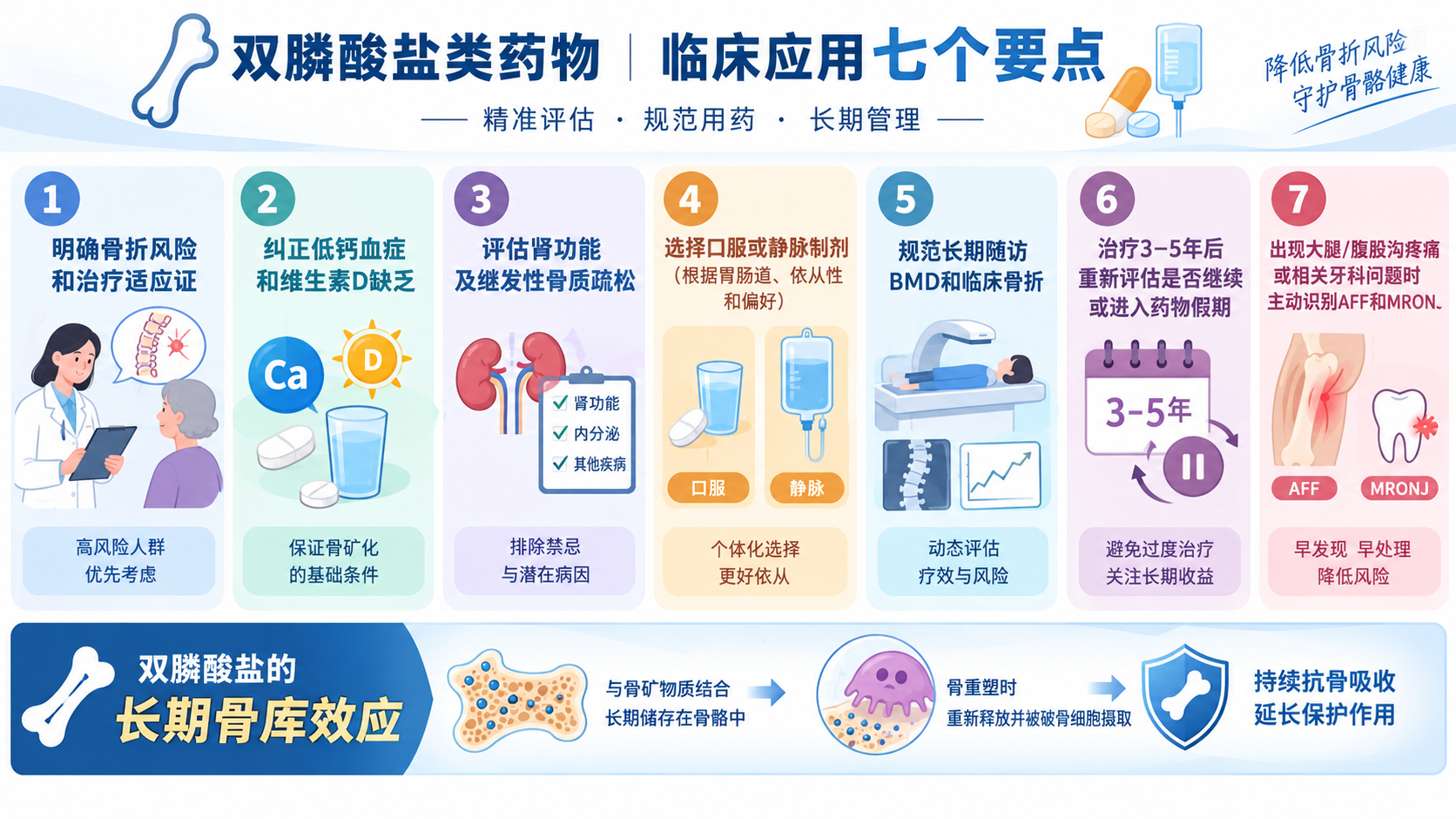
临床应用双膦酸盐可以概括为七点:**①明确骨折风险和治疗适应证;②治疗前纠正低钙血症和维生素D缺乏;③评估肾功能及继发性骨质疏松;④根据患者胃肠道情况、依从性和偏好选择口服或静脉制剂;⑤规范长期随访BMD和临床骨折;⑥治疗3–5年后重新评估是否继续或进入药物假期;⑦出现大腿/腹股沟疼痛或相关牙科问题时主动识别AFF和MRONJ。需要特别强调:双膦酸盐的“长期骨库效应”是其优势,也是长期管理必须考虑的药理学特征。
Seven practical principles summarize bisphosphonate use: (1) establish fracture risk and treatment indication; (2) correct hypocalcemia and vitamin D deficiency; (3) assess renal function and secondary osteoporosis; (4) select oral or intravenous therapy according to gastrointestinal tolerance, adherence, and patient preference; (5) monitor BMD and clinical fractures longitudinally; (6) reassess the need for continued therapy or a drug holiday after approximately 3–5 years; and (7) actively evaluate persistent thigh/groin pain and relevant dental problems for AFF and MRONJ. The prolonged skeletal retention of bisphosphonates is both a major therapeutic advantage and a key consideration in long-term management.
结语|Conclusion
双膦酸盐并不是简单的“降骨吸收药”,其临床价值来自明确的分子靶点、长期骨组织滞留以及大量随机对照试验和真实世界证据。现代骨质疏松管理的重点已经从“是否使用双膦酸盐”逐渐转向“谁应该使用、使用多久、何时停药、何时重新启动,以及高危患者是否需要更强效的序贯治疗”。因此,合理应用双膦酸盐应当建立在个体化骨折风险分层、DXA动态监测和长期治疗策略之上。
Bisphosphonates should not be viewed simply as “bone-resorption suppressors.” Their clinical value derives from well-characterized molecular targets, prolonged skeletal retention, and extensive evidence from randomized trials and real-world studies. Contemporary osteoporosis management is increasingly moving beyond the question of whether to prescribe a bisphosphonate toward who should receive it, how long it should be continued, when a holiday is appropriate, when treatment should be restarted, and when patients at very high risk may require more potent sequential strategies. Rational bisphosphonate therapy therefore requires individualized fracture-risk stratification, longitudinal DXA assessment, and a long-term treatment plan.
参考文献|References
- Eastell R, Rosen CJ, Black DM, et al. Pharmacological management of osteoporosis in postmenopausal women: An Endocrine Society clinical practice guideline. J Clin Endocrinol Metab. 2019;104:1595–1622. Updated recommendations.
- Anovadiya AP, et al. Goal-directed osteoporosis treatment: ASBMR/BHOF task force position statement 2024. J Bone Miner Res. 2024.
- Russell RGG. Bisphosphonates: the first 40 years. Bone. 2011;49:2–19.
- Rogers MJ, Crockett JC, Coxon FP, Mönkkönen J. Biochemical and molecular mechanisms of action of bisphosphonates. Bone. 2011;49:34–41.
- Fleisch H. Bisphosphonates: mechanisms of action. Endocr Rev. 1998;19:80–100.
- Papapoulos SE. Bisphosphonates: how do they work? Best Pract Res Clin Endocrinol Metab. 2008;22:831–847.
- Black DM, Schwartz AV, Ensrud KE, et al. Effects of continuing or stopping alendronate after 5 years of treatment: the FLEX trial. JAMA. 2006;296:2927–2938.
- Black DM, Reid IR, Boonen S, et al. The effect of 3 versus 6 years of zoledronic acid treatment of osteoporosis: HORIZON-PFT extension. J Bone Miner Res. 2012;27:243–254.
- Adler RA, El-Hajj Fuleihan G, Bauer DC, et al. Managing osteoporosis in patients on long-term bisphosphonate treatment: ASBMR task force report. J Bone Miner Res. 2016;31:16–35.
- 2026 real-world cohort study of fragility fracture, atypical femoral fracture, and osteonecrosis of the jaw after 3 and 5 years of bisphosphonate prescription. BMJ. 2026.
- Systematic review of health outcomes and adverse events associated with extended oral bisphosphonate therapy. Journal of Clinical Endocrinology & Metabolism. 2026.