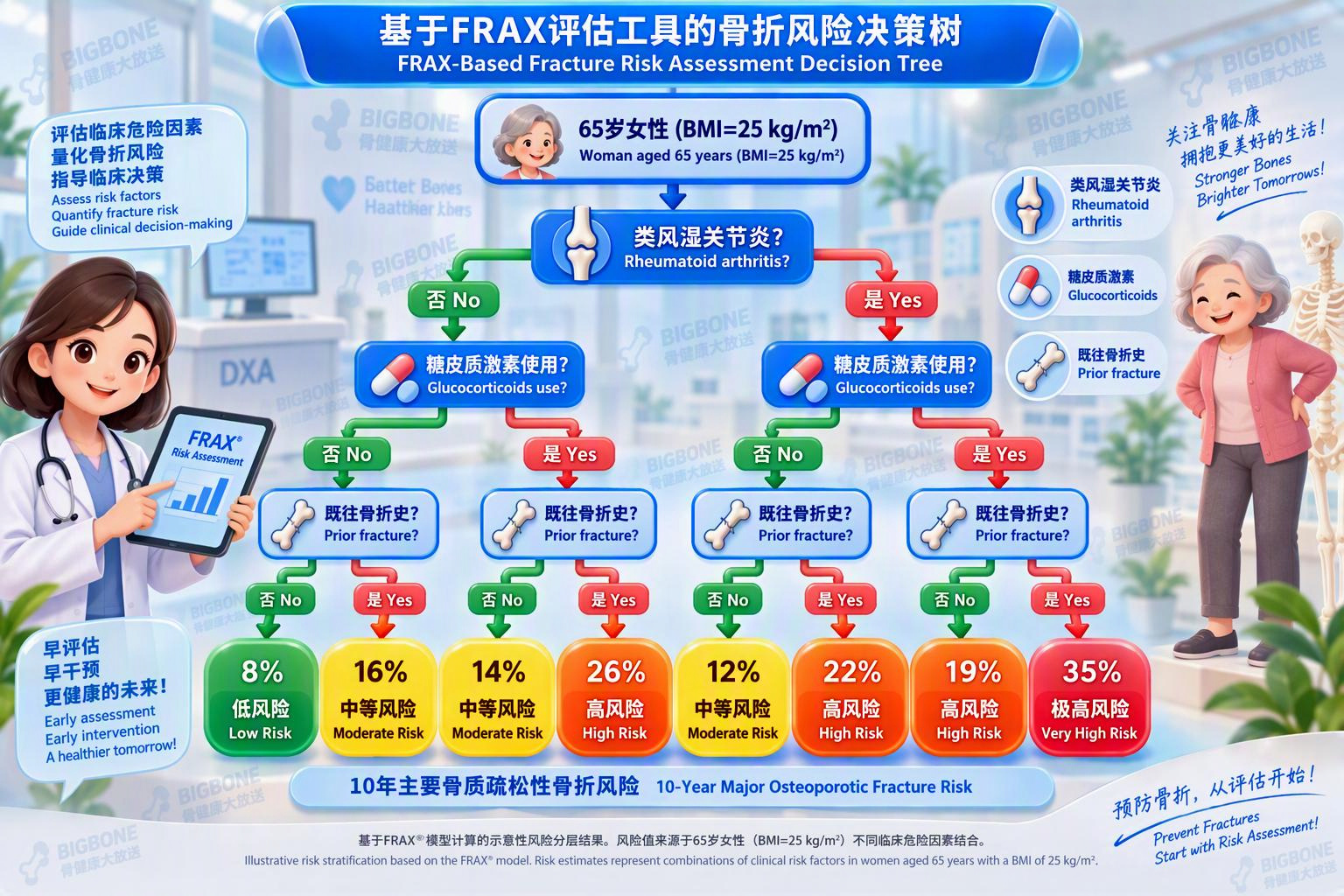
从骨密度诊断走向绝对骨折风险|From BMD Diagnosis to Absolute Fracture Risk
骨密度(BMD)是骨质疏松诊断的基础,但单纯BMD并不能完整描述患者未来发生骨折的概率。FRAX(Fracture Risk Assessment Tool)通过整合年龄、性别、体重指数、既往骨折、父母髋部骨折、吸烟、糖皮质激素使用、类风湿关节炎、继发性骨质疏松、过量饮酒以及股骨颈BMD等因素,计算未来10年髋部骨折和主要骨质疏松性骨折(major osteoporotic fracture,MOF)的概率。目前FRAX仍是全球临床应用最广泛、外部验证最多的骨折风险预测工具之一。
Bone mineral density (BMD) remains fundamental for the diagnosis of osteoporosis, but BMD alone does not fully capture an individual's absolute probability of future fracture. The FRAX® tool integrates age, sex, body mass index, previous fracture, parental hip fracture, smoking, glucocorticoid exposure, rheumatoid arthritis, secondary osteoporosis, alcohol intake, and femoral-neck BMD to estimate the 10-year probability of hip fracture and major osteoporotic fracture (MOF). FRAX remains one of the most widely used and extensively externally validated fracture prediction tools worldwide.
1. FRAX到底计算什么?|What Does FRAX Actually Calculate?
FRAX输出的是两个核心指标:10年髋部骨折概率(10-year hip fracture probability)和10年主要骨质疏松性骨折概率。后者包括临床椎体、前臂、髋部和肩部骨折。需要强调,FRAX计算的是“概率”,而不是患者一定会发生骨折的预测。因此,FRAX结果应理解为群体模型基础上的个体化风险估计,而不是一个绝对的临床诊断标签。
FRAX produces two principal outputs: the 10-year probability of hip fracture and the 10-year probability of a major osteoporotic fracture. The latter includes clinical vertebral, forearm, hip, and humeral fractures. Importantly, FRAX provides a probability rather than a deterministic prediction. Its result should therefore be interpreted as an individualized estimate derived from population-based fracture models rather than as a definitive clinical diagnosis.
2. 正确填写FRAX:首先选择正确国家模型|Correct Data Entry: Select the Appropriate Country Model
FRAX最容易被忽视的问题之一,是国家/地区模型的选择。FRAX并不是一个全球统一的单一算法,而是基于不同国家或地区的骨折和死亡流行病学数据建立模型。因此,使用FRAX时应选择与患者实际人群最匹配的国家模型。当前FRAXplus平台已经覆盖大量国家和地区,并持续更新模型。例如新加坡临床实践中可以选择Singapore模型,而不是直接使用默认的英国模型。
One of the most frequently overlooked aspects of FRAX is selection of the appropriate country-specific model. FRAX is not a single universal algorithm; its models incorporate country- or region-specific fracture and mortality epidemiology. Clinicians should therefore select the model that best represents the patient's population. The current FRAXplus platform provides a large number of country-specific models and continues to expand and update them. For example, clinicians in Singapore should select the Singapore model rather than simply accepting the default UK model.
3. BMD应该填什么?|Which BMD Value Should Be Entered?
如果获得DXA数据,FRAX推荐输入股骨颈BMD,而不是腰椎BMD或最低T-score。FRAX算法已经将股骨颈BMD与临床危险因素进行了特定方式的整合,因此不能简单地把腰椎T-score替代股骨颈BMD输入。尤其需要注意,临床医生不能因为腰椎BMD明显低于髋部,就自行修改FRAX结果;如果腰椎与股骨颈之间存在明显不一致,应将这种“骨骼部位差异”纳入最终临床判断。
When DXA data are available, FRAX should incorporate femoral-neck BMD, rather than lumbar-spine BMD or the lowest T-score. The FRAX algorithm was specifically developed to integrate femoral-neck BMD with clinical risk factors. Therefore, lumbar-spine T-scores should not simply be substituted into the BMD field. When substantial discordance exists between lumbar-spine and hip BMD, the discrepancy should instead be incorporated into overall clinical judgment.
4. FRAX的几个“盲区”|Important Blind Spots of FRAX
FRAX虽然成熟,但并不涵盖所有影响骨折风险的重要因素。例如FRAX传统模型没有直接区分既往骨折发生的时间,也没有充分量化跌倒次数、骨折数量、糖皮质激素剂量、腰椎与股骨颈BMD差异等因素。对于近期发生骨折、反复跌倒、长期高剂量糖皮质激素使用或存在明显脊柱—髋部BMD不一致的患者,单纯FRAX可能低估真实风险。
Although FRAX is robust, it does not capture every clinically important determinant of fracture risk. The conventional model does not fully account for the recency or number of previous fractures, frequency of falls, high-dose glucocorticoid exposure, or lumbar-spine versus femoral-neck BMD discordance. Consequently, FRAX may underestimate risk in patients with a recent fracture, recurrent falls, high-dose glucocorticoid exposure, or substantial skeletal-site discordance.
5. FRAXplus:FRAX发展的重要方向|FRAXplus: An Important Evolution of FRAX
FRAXplus正是针对上述局限进行扩展。当前FRAXplus可对传统FRAX概率进行进一步调整,包括**既往骨折发生时间、过去一年跌倒次数、高剂量口服糖皮质激素、2型糖尿病病程、腰椎BMD、髋轴长度(HAL)以及TBS(trabecular bone score)**等因素。2026年FRAX平台已经更新至FRAX 1.4.9,并继续增加和更新国家模型。需要注意的是,FRAXplus中的部分调整属于进一步校正功能,并不能理解为已经完全取代标准FRAX。
FRAXplus was developed to address several of these limitations. Current FRAXplus functionality allows adjustment of conventional FRAX probabilities for factors including time since previous fracture, number of falls during the preceding year, high-dose oral glucocorticoids, duration of type 2 diabetes, lumbar-spine BMD, hip axis length (HAL), and trabecular bone score (TBS). As of 2026, the platform has reached FRAX version 1.4.9, with continuing updates to country-specific models. Importantly, these adjustments should be regarded as refinements of the conventional FRAX estimate rather than as a complete replacement for the standard model.
6. FRAX不是治疗阈值本身|FRAX Is Not the Treatment Threshold Itself
FRAX的一个重要临床误区,是把某一个百分比机械地视为全球统一的“治疗线”。事实上,不同国家和指南可以采用不同的干预阈值,并结合年龄、既往骨折、BMD以及医疗资源等因素制定治疗策略。因此,FRAX结果应与所在国家或地区指南结合使用。对于已经存在髋部或椎体脆性骨折、或者符合骨质疏松诊断标准的高危患者,也不应因为FRAX数值低于某个阈值就延迟治疗。
A major clinical misconception is to treat a particular FRAX percentage as a universal treatment threshold. In reality, intervention thresholds vary between countries and guidelines and are influenced by age, previous fracture, BMD, healthcare systems, and cost-effectiveness considerations. FRAX should therefore be interpreted within the relevant national guideline framework. Patients with established hip or vertebral fragility fractures, or those who clearly meet criteria for osteoporosis, should not have appropriate treatment unnecessarily delayed because a calculated FRAX value falls below an arbitrary threshold.
7. FRAX、Garvan还是QFracture?|FRAX, Garvan, or QFracture?
目前临床和研究中还可以看到Garvan Fracture Risk Calculator和QFracture。Garvan模型特别重视既往骨折数量和跌倒史,并可以估计不同类型骨折风险;QFracture则基于英国大型初级医疗数据库,纳入的临床变量更加丰富,在英国人群中具有较好的预测性能。2024年一项系统综述和Meta分析比较了13种经过外部验证的骨折预测工具,FRAX拥有最多的独立外部验证研究;Garvan和QFracture也是少数获得多次独立验证的工具。
Two other established tools are the Garvan Fracture Risk Calculator and QFracture. Garvan places particular emphasis on the number of previous fractures and falls and provides estimates for different fracture outcomes. QFracture was developed from a large UK primary-care database and incorporates a broader range of clinical variables, with strong predictive performance in UK populations. A recent systematic review and meta-analysis comparing 13 externally validated fracture prediction tools found that FRAX had by far the largest body of independent external validation, while Garvan and QFracture were among the few other tools repeatedly validated in population-based studies.
8. 临床最实用的工具组合|A Practical Clinical Combination
对于大多数骨质疏松门诊,推荐以FRAX作为基础工具:首先完成病史和危险因素采集,必要时结合DXA股骨颈BMD计算FRAX;对于风险接近治疗决策阈值、存在近期骨折或明显跌倒风险的患者,可进一步考虑FRAXplus、TBS或VFA等信息。Garvan可作为具有较强跌倒/既往骨折特征患者的补充分析,而QFracture更适合英国医疗数据库环境。研究和真实世界数据分析则可以同时比较多个模型的校准度和区分度,而不宜仅比较一个AUC数字。
For most osteoporosis clinics, FRAX should remain the practical first-line tool. Clinical risk factors should be collected first, followed by FRAX calculation with femoral-neck BMD when DXA is available. In patients close to a treatment threshold, or those with recent fractures or substantial fall risk, FRAXplus, TBS, and VFA may provide additional information. Garvan can be useful when falls and multiple previous fractures are particularly relevant, whereas QFracture is especially applicable to UK primary-care settings. In research and real-world data analyses, multiple models may be compared for calibration and discrimination rather than relying on a single AUC value.
9. 一个值得推广的临床工作流程|A Practical Clinical Workflow
临床上可以采用“四步FRAX流程”:第一步,确认年龄、性别、国家模型及危险因素;第二步,获得DXA后输入股骨颈BMD;第三步,将FRAX结果与既往髋部/椎体骨折、VFA、跌倒风险及BMD部位差异结合;第四步,根据国家指南确定是否达到药物治疗或进一步评估标准。对于正在接受抗骨质疏松治疗的患者,FRAX不适合作为常规疗效监测指标,也不能简单使用FRAX下降作为“治疗达标”的依据。
A useful four-step FRAX workflow is: first, confirm age, sex, country model, and clinical risk factors; second, enter femoral-neck BMD when DXA is available; third, integrate the FRAX result with previous hip or vertebral fractures, VFA, fall risk, and BMD discordance; and fourth, apply the relevant national guideline to determine whether pharmacological treatment or further evaluation is indicated. In patients already receiving osteoporosis therapy, FRAX should not be routinely used as a treatment-monitoring endpoint, and a reduction in FRAX probability should not be interpreted as a treatment target.
结语|Conclusion
FRAX最大的价值,在于把传统的“骨密度诊断”转化为更接近临床决策的绝对骨折风险评估。但FRAX不是一个脱离临床背景的自动决策器。对于医学专业人员而言,真正重要的是理解其输入变量、国家模型、股骨颈BMD要求、适用范围及系统性低估风险的情形。未来骨折风险评估将逐渐从单纯FRAX走向FRAX + TBS + VFA + 跌倒风险 + 纵向BMD + 临床人工智能模型的多维风险分层体系。
The major value of FRAX is its ability to move osteoporosis assessment beyond BMD classification toward absolute fracture-risk estimation. However, FRAX is not an autonomous clinical decision-maker. Healthcare professionals should understand its input variables, country-specific models, femoral-neck BMD requirement, limitations, and situations in which fracture risk may be underestimated. The future of fracture-risk assessment is likely to evolve from conventional FRAX toward multidimensional models integrating FRAX, TBS, VFA, fall risk, longitudinal BMD, and potentially artificial-intelligence-based clinical prediction models.
参考文献|References
- Kanis JA, Johnell O, Oden A, et al. FRAX and the assessment of fracture probability in men and women from the UK. Osteoporosis International. 2008;19:385–397.
- Kanis JA, Hans D, Cooper C, et al. Interpretation and use of FRAX in clinical practice. Osteoporosis International. 2011;22:2395–2411.
- Kanis JA, Harvey NC, Johansson H, et al. A decade of FRAX: how has it changed the management of osteoporosis? Aging Clinical and Experimental Research. 2020;32:187–196.
- McCloskey EV, Harvey NC, Johansson H, et al. Fracture risk assessment by the FRAX tool: the role of TBS and other clinical risk factors. Osteoporosis International.
- Leslie WD, Lix LM, Morin SN. Does osteoporosis therapy invalidate FRAX for fracture prediction? Journal of Bone and Mineral Research. 2012;27:1243–1251.
- Leslie WD, Majumdar SR, Morin SN, et al. Can change in FRAX score be used to “treat-to-target”? Journal of Bone and Mineral Research. 2014;29:1061–1066.
- International Osteoporosis Foundation. Other diagnostic tools: FRAXplus and fracture risk assessment. Updated information accessed 2026.
- Kahwati LC, Kistler CE, Booth G, et al. Screening for Osteoporosis to Prevent Fractures: An Evidence Review for the U.S. Preventive Services Task Force. AHRQ Evidence Synthesis No. 238. 2025.
- FRAXplus®. FRAX fracture risk assessment platform, version 1.4.9, 2026.
- Systematic review and meta-analysis of osteoporotic fracture prediction tools. 2024. The analysis included 45 studies and 13 externally validated tools and found that FRAX had the largest body of independent external validation.