从“骨密度诊断”走向“骨折风险管理”
骨质疏松症(osteoporosis)的临床决策已经从单纯依据骨密度(BMD)T-score,逐渐转向综合评估未来骨折风险。当前国际指南虽然在具体干预阈值和药物排序上存在地域差异,但总体趋势高度一致:应结合既往脆性骨折、BMD、年龄、临床危险因素以及FRAX等工具进行风险分层,而不是仅根据T-score决定是否治疗。NOGG 2024尤其强调,对存在临床危险因素者进行FRAX评估,并根据初筛风险决定是否进一步进行DXA。
Osteoporosis management has moved beyond a simple BMD-based diagnostic model toward comprehensive fracture-risk management. Although international guidelines differ in specific intervention thresholds and drug sequencing, they broadly agree that treatment decisions should integrate prior fragility fractures, BMD, age, clinical risk factors, and tools such as FRAX rather than relying on T-score alone. The 2024 NOGG guideline particularly emphasizes FRAX-based case finding followed by DXA according to the initial level of fracture risk.
一、首先区分“骨质疏松”与“高骨折风险”
临床上需要区分两个概念:骨质疏松症是疾病诊断,而骨折风险是治疗决策的重要依据。DXA测得股骨颈、全髋或腰椎BMD T-score ≤−2.5仍是经典诊断标准,但发生髋部或椎体等脆性骨折的患者,即使BMD并未达到−2.5,也可能属于需要药物干预的高风险人群。BHOF 2022 Clinician’s Guide同样将既往骨折、BMD以及FRAX概率纳入治疗决策。
Clinicians should distinguish the diagnosis of osteoporosis from the broader concept of fracture risk. A DXA T-score of ≤−2.5 at the femoral neck, total hip, or lumbar spine remains a classic diagnostic criterion. However, patients with fragility fractures—particularly hip or vertebral fractures—may warrant pharmacological treatment even when their BMD does not meet the −2.5 threshold. The 2022 BHOF Clinician’s Guide similarly integrates fracture history, BMD, and FRAX probability into treatment decisions.
二、FRAX的价值:把“骨密度”转化为“绝对风险”
FRAX的临床意义并不是取代DXA,而是将年龄、性别、BMI、既往骨折、父母髋部骨折、吸烟、糖皮质激素、类风湿关节炎、继发性骨质疏松和饮酒等危险因素整合为10年骨折概率。NOGG 2024进一步强调,应根据FRAX初步风险决定DXA以及后续干预策略。需要注意的是,FRAX存在国家和人群校准问题,不能机械地将某一国家的治疗阈值直接移植到另一个医疗体系。
FRAX does not replace DXA; rather, it translates multiple clinical risk factors into an estimated 10-year probability of major osteoporotic fracture and hip fracture. NOGG 2024 uses FRAX as a central component of case finding and treatment thresholds. Importantly, FRAX is population- and country-calibrated, meaning that intervention thresholds should not be transferred mechanically from one healthcare system to another.
三、治疗策略的核心变化:从“谁都用双膦酸盐”走向风险分层
对于高骨折风险患者,口服阿仑膦酸钠、利塞膦酸钠或静脉唑来膦酸仍然是多数指南认可的重要一线抗骨吸收治疗。Endocrine Society指南强调,绝经后高风险女性可首先考虑双膦酸盐,并在治疗3–5年后重新评估风险;低至中等风险患者可以考虑双膦酸盐“drug holiday”。
For patients at high fracture risk, oral alendronate or risedronate and intravenous zoledronic acid remain major first-line antiresorptive options across many guidelines. The Endocrine Society recommends bisphosphonates as an initial therapeutic choice for high-risk postmenopausal women, with reassessment after approximately 3–5 years and consideration of a bisphosphonate holiday in those whose risk has fallen to low or moderate levels.
四、“极高风险”患者:治疗目标已经发生变化
真正值得关注的变化,是越来越多指南将患者进一步划分为high risk和very high risk。对于近期严重脆性骨折、多发椎体骨折、极低BMD或持续发生骨折的患者,仅仅使用抗骨吸收药物可能并非最佳策略。AACE指南强调,对于极高风险患者,可考虑特立帕肽、阿巴洛肽、罗莫司单抗等具有促骨形成作用或兼具骨形成作用的药物。随后通常需要使用抗骨吸收药物维持获得的骨量。
An important evolution is the distinction between high-risk and very-high-risk patients. Individuals with recent severe fragility fractures, multiple vertebral fractures, very low BMD, or fractures occurring despite therapy may benefit from a more intensive strategy. AACE and Endocrine Society guidance support consideration of anabolic or bone-forming therapies such as teriparatide, abaloparatide, or romosozumab in selected very-high-risk patients, followed by antiresorptive therapy to maintain the gains achieved.
五、地舒单抗:最大的临床要点不是“能不能用”,而是“不能随意停”
地舒单抗(denosumab)是有效的抗RANKL治疗,但其临床管理与双膦酸盐明显不同。由于停药后骨转换可快速反弹,因此不能像双膦酸盐那样简单实施药物假期。Endocrine Society明确指出,地舒单抗不推荐进行常规drug holiday或无计划的治疗中断;如果决定停止,应安排后续抗骨吸收治疗,以降低快速BMD丢失及椎体骨折风险。
Denosumab requires a fundamentally different treatment strategy from bisphosphonates. Because bone turnover can rebound rapidly after discontinuation, routine drug holidays are not recommended. If denosumab is stopped, subsequent antiresorptive therapy should be planned to reduce the risk of rapid bone loss and rebound vertebral fractures. This is one of the most important practical safety messages across contemporary osteoporosis guidance.
六、不要忽视钙、维生素D、运动与跌倒预防
药物治疗并不能替代基础骨健康管理。多数指南均强调足够的钙和维生素D摄入、规律负重及肌力运动、戒烟、限制过量饮酒以及跌倒风险管理。需要特别强调的是,钙和维生素D通常是骨质疏松药物治疗的基础支持措施,而不是在明确高骨折风险患者中替代抗骨质疏松药物的主要治疗方案。IOF相关建议也更倾向优先通过膳食获得钙,在摄入不足或存在较高骨折风险时考虑补充。
Pharmacological therapy should be accompanied by adequate calcium and vitamin D intake, regular weight-bearing and resistance exercise, smoking cessation, moderation of alcohol intake, and fall prevention. Calcium and vitamin D should generally be regarded as supportive components of osteoporosis management rather than substitutes for effective anti-osteoporosis medication in patients who clearly meet treatment criteria. IOF guidance favors dietary calcium whenever possible, with supplementation considered when dietary intake is insufficient.
七、如何理解不同国际指南之间的差异?
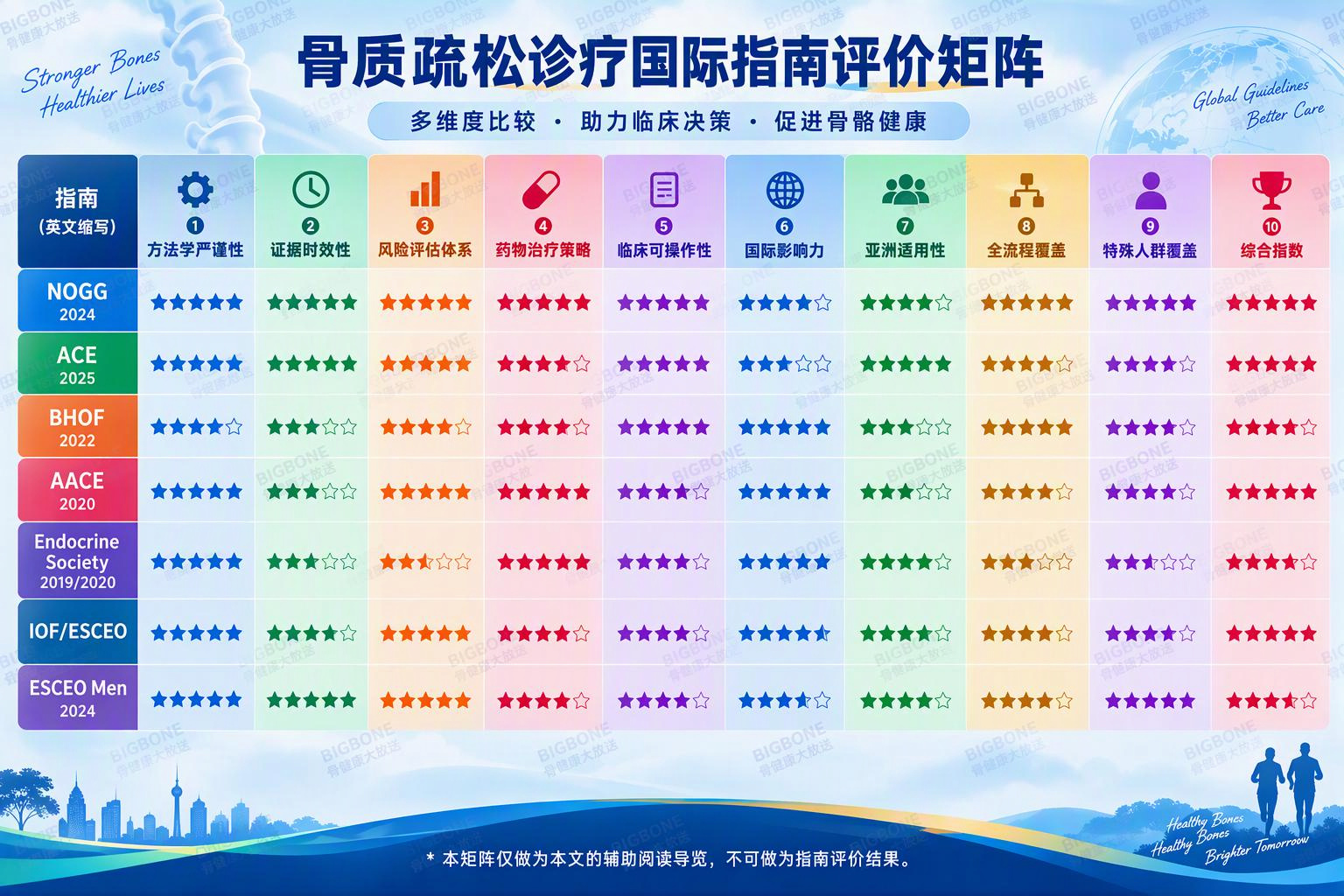
目前全球并不存在一部可以完全取代其他指南的“唯一标准”。IOF/ESCEO更强调基于FRAX和经济学因素的风险分层;AACE强调high/very-high fracture risk以及治疗序列;BHOF提供美国临床实践中较为完整的风险评估与治疗框架;Endocrine Society重点关注绝经后女性药物治疗、序贯治疗和长期管理;NOGG则建立了较为清晰的FRAX干预阈值和临床路径。2025年新加坡ACE临床指南进一步体现了“本地化阈值”的重要性,其根据新加坡医疗环境建立了骨量减少人群的本地干预阈值。
There is no single universal osteoporosis guideline that should replace all others. IOF/ESCEO emphasizes FRAX-based risk stratification and health-economic considerations; AACE emphasizes high- versus very-high-risk categories and treatment sequencing; BHOF provides a comprehensive US clinical framework; the Endocrine Society focuses strongly on pharmacological management and sequential treatment in postmenopausal women; and NOGG provides explicit FRAX-based intervention thresholds and clinical pathways. The 2025 Singapore ACE guideline illustrates another important principle: intervention thresholds may need local calibration to reflect the epidemiology and healthcare system of a specific population.
八、临床真正需要掌握的是“治疗路径”
因此,临床实践可以概括为一条连续路径:识别危险因素 → FRAX风险评估 → DXA及必要的椎体影像 → 排除继发性骨质疏松 → 判断high/very-high fracture risk → 选择抗骨吸收或骨形成治疗 → 进行序贯治疗 → 定期重新评估。 对于近期脆性骨折或极高风险患者,应尽早进入骨折二级预防体系,而不是等待下一次DXA下降后才开始治疗。
The practical value of guidelines lies in translating this evidence into a clinical pathway: identify risk factors → assess fracture probability with FRAX → perform DXA and vertebral imaging when appropriate → exclude secondary osteoporosis → classify high versus very-high fracture risk → select antiresorptive or bone-forming therapy → plan sequential treatment → reassess fracture risk and treatment response. Patients with recent fragility fractures or very high fracture risk should enter secondary fracture-prevention pathways promptly rather than waiting for a subsequent decline in BMD.
结语:从“治疗骨密度”转向“预防下一次骨折”
现代骨质疏松管理最重要的理念变化,是治疗目标已经从“提高BMD”转向降低患者未来发生髋部、椎体及其他脆性骨折的绝对风险。BMD仍然重要,但它只是风险评估体系中的一个变量。对于医学专业人员而言,真正理解指南的关键不是记住某一种药物是“一线”还是“二线”,而是能够根据患者的骨折风险、年龄、既往骨折、合并症、治疗史以及药物停用后的风险,设计合理的个体化治疗序列。
The central paradigm of modern osteoporosis care is therefore shifting from simply “improving BMD” to reducing the patient’s absolute risk of future hip, vertebral, and other fragility fractures. BMD remains important, but it is only one component of the overall risk assessment. For healthcare professionals, interpreting guidelines means understanding how fracture probability, previous fractures, age, comorbidities, treatment history, and the consequences of treatment discontinuation should collectively determine an individualized therapeutic sequence.
参考指南与权威文件|Key Guidelines and Authoritative Documents
1. NOGG 2024 — Clinical guideline for
the prevention and treatment of osteoporosis
英国 National
Osteoporosis Guideline Group。当前非常值得临床人员重点阅读的版本,更新了FRAX、干预阈值、极高骨折风险及药物治疗策略。
2. ACE Clinical Guideline 2025 —
Osteoporosis: diagnosis and management
新加坡ACE于2025年更新,尤其值得亚洲临床人员关注;首次将本地经济学模型用于骨量减少患者的干预阈值。
3. BHOF 2022 — Clinician’s Guide to
Prevention and Treatment of Osteoporosis
美国 Bone Health and
Osteoporosis Foundation(原NOF)的临床指南,覆盖绝经后女性和≥50岁男性,是美国临床实践的重要参考。
4. AACE 2020 — Clinical Practice
Guideline for the Diagnosis and Treatment of Postmenopausal Osteoporosis
AACE的经典指南,特别值得用于理解“high risk / very high risk”分层、骨形成治疗以及序贯治疗。目前AACE正在开发该指南的更新版本。
5. Endocrine Society — Pharmacological
Management of Osteoporosis in Postmenopausal Women
虽然基础指南发表于2019年、更新于2020年,但仍是理解双膦酸盐、地舒单抗、骨形成治疗、romosozumab及治疗后序贯管理的重要国际指南。
6. IOF/ESCEO — European guidance for the
diagnosis and management of osteoporosis in postmenopausal women
欧洲骨质疏松领域具有代表性的经典框架,重点涉及FRAX、骨折风险评估、BMD、骨微结构及骨折二级预防等。
7. ESCEO 2024 — Evidence-Based Guideline
for the management of osteoporosis in men
如果将骨健康模型扩展到男性,这份指南尤其重要,是目前男性骨质疏松管理的重要国际循证依据。
参考文献|References
- Compston JE, et al. UK clinical guideline for the prevention and treatment of osteoporosis. Arch Osteoporos. 2024; NOGG 2024 update.
- LeBoff MS, et al. The clinician's guide to prevention and treatment of osteoporosis. Osteoporos Int. 2022;33:2049–2102.
- Camacho PM, et al. American Association of Clinical Endocrinologists/American College of Endocrinology Clinical Practice Guidelines for the Diagnosis and Treatment of Postmenopausal Osteoporosis—2020 Update. Endocr Pract. 2020;26(Suppl 1):1–46.
- Shoback D, et al. Pharmacological Management of Osteoporosis in Postmenopausal Women: An Endocrine Society Guideline Update. J Clin Endocrinol Metab. 2020.
- Kanis JA, Cooper C, Rizzoli R, Reginster JY. European guidance for the diagnosis and management of osteoporosis in postmenopausal women. Osteoporos Int. 2019;30:3–44.
- Fuggle NR, et al. Evidence-based guideline for the management of osteoporosis in men. Nat Rev Rheumatol. 2024.