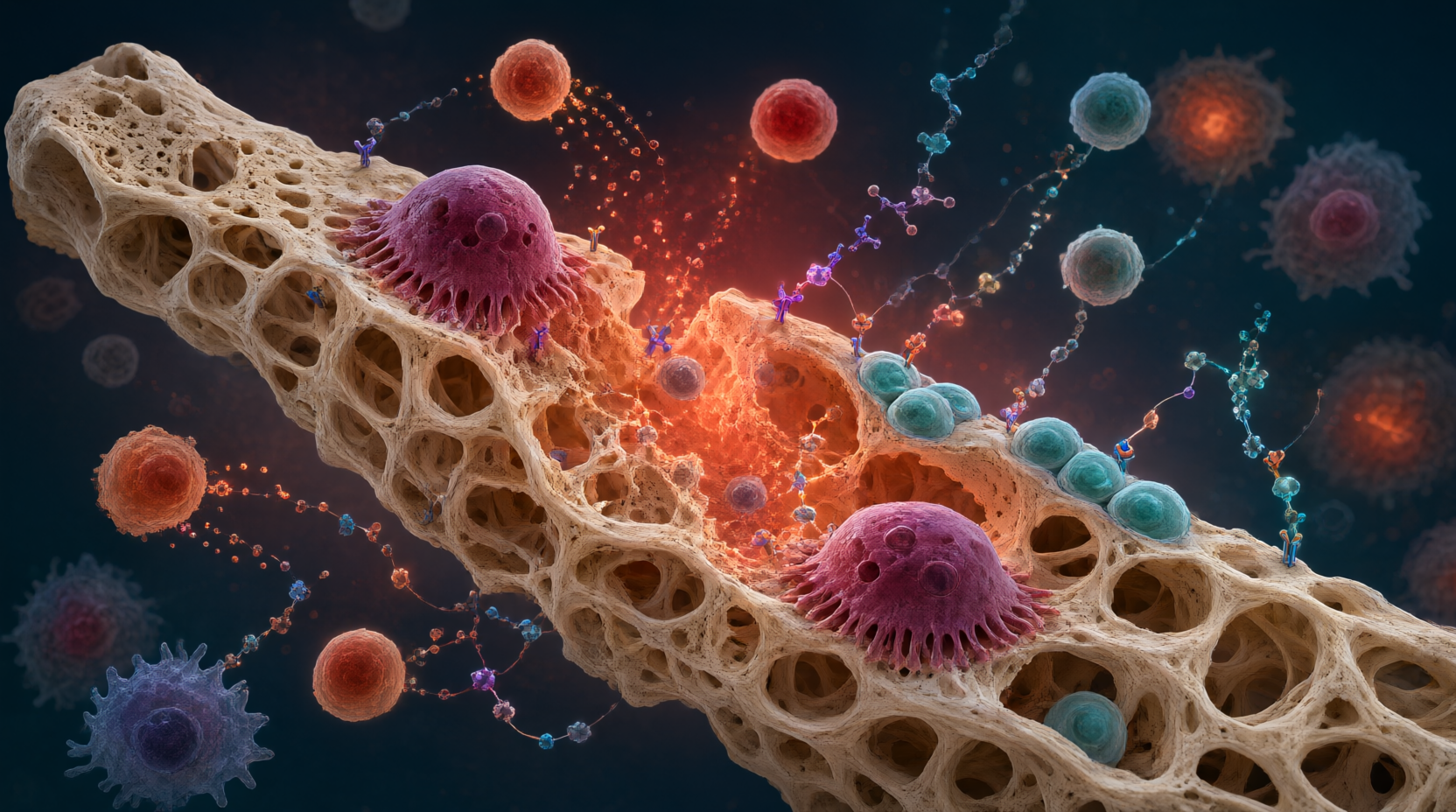
骨骼并不是一个与免疫系统彼此独立的组织。骨髓中聚集着大量免疫细胞,而成骨细胞、破骨细胞和骨细胞也能够产生多种细胞因子和趋化因子,因此骨代谢与免疫反应之间存在着密切联系。这一交叉领域被称为骨免疫学(osteoimmunology)。在健康状态下,炎症信号能够参与骨损伤修复和组织重塑;但当炎症长期存在时,免疫系统可能持续推动破骨细胞形成,同时抑制成骨细胞功能,最终使骨重塑从“平衡更新”转变为“骨吸收占优势”。近年来的研究进一步表明,慢性低度炎症可能是衰老相关骨量下降的重要驱动因素之一。
Bone is not an isolated tissue independent of the immune system. The bone marrow contains abundant immune cells, while osteoblasts, osteoclasts, and osteocytes can also produce cytokines and chemokines. This intimate interaction between skeletal and immune biology has given rise to the field of osteoimmunology. Under normal conditions, inflammatory signals can contribute to tissue repair and skeletal remodeling. However, persistent inflammation can promote osteoclastogenesis while impairing osteoblast function, shifting bone remodeling from balanced renewal toward net bone resorption. Increasing evidence suggests that chronic low-grade inflammation may be an important driver of age-related skeletal deterioration.
1. 炎症为什么会导致骨量下降?
骨重塑的核心是破骨细胞和成骨细胞之间的动态平衡。炎症状态下,TNF-α、IL-1β、IL-6和IL-17等促炎细胞因子可以通过不同途径增强破骨细胞分化,并影响RANKL–RANK–OPG系统。RANKL是破骨细胞形成最重要的信号之一;当炎症使RANKL表达增加或提高破骨细胞前体对RANKL的敏感性时,骨吸收就会增强。与此同时,部分炎症因子还能抑制成骨细胞分化,使“拆除”和“重建”之间出现双重失衡。2026年的综述将这种机制概括为炎症介导的“骨吸收放大环”。
The central problem is a disruption of the balance between osteoclast-mediated resorption and osteoblast-mediated formation. During inflammation, cytokines such as TNF-α, IL-1β, IL-6, and IL-17 can promote osteoclast differentiation through multiple pathways and modify the RANKL–RANK–OPG system. RANKL is a major driver of osteoclastogenesis; when inflammation increases RANKL expression or enhances the responsiveness of osteoclast precursors to RANKL, bone resorption accelerates. At the same time, inflammatory mediators can impair osteoblast differentiation, creating a double imbalance in which bone is removed more rapidly while its replacement is compromised. A 2026 review described this process as an inflammation-driven amplification loop of osteoclastogenesis.
2. TNF-α:连接炎症与骨吸收的重要分子
在炎症相关骨丢失中,**肿瘤坏死因子α(TNF-α)**是研究最充分的细胞因子之一。TNF-α能够与RANKL协同促进破骨细胞形成,并通过NF-κB、MAPK等信号通路增强破骨细胞活性。同时,它还能促进成骨细胞凋亡,降低骨形成相关蛋白的表达。因此,TNF-α实际上可以同时从“增加骨吸收”和“减少骨形成”两个方向破坏骨稳态。2026年的最新综述指出,类风湿关节炎、银屑病关节炎、强直性脊柱炎以及炎症性肠病等慢性炎症疾病患者,往往存在全身性骨量下降和骨折风险增加。
Among inflammatory mediators, tumor necrosis factor-alpha (TNF-α) is one of the best-characterized links between inflammation and skeletal loss. TNF-α can cooperate with RANKL to promote osteoclast formation and enhance osteoclast activity through signaling pathways including NF-κB and MAPK. At the same time, TNF-α can impair osteoblast survival and reduce expression of bone-formation markers. It therefore disrupts skeletal homeostasis from two directions: increasing bone resorption while suppressing bone formation. A 2026 review highlighted systemic bone loss and increased fracture risk across chronic inflammatory disorders including rheumatoid arthritis, psoriatic arthritis, ankylosing spondylitis, and inflammatory bowel disease.
3. IL-6和IL-17:免疫细胞如何“指挥”破骨细胞?
炎症对骨骼的影响并不只来自单个细胞因子。Th17细胞、Th1细胞、巨噬细胞以及其他免疫细胞能够形成相互作用的网络。例如,Th17细胞产生的IL-17可以促进RANKL相关信号,并增强破骨细胞形成;IL-6则能够参与炎症反应、免疫细胞分化以及骨髓微环境改变。2026年的骨免疫学研究提出,与其将某一种细胞因子视为“唯一原因”,不如将RANKL看作多个炎症信号最终汇聚的效应节点。也就是说,炎症导致骨吸收增加可能是一个网络效应,而不是单一通路效应。
The skeletal effects of inflammation cannot be explained by a single cytokine. Th17 cells, Th1 cells, macrophages, and other immune populations interact within the bone-marrow microenvironment. For example, IL-17 produced by Th17 cells can enhance RANKL-related signaling and osteoclastogenesis, while IL-6 participates in inflammatory signaling, immune-cell differentiation, and remodeling of the marrow niche. A 2026 osteoimmunology framework proposed that rather than treating any single cytokine as the sole cause, RANKL may be viewed as a convergent effector node receiving signals from multiple inflammatory pathways. In other words, inflammation-driven bone loss is increasingly understood as a network phenomenon rather than a single-pathway disorder.
4. 巨噬细胞:既可以破坏骨,也可以帮助修复
巨噬细胞在骨代谢中的作用尤其复杂。炎症环境下,偏向促炎表型的巨噬细胞能够产生TNF-α、IL-1β和其他炎症介质,促进破骨细胞形成;而具有组织修复特征的巨噬细胞则可能产生IL-10、TGF-β等因子,帮助炎症消退并支持骨组织修复。因此,巨噬细胞并不是简单的“有害细胞”或“有益细胞”,其功能取决于所处的微环境、代谢状态以及疾病阶段。最新研究越来越重视所谓的免疫细胞状态(immune cell states),而不是简单按照M1/M2二分法理解免疫细胞。
Macrophages illustrate the complexity of osteoimmune regulation particularly well. In inflammatory environments, pro-inflammatory macrophage states can produce TNF-α, IL-1β, and other mediators that enhance osteoclastogenesis. By contrast, macrophage states associated with tissue repair can produce IL-10, TGF-β, and other factors that promote resolution of inflammation and support skeletal repair. Macrophages are therefore neither simply “harmful” nor “beneficial”; their effects depend on the surrounding microenvironment, metabolic state, and stage of disease. Current research increasingly emphasizes immune-cell states rather than relying on a simple M1/M2 classification.
5. 炎症与骨形成:成骨细胞也会受到攻击
炎症不仅促进骨吸收,还可能直接抑制骨形成。持续的TNF-α、IL-1β和其他炎症信号能够影响间充质干细胞向成骨细胞分化,并干扰RUNX2、Wnt/β-catenin等重要成骨通路。在慢性炎症环境中,骨髓间充质基质细胞可能更倾向于脂肪生成而不是成骨分化。这意味着炎症会同时改变骨髓细胞的“命运选择”,进一步削弱骨形成能力。因此,慢性炎症导致的骨量流失并不是简单的“破骨细胞过度活跃”,而是骨吸收增强+骨形成受抑制的双重过程。
Inflammation also suppresses bone formation. Persistent TNF-α, IL-1β, and related signals can interfere with mesenchymal stromal-cell differentiation and disrupt osteogenic pathways such as RUNX2 and Wnt/β-catenin. In a chronically inflammatory marrow environment, mesenchymal stromal cells may increasingly favor adipogenic rather than osteogenic differentiation. Thus, inflammation can alter cellular fate decisions within the marrow and further weaken bone formation. Inflammatory bone loss is therefore not simply a matter of “overactive osteoclasts”; it involves a dual process of enhanced resorption and impaired formation.
6. 炎症衰老:为什么年龄越大,骨骼越容易受到炎症影响?
随着年龄增长,人体可能逐渐形成一种称为**“炎症性衰老”(inflammaging)**的慢性低度炎症状态。它与感染、组织损伤、肠道屏障变化、代谢异常、免疫衰老以及细胞衰老等因素有关。2025年的 Nature Aging 综述指出,inflammaging并不是一种完全相同的疾病状态,而是受到遗传、生活方式、环境暴露和一生中炎症刺激累积影响的高度异质性过程。对于骨骼而言,这种长期低水平炎症可能持续改变骨髓微环境,使骨重塑逐渐偏向骨吸收。
With ageing, the body may gradually develop a state of chronic low-grade inflammation known as inflammaging. It is influenced by infections, tissue damage, altered barrier function, metabolic dysfunction, immunosenescence, cellular senescence, and other lifelong exposures. A 2025 Nature Aging review emphasized that inflammaging is not a uniform biological state; rather, it is highly heterogeneous and shaped by genetics, lifestyle, environmental exposures, and cumulative inflammatory burden throughout life. In the skeleton, persistent low-grade inflammation may progressively alter the marrow microenvironment and shift remodeling toward net bone resorption.
7. 衰老细胞与SASP:炎症为什么会“自我维持”?
细胞衰老是连接年龄、炎症和骨丢失的重要机制。衰老细胞虽然不再正常增殖,却可以持续释放一系列炎症因子、趋化因子、蛋白酶以及其他分子,这一分泌模式被称为SASP(senescence-associated secretory phenotype,衰老相关分泌表型)。SASP中的IL-6、IL-1β、TNF-α、趋化因子和RANKL等,可以促进破骨细胞形成、抑制成骨细胞,并影响邻近细胞进入衰老状态。于是形成一种可能的恶性循环:衰老→SASP→炎症→骨重塑失衡→进一步组织损伤和衰老。
Cellular senescence provides an important mechanistic bridge between ageing, inflammation, and skeletal deterioration. Senescent cells no longer proliferate normally but can continuously release inflammatory cytokines, chemokines, proteases, and other factors collectively known as the senescence-associated secretory phenotype (SASP). SASP components including IL-6, IL-1β, TNF-α, chemokines, and RANKL can promote osteoclastogenesis, impair osteoblast function, and induce secondary senescence in neighboring cells. This may create a vicious cycle: senescence → SASP → inflammation → remodeling imbalance → further tissue damage and senescence. Recent reviews have identified this process as a major area of investigation in skeletal ageing.
8. 免疫衰老:骨髓正在发生什么变化?
骨髓不仅是造血器官,也是一个复杂的免疫生态系统。随着年龄增长,T细胞、B细胞、巨噬细胞以及骨髓基质细胞的组成和功能都会发生变化。例如,部分促炎T细胞亚群增加,而免疫调节能力下降;与此同时,骨髓中的细胞间通讯、线粒体功能和代谢状态也会发生改变。2025年的研究综述认为,免疫细胞—间充质细胞—成骨细胞—破骨细胞之间的交互失衡,是骨衰老的重要特征。这也意味着未来治疗骨质疏松可能不仅需要针对骨细胞,还需要考虑骨髓免疫生态系统。
The bone marrow is not only a hematopoietic organ but also a complex immune ecosystem. With ageing, the composition and function of T cells, B cells, macrophages, and marrow stromal cells change substantially. Some pro-inflammatory T-cell states may expand while immune-regulatory capacity declines. At the same time, intercellular communication, mitochondrial function, and metabolic states within the marrow are altered. A 2025 review proposed that disruption of the immune cell–mesenchymal stromal cell–osteoblast–osteoclast network is a central feature of skeletal ageing. This suggests that future osteoporosis therapies may need to consider not only bone cells but also the broader immune ecosystem within bone marrow.
9. 最新研究:炎症指标能否预测骨折?
如果炎症真的参与骨量下降,那么血液中的炎症指标是否可以预测骨折?2026年发表的一项系统综述和Meta分析汇总了多个研究,专门分析外周血炎症和免疫标志物与骨质疏松性骨折之间的关系。研究支持慢性炎症和免疫失调与骨脆弱性之间存在联系,但同时强调,目前这些炎症指标仍具有明显异质性,不能取代BMD、FRAX等成熟的骨折风险评估工具。这意味着未来更可能出现的是“骨密度+骨微结构+炎症+免疫状态”的综合风险模型,而不是用CRP或某一种细胞因子单独预测骨折。
Can inflammatory biomarkers predict fracture risk? A 2026 systematic review and meta-analysis evaluated associations between circulating inflammatory or immune markers and osteoporotic or fragility fractures. The evidence supports a relationship between chronic inflammation, immune dysregulation, and skeletal fragility, but substantial heterogeneity remains. Importantly, inflammatory biomarkers cannot currently replace established fracture-risk tools such as BMD and FRAX. The more likely future direction is therefore an integrated model combining bone density, microarchitecture, inflammatory burden, and immune state rather than relying on CRP or any single cytokine.
10. 抗炎治疗能不能保护骨骼?
一个非常值得关注的问题是:如果炎症促进骨丢失,那么抑制炎症是否能够保护骨骼?答案目前是“部分成立,但不能简单等同”。例如,TNF-α抑制剂首先是为了治疗类风湿关节炎等炎症疾病,但临床研究已经观察到部分患者的骨密度和骨转换指标得到改善。然而,炎症控制并不一定意味着所有骨折风险都会完全消失,因为骨量下降还受到年龄、激素、营养、机械负荷、疾病本身以及药物等多种因素影响。因此,控制炎症是骨保护的重要组成部分,但并不能完全替代针对骨骼本身的抗骨吸收或促骨形成治疗。
Can anti-inflammatory treatment protect bone? The answer is promising but nuanced. TNF inhibitors, for example, were developed primarily to control inflammatory diseases such as rheumatoid arthritis, yet clinical studies suggest that controlling TNF-mediated inflammation can preserve or modestly improve BMD and favorably influence bone-turnover markers in some patients. However, controlling inflammation does not necessarily eliminate fracture risk because skeletal fragility is also determined by age, hormones, nutrition, mechanical loading, the underlying disease, and medications. Thus, controlling inflammation may be an important component of skeletal protection but does not necessarily replace bone-specific antiresorptive or anabolic therapy.
11. 一个更前沿的方向:Senolytics
近年来一个非常受关注的研究方向是Senolytics(衰老细胞清除药物)。理论上,如果能够选择性清除产生SASP的衰老细胞,就可能减少炎症信号、恢复骨髓微环境,并改善骨重塑。动物实验中,达沙替尼联合槲皮素(dasatinib + quercetin)、非瑟酮(fisetin)以及一些骨靶向递送策略已经显示出一定的骨保护潜力。然而,截至2026年,这一领域仍主要处于机制研究和早期转化阶段。一个关键问题是:究竟应该清除哪些衰老细胞?如果没有细胞类型和空间定位上的精准选择,广泛清除衰老细胞可能产生新的风险。因此,未来的重点可能不是简单的“杀死衰老细胞”,而是进行细胞类型特异性的Senolytics治疗。
One of the most intriguing emerging strategies is senolytic therapy, which aims to selectively eliminate senescent cells that produce SASP factors. In theory, reducing the senescent-cell burden could decrease chronic inflammatory signaling, restore the marrow microenvironment, and rebalance bone remodeling. Preclinical studies involving dasatinib plus quercetin, fisetin, and bone-targeted delivery strategies have shown promising skeletal effects. However, as of 2026, senolytics remain primarily in the mechanistic and early translational stages. A central unresolved question is which senescent cells should actually be eliminated. Broad removal of senescent cells may carry unintended consequences. The future may therefore lie in cell-type-specific senolytic interventions rather than indiscriminate elimination of all senescent cells.
12. 从“骨质疏松”走向“骨免疫失衡”
过去,我们常把骨质疏松理解为一种单纯的骨代谢疾病:破骨细胞太活跃,成骨细胞太弱。但今天的研究正在建立一个更加完整的模型:
慢性炎症 / 免疫衰老 → cytokine network → RANKL↑ → osteoclastogenesis↑ → bone resorption↑ → microarchitecture deterioration → fracture risk↑
与此同时:
炎症 / SASP → mesenchymal stem-cell dysfunction → osteoblast differentiation↓ → bone formation↓
因此,骨量流失实际上是免疫系统、骨细胞、骨髓微环境和全身代谢共同作用的结果。2026年的研究尤其强调RANKL可能是多个免疫信号汇聚的“共同终点”,这为未来进行骨免疫分型和精准治疗提供了新的理论基础。
Historically, osteoporosis was largely viewed as a skeletal metabolic disorder in which osteoclast activity becomes excessive and osteoblast activity becomes insufficient. Modern research is developing a broader model:
Chronic inflammation / immunosenescence → cytokine network → ↑RANKL → ↑osteoclastogenesis → ↑bone resorption → microarchitectural deterioration → ↑fracture risk
At the same time:
Inflammation / SASP → mesenchymal stromal-cell dysfunction → ↓osteoblast differentiation → ↓bone formation
Bone loss is therefore increasingly understood as the consequence of interactions among the immune system, skeletal cells, bone-marrow microenvironment, and systemic metabolism. The 2026 osteoimmunology framework particularly highlights RANKL as a potential convergent endpoint for multiple immune signals, providing a conceptual basis for future immune phenotyping and precision treatment of skeletal disease.
结语|Conclusion
炎症反应与骨量流失之间并不是简单的因果关系,而是一个不断相互强化的动态网络。短暂的炎症可以帮助骨组织修复,但持续的炎症、免疫衰老和细胞衰老可能使骨髓微环境逐渐转变为促破骨、抑成骨的状态。TNF-α、IL-1β、IL-6、IL-17、RANKL以及SASP共同构成了连接免疫系统和骨重塑的重要分子网络。
The relationship between inflammation and bone loss is not a simple linear cause-and-effect process but a dynamic, self-reinforcing network. Acute inflammation can support skeletal repair, whereas persistent inflammation, immunosenescence, and cellular senescence may gradually transform the marrow microenvironment into one that favors osteoclastogenesis and suppresses osteoblast function. TNF-α, IL-1β, IL-6, IL-17, RANKL, and SASP factors collectively form an important molecular bridge between immunity and skeletal remodeling.
未来的骨健康管理可能因此发生一个重要转变:从单纯测量**“骨密度有多少”,进一步走向评估“骨重塑是否平衡、骨髓免疫环境是否健康、炎症负荷有多高以及哪些细胞正在推动骨丢失”。如果未来能够结合单细胞测序、空间转录组、多组学、骨微结构成像和人工智能模型,就有可能建立真正意义上的“骨免疫精准医学(precision osteoimmunology)”**。
Future skeletal medicine may therefore shift from simply measuring “how much bone is present” toward determining “whether remodeling is balanced, whether the marrow immune environment is healthy, how much inflammatory burden exists, and which cellular populations are driving bone loss.” Integration of single-cell sequencing, spatial transcriptomics, multi-omics, advanced bone imaging, and artificial intelligence could eventually enable a new form of precision osteoimmunology, in which skeletal disease is classified and treated according to its underlying immune and cellular state.
参考文献|References
- Zheng K, Ouyang Y, Jiang W, et al. RANKL-convergent osteoimmune network framework in osteoporosis: integrating macrophage activation, T-cell imbalance, and cytokine crosstalk. Frontiers in Immunology. 2026;17:1911132. doi:10.3389/fimmu.2026.1911132.
- Lin WY, Pan YJ, Yeh KT, et al. Tumor necrosis factor-alpha-mediated inflammatory bone loss: Pathogenic mechanisms and therapeutic potential of its inhibitors. Tzu Chi Medical Journal. 2026;38(2):125–136. doi:10.4103/tcmj.TCMJ-D-25-00128.
- Li C, Zhao C, Fu R, et al. Associations Between Peripheral Blood Inflammatory and Immune Markers and Osteoporotic and Fragility Fractures: A Systematic Review and Meta-Analysis. Calcified Tissue International. 2026. doi:10.1007/s00223-026-01606-7.
- Senescent immune cells, inflammaging, and bone loss: therapeutic potential and translational challenges of senolytics in osteoporosis. 2026.
- Li K, Hu S, Chen H. Cellular senescence and other age-related mechanisms in skeletal diseases. Bone Research. 2025;13:68.
- Wang J, Xin Y, Dong Z, et al. The interplay between the immune microenvironment and bone aging: From molecular mechanisms to therapeutic interventions. Experimental Gerontology. 2025;212:112974. doi:10.1016/j.exger.2025.112974.
- Franceschi C, Olivieri F, Moskalev A, et al. Toward precision interventions and metrics of inflammaging. Nature Aging. 2025;5:1441–1454.
- Lymphatic vascular aging and age-related bone loss: current status and future perspectives. 2026.