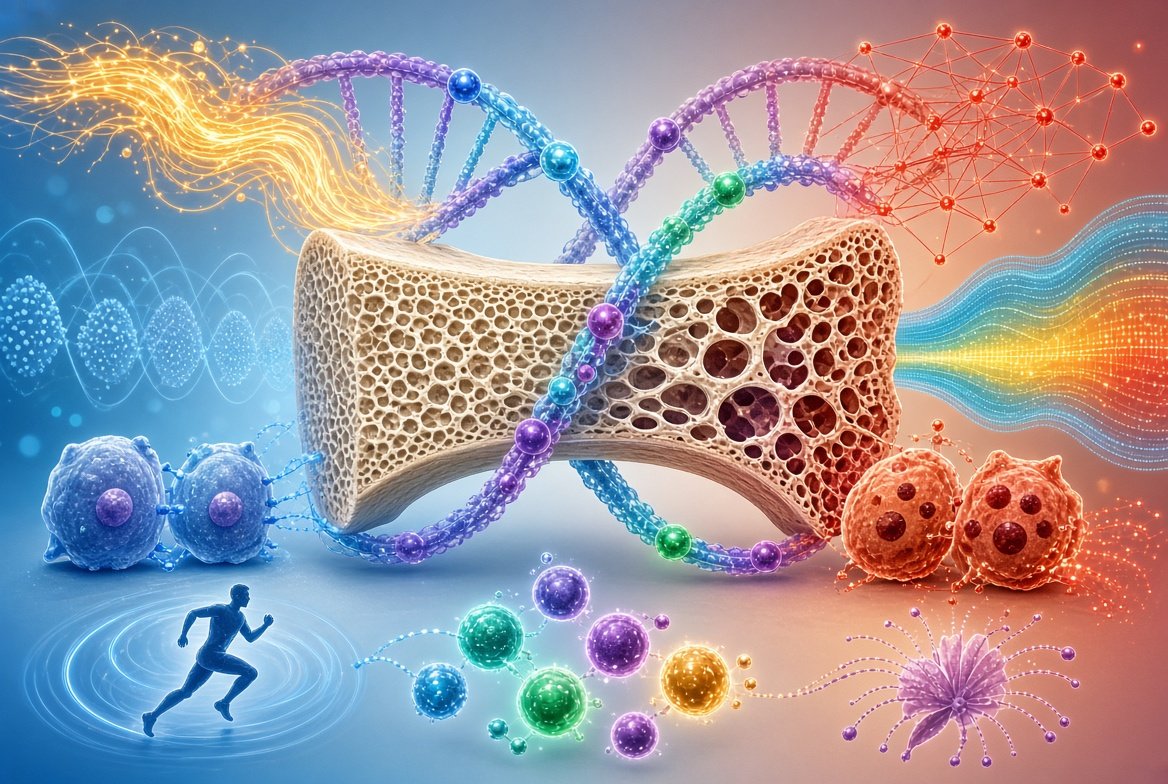
骨质疏松症(osteoporosis)是一种以骨量降低、骨微结构受损和骨脆性增加为主要特征的全身性骨骼疾病。年龄增长、绝经、营养状况、身体活动和激素水平都会影响骨骼健康,但遗传因素同样发挥着重要作用。研究表明,骨矿物质密度(bone mineral density,BMD)具有较高的遗传度,常见估计约为50%–80%,但具体数值会因研究人群、年龄、骨骼部位和测量方法而异。需要注意的是,遗传度描述的是特定人群中遗传差异对性状差异的贡献,并不意味着一个人的骨质疏松风险有相同比例是不可改变的。
Osteoporosis is a systemic skeletal disorder characterized by reduced bone mass, deterioration of bone microarchitecture, and increased bone fragility. Aging, menopause, nutrition, physical activity, and hormonal status all influence skeletal health, but genetic factors also play an important role. Bone mineral density (BMD) is substantially heritable, with commonly reported estimates of approximately 50%–80%, although the exact value varies by population, age, skeletal site, and measurement method. Importantly, heritability describes the contribution of genetic variation to differences within a particular population; it does not mean that the same proportion of an individual's osteoporosis risk is unchangeable.
1. 骨质疏松是一种多基因疾病
大多数骨质疏松病例并非由单个基因突变引起,而是受到成百上千种遗传变异的共同影响。这些变异可能分别影响成骨细胞的分化、破骨细胞的活性、钙磷代谢、骨基质形成以及骨骼对机械负荷的适应能力。每一种常见变异的独立效应通常较小,但当许多变异共同作用时,就可能显著影响一个人达到峰值骨量的能力,以及成年后骨量下降和发生脆性骨折的风险。因此,骨质疏松通常被视为一种多基因、复杂性疾病(polygenic complex disease)。
Most cases of osteoporosis are not caused by a single genetic mutation. Instead, they reflect the combined effects of hundreds or thousands of genetic variants. These variants may influence osteoblast differentiation, osteoclast activity, calcium and phosphate metabolism, bone-matrix formation, and skeletal adaptation to mechanical loading. Although the effect of any individual common variant is usually small, their combined influence can affect peak bone mass, age-related bone loss, and susceptibility to fragility fractures. Osteoporosis is therefore generally considered a polygenic complex disease.
2. 哪些基因与骨骼健康有关?
目前已知多个基因及其相关信号通路参与骨量调节。例如,LRP5 和 WNT16 与骨形成及骨皮质特征有关;SOST 编码硬化蛋白,可抑制Wnt/β-catenin成骨信号;RUNX2 是成骨细胞分化的重要转录调控因子;而 RANK、RANKL 和 OPG 所构成的信号系统参与破骨细胞的生成与调节。此外,ESR1等基因与雌激素信号及骨代谢有关。这些基因并不是孤立地工作,而是通过相互连接的分子网络共同影响骨骼形成、吸收和修复。
Several genes and signaling pathways are known to influence skeletal traits. LRP5 and WNT16 are associated with bone formation and cortical bone characteristics. SOST encodes sclerostin, which inhibits osteogenic Wnt/β-catenin signaling. RUNX2 is a key transcriptional regulator of osteoblast differentiation, while the RANK–RANKL–OPG signaling system regulates osteoclast formation. Genes such as ESR1 are also involved in estrogen signaling and bone metabolism. These genes do not act independently; they function within interconnected molecular networks that coordinate bone formation, resorption, and repair.
3. 全基因组关联研究如何寻找骨质疏松相关基因?
科学家常使用**全基因组关联研究(genome-wide association studies,GWAS)**寻找与骨密度和骨折风险有关的遗传变异。这类研究会分析大量个体的基因组,比较不同遗传变异与骨骼表型之间的统计关联。2025年发表的一项多骨骼部位研究,对超过30,000名欧洲参与者的DXA骨密度数据进行了分析,发现了91个与不同部位骨密度及骨折相关的独立遗传位点,其中包括涉及ABCA1、CHSY1、CYP24A1、SWAP70和PAX1等基因的新位点。这些结果进一步说明,骨质疏松的遗传基础具有广泛的分子异质性。
Scientists commonly use genome-wide association studies (GWAS) to identify genetic variants associated with BMD and fracture risk. These studies analyze genomic data from large populations and assess statistical associations between genetic variation and skeletal traits. A study published in 2025 examined DXA-derived BMD across multiple skeletal sites in more than 30,000 European participants. It identified 91 independent loci associated with BMD traits and fractures, including novel loci involving genes such as ABCA1, CHSY1, CYP24A1, SWAP70, and PAX1. These findings further demonstrate the extensive molecular heterogeneity underlying osteoporosis.
4. 遗传风险评分:能否提前识别高风险人群?
单个基因通常不足以准确预测一个人是否会患骨质疏松,因此研究人员开发了多基因风险评分(polygenic risk score,PRS)。这种方法根据大量遗传变异与疾病之间的关联强度进行加权计算,形成一个综合遗传风险指标。PRS并不能直接诊断骨质疏松,但有望帮助识别需要更早进行骨健康评估的人群。
A single gene is generally insufficient to predict whether an individual will develop osteoporosis. Researchers have therefore developed polygenic risk scores (PRSs), which combine the estimated effects of numerous genetic variants into a single measure of inherited susceptibility. A PRS cannot diagnose osteoporosis, but it may help identify individuals who could benefit from earlier skeletal assessment.
2026年1月发表在 BMC Medicine 的一项研究分析了英国生物样本库中223,818名女性的数据。研究发现,在调整相关因素后,遗传风险评分较高的女性发生骨质疏松的风险明显高于中等风险组。研究团队据此估算,高遗传风险组达到特定骨质疏松风险水平的年龄可能比中等风险组提前约5年。这为根据遗传风险优化筛查时间提供了重要证据,但研究人群主要来自英国,相关结果仍需要在其他人群中验证。
A study published in BMC Medicine in January 2026 analyzed data from 223,818 women in the UK Biobank. After adjustment for relevant factors, women with higher genetic risk scores had a substantially greater risk of osteoporosis than those in the intermediate-risk group. The researchers estimated that women in the high-risk group could reach a specified osteoporosis risk threshold approximately five years earlier than those in the intermediate-risk group. These findings provide important evidence for risk-adapted screening, although validation in other populations is necessary because the study cohort was predominantly British.
5. 遗传因素如何与生活方式相互作用?
遗传因素并不是独立决定骨骼命运的力量。骨骼发育和维持还受到钙与维生素D摄入、蛋白质营养、负重运动、吸烟、饮酒、激素变化和某些药物使用的影响。例如,一个人可能携带与较低骨密度相关的遗传变异,但如果能够在生长发育阶段建立较高的峰值骨量,并在成年后保持适当运动和营养,其骨骼健康仍可能得到改善。相反,长期缺乏运动、营养不足或长期使用某些影响骨代谢的药物,则可能进一步放大遗传易感性。
Genetic susceptibility does not independently determine skeletal outcomes. Bone development and maintenance are also influenced by calcium and vitamin D intake, protein nutrition, weight-bearing exercise, smoking, alcohol consumption, hormonal changes, and certain medications. For example, someone carrying variants associated with lower BMD may still improve their skeletal health by achieving a higher peak bone mass during development and maintaining appropriate nutrition and physical activity throughout adulthood. Conversely, prolonged inactivity, nutritional deficiencies, or certain medications that adversely affect bone metabolism may amplify inherited susceptibility.
这种关系也被称为基因—环境相互作用(gene–environment interaction)。遗传变异可能影响人体对营养、激素或机械负荷的反应,而环境因素也可能改变相关基因的表达及其下游信号。2025年的骨质疏松遗传学综述指出,不同人群中的遗传关联及其效应可能存在差异,饮食和身体活动等因素也会影响研究结果的适用性。因此,遗传风险应当与临床和生活方式因素共同解读,而不能孤立使用。
This relationship is known as a gene–environment interaction. Genetic variants may influence how the body responds to nutrition, hormones, or mechanical loading, while environmental factors can modify gene expression and downstream signaling. A 2025 review of osteoporosis genetics emphasized that genetic associations and their effect sizes may differ across populations, and that factors such as diet and physical activity influence the applicability of research findings. Genetic risk should therefore be interpreted alongside clinical and lifestyle factors rather than in isolation.
6. 少数骨骼疾病由单基因变异引起
虽然大多数骨质疏松具有多基因特征,但部分罕见骨骼疾病确实由单个基因的致病变异引起。例如,LRP5 的不同变异可以导致低骨量相关疾病,也可能造成高骨量表型;COL1A1 和 COL1A2 的致病变异则与成骨不全症(osteogenesis imperfecta)密切相关。某些遗传性骨骼疾病可能在儿童或年轻成人时期就出现反复骨折、明显低骨密度或其他异常表现。
Although most osteoporosis is polygenic, some rare skeletal disorders result from pathogenic variants in a single gene. Different variants in LRP5, for example, can cause low-bone-mass disorders or high-bone-mass phenotypes, while pathogenic variants in COL1A1 and COL1A2 are strongly associated with osteogenesis imperfecta. Some inherited skeletal disorders become apparent during childhood or early adulthood, presenting with recurrent fractures, markedly reduced BMD, or other skeletal abnormalities.
2026年发表在 Nature Reviews Endocrinology 的综述进一步讨论了单基因骨量疾病的发病机制,强调不同遗传疾病可能影响间充质细胞、造血细胞以及骨形成和骨吸收之间的相互作用。这类研究不仅有助于解释罕见疾病,也能够帮助科学家理解普通骨质疏松涉及的分子通路。不过,不能因为某个基因与罕见骨病有关,就直接认定它能够单独解释普通人群的骨质疏松风险。
A 2026 review in Nature Reviews Endocrinology further examined the mechanisms of monogenic bone-mass disorders, emphasizing how different genetic conditions affect mesenchymal and hematopoietic lineages and the interactions between bone formation and resorption. Such research helps explain rare diseases while also illuminating molecular pathways relevant to common osteoporosis. However, the involvement of a gene in a rare skeletal disorder does not mean that the same gene independently explains osteoporosis risk in the general population.
7. 多基因风险评分目前有哪些局限?
尽管PRS具有潜力,但它仍面临多个重要挑战。首先,风险评分通常是在特定人群中建立的,其准确性可能受到遗传祖源差异的影响。其次,骨密度与骨折风险并不完全相同:骨折还受到年龄、跌倒、肌肉力量、药物使用和骨微结构等因素影响。最后,即使PRS能够将人群划分为不同遗传风险组,也不意味着它一定能显著提高现有临床预测工具的准确性。
Despite its potential, PRS faces several important limitations. First, scores are usually developed in specific populations, and their accuracy may be affected by differences in genetic ancestry. Second, BMD and fracture risk are not identical: fractures are also influenced by age, falls, muscle strength, medications, and bone microarchitecture. Finally, the ability of a PRS to stratify individuals into genetic risk groups does not necessarily mean that it substantially improves the accuracy of existing clinical prediction tools.
2026年的一项研究将基于全基因组骨密度数据构建的多基因评分整合到FRAX骨折风险评估框架中,并在绝经后女性队列中进行验证。研究探索了遗传信息对传统临床风险评估的补充价值,也反映出这一领域正在从发现遗传关联走向临床应用。但遗传评分是否能改善实际筛查效率、减少骨折并具有成本效益,仍需更多前瞻性研究验证。
A 2026 study integrated genome-wide BMD-derived polygenic scores into the FRAX fracture-risk assessment framework and evaluated the approach in a cohort of postmenopausal women. The research explored whether genetic information could complement conventional clinical risk assessment, illustrating the field's transition from discovering genetic associations toward clinical implementation. However, further prospective studies are needed to establish whether genetic scores improve screening efficiency, prevent fractures, and provide sufficient cost-effectiveness.
8. 遗传学将如何改变未来的骨健康管理?
未来,骨质疏松风险评估可能逐步整合遗传信息、DXA骨密度、既往脆性骨折史、家族史、实验室指标和生活方式数据,形成更加个体化的评估模型。全基因组关联研究、多组学分析和人工智能辅助建模,有望帮助科学家进一步识别与骨形成、骨吸收及骨折风险相关的生物学通路,并为新药靶点研究提供线索。不过,基因检测并不能替代临床评估,也不能仅凭一个遗传风险评分决定是否开始治疗。
In the future, osteoporosis assessment may increasingly integrate genetic information with DXA-derived BMD, previous fragility fractures, family history, laboratory measurements, and lifestyle data. GWAS, multi-omics analyses, and AI-assisted modeling may help researchers identify additional biological pathways associated with bone formation, resorption, and fracture susceptibility, while informing the discovery of potential therapeutic targets. Nevertheless, genetic testing cannot replace clinical assessment, and a PRS alone should not determine whether treatment is initiated.
结语|Conclusion
遗传因素为我们理解骨质疏松提供了重要线索,但遗传易感性并不等于必然患病。骨量和骨折风险是遗传背景、激素状态、营养、运动、年龄以及其他健康因素共同作用的结果。2025—2026年的研究显示,多基因风险评分有望帮助识别高风险人群,并为更早、更精准的骨健康筛查提供依据;与此同时,遗传祖源差异、模型准确性和临床效益仍需要进一步验证。未来骨健康管理的关键,不是简单地给每个人贴上遗传风险标签,而是将遗传信息转化为可靠、可解释且真正有助于预防骨折的个体化策略。
Genetics provides important insights into osteoporosis, but genetic susceptibility does not make disease inevitable. Bone mass and fracture risk arise from the combined effects of inherited biology, hormonal status, nutrition, physical activity, aging, and other health factors. Research published in 2025–2026 suggests that polygenic risk scores may help identify high-risk individuals and support earlier, more personalized skeletal screening. At the same time, ancestry-related differences, predictive accuracy, and clinical utility require further validation. The ultimate goal is not simply to label people according to genetic risk, but to translate genetic information into reliable, interpretable strategies that genuinely help prevent fractures.
参考文献|References
1. Wang D, Sun W, Liu D, et al. Polygenic risk score-guided personalized osteoporosis screening: a population-based study. BMC Medicine. 2026;24:56. Published January 14, 2026. https://doi.org/10.1186/s12916-025-04601-1.
2. Qian Y, Xia J, Wang P. Genome-wide Association Studies of over 30,000 Samples with Bone Mineral Density at Multiple Skeletal Sites and Its Clinical Relevance. Genomics, Proteomics & Bioinformatics. 2025;23(5):qzaf097. https://doi.org/10.1093/gpbjnl/qzaf097.
3. Wu Q, Dai J, Liu J, et al. Bridging Genomic Research Disparities in Osteoporosis GWAS: Insights for Diverse Populations. Current Osteoporosis Reports. 2025;23:24. https://doi.org/10.1007/s11914-025-00917-2.
4. Liu A, Liu J, Wu Q. Advanced Bayesian BMD-Derived Genome-Wide Polygenic Scores Enhance Clinical FRAX-Based Fracture Risk Prediction in Postmenopausal Women. Calcified Tissue International. 2026;117:46. https://doi.org/10.1007/s00223-026-01497-8.
5. Padidela R, Hendrickx G, Mortier G, et al. The pathogenesis and intersecting mechanisms of monogenic bone mass disorders. Nature Reviews Endocrinology. 2026;22:490–506. https://doi.org/10.1038/s41574-026-01260-x.
6. Li S, Trajanoska K. PHEWAS, TWAS, Mendelian Randomization in Osteoporosis Research: The Good, the Bad, and the Ugly. Current Osteoporosis Reports. 2026;24:16. https://doi.org/10.1007/s11914-026-00962-5.