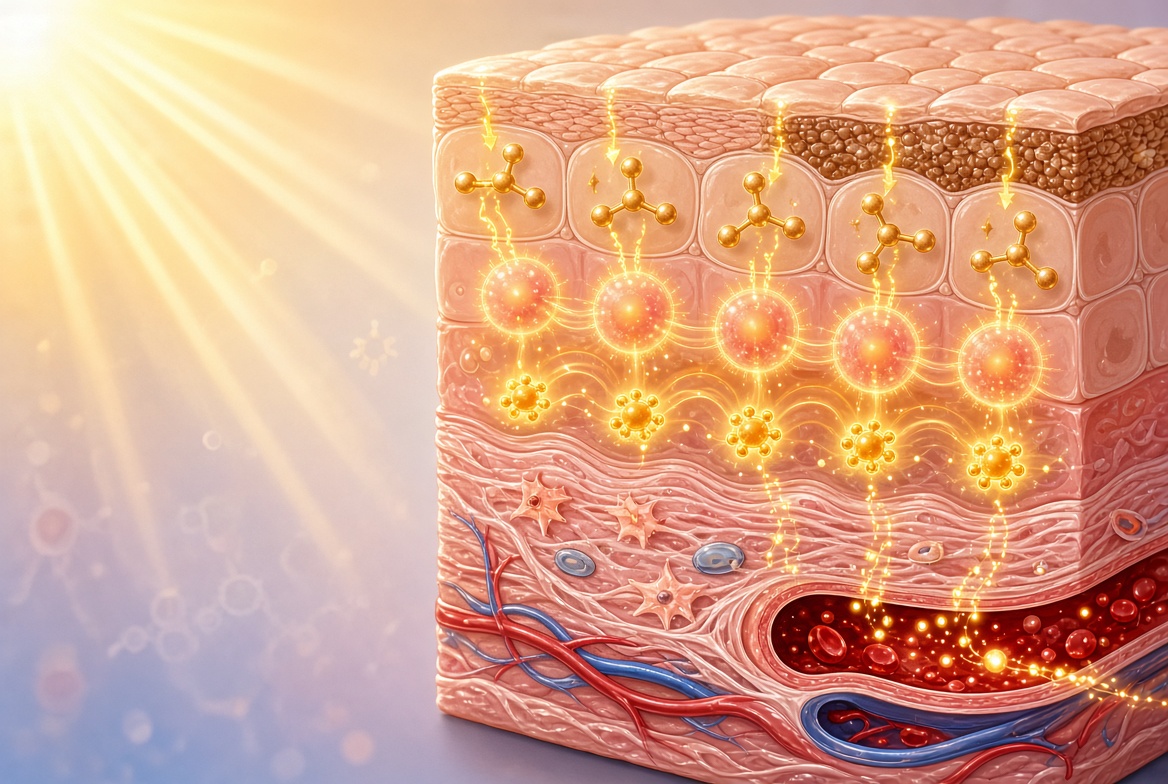
很多人把维生素D理解为一种需要从食物中摄取的营养素,但人体实际上具有非常特殊的“自我合成”能力。皮肤是人体合成维生素D₃(vitamin D₃)的主要场所,其中表皮角质形成细胞含有丰富的 7-脱氢胆固醇(7-dehydrocholesterol,7-DHC)。当太阳光中的紫外B(UVB)照射到皮肤时,特定波长的光子能够被7-DHC吸收,引发一系列光化学和热异构化反应,最终生成维生素D₃。因此,严格来说,皮肤中的维生素D合成首先是一种光化学反应,而不是传统意义上的酶促合成。
Many people think of vitamin D primarily as a nutrient obtained from food, but humans possess a remarkable capacity to synthesize it internally. The skin is the major site of endogenous vitamin D₃ production, and epidermal keratinocytes contain abundant 7-dehydrocholesterol (7-DHC). When the skin is exposed to ultraviolet B (UVB) radiation from sunlight, photons at appropriate wavelengths are absorbed by 7-DHC and initiate a series of photochemical and thermal reactions that ultimately generate vitamin D₃. Thus, the first step of cutaneous vitamin D synthesis is fundamentally a photochemical process, rather than a conventional enzyme-catalyzed reaction.
1. 第一步:UVB激活7-脱氢胆固醇
维生素D合成的起点是皮肤中的7-DHC。UVB主要位于约 290–315 nm 的紫外光谱范围。当合适波长的UVB光子被7-DHC吸收后,其甾醇结构中的B环发生光化学断裂,形成一种不稳定的中间产物——前维生素D₃(pre-vitamin D₃)。这一过程与光的能量密切相关,因此太阳高度角、纬度、季节、大气条件以及照射时间都会影响皮肤能够产生多少前维生素D₃。
The first step in cutaneous vitamin D synthesis begins with 7-DHC. UVB occupies approximately the 290–315 nm portion of the ultraviolet spectrum. When photons within this range are absorbed by 7-DHC, photochemical cleavage of its steroid B-ring occurs, producing the unstable intermediate pre-vitamin D₃. Because this reaction depends directly on photon energy reaching the skin, factors such as solar elevation, latitude, season, atmospheric conditions, and exposure duration can all influence the amount of pre-vitamin D₃ generated.
2. 第二步:前维生素D₃变成维生素D₃
生成前维生素D₃以后,反应并没有结束。前维生素D₃会在皮肤温度条件下发生一个不依赖酶的**热异构化(thermal isomerization)**过程,逐渐转化为维生素D₃,也就是通常所说的胆钙化醇(cholecalciferol)。随后,维生素D₃从皮肤进入细胞外环境和循环系统,并与维生素D结合蛋白(vitamin D-binding protein,DBP)等运输系统结合,进入全身代谢过程。
The formation of pre-vitamin D₃ is not the end of the pathway. Under physiological skin temperatures, pre-vitamin D₃ undergoes thermal isomerization, a non-enzymatic process that converts it into vitamin D₃, also known as cholecalciferol. Vitamin D₃ can then leave the skin and enter the circulation, where it associates with transport proteins such as vitamin D-binding protein (DBP) and proceeds through systemic vitamin D metabolism.
3. 皮肤不会无限制造维生素D
一个非常有趣的现象是,继续增加UVB照射并不会让皮肤无限产生维生素D₃。随着UVB暴露增加,前维生素D₃和维生素D₃还会发生进一步的光化学反应,生成 **lumisterol₃(光甾醇₃)和tachysterol₃(速甾醇₃)**等光产物。这些反应实际上构成了一个重要的“光保护性反馈”机制,使维生素D₃的生成不会随着UVB剂量无限增加。因此,维生素D皮肤合成存在一种天然的“平台期”。
Interestingly, the skin does not produce unlimited amounts of vitamin D₃ simply by increasing UVB exposure. With continued irradiation, pre-vitamin D₃ and vitamin D₃ can undergo additional photochemical reactions that generate products such as lumisterol₃ and tachysterol₃. These pathways act, at least in part, as a photochemical buffering mechanism that prevents vitamin D₃ production from increasing indefinitely with UVB dose. Consequently, cutaneous vitamin D synthesis eventually approaches a plateau rather than rising linearly with continued exposure.
4. Lumisterol和Tachysterol可能并不是“废物”
过去,人们通常把lumisterol和tachysterol理解为维生素D合成过程中的旁路产物,认为它们对人体没有重要作用。但近年来这一观点正在发生变化。研究发现,皮肤中的lumisterol₃和tachysterol₃可以进一步被 CYP11A1、CYP27A1等酶代谢,产生具有生物活性的羟基化代谢物。这些物质可能参与角质形成细胞分化、抗氧化、抗炎以及皮肤屏障保护等过程。
For many years, lumisterol and tachysterol were regarded largely as photochemical by-products of vitamin D synthesis. This view is now being revised. Recent research shows that lumisterol₃ and tachysterol₃ can undergo further metabolism by enzymes including CYP11A1 and CYP27A1, generating biologically active hydroxylated metabolites. These compounds may influence keratinocyte differentiation, oxidative stress responses, inflammation, and skin-barrier biology.
5. 维生素D₃离开皮肤后,还要经过两次“加工”
皮肤合成的维生素D₃本身并不是维生素D发挥主要内分泌作用的最终形式。进入循环后,维生素D₃首先主要在肝脏经过 CYP2R1等25-羟化酶作用,形成25-羟维生素D,即 25(OH)D。25(OH)D是临床上最常用于评价人体维生素D状态的血液指标。随后,25(OH)D在肾脏经 **CYP27B1(1α-hydroxylase)**进一步羟化,形成具有强生物活性的 1,25-二羟维生素D₃[1,25(OH)₂D₃],也就是骨化三醇(calcitriol)。
Vitamin D₃ synthesized in the skin is not yet the principal endocrine form of vitamin D. After entering the circulation, it is predominantly hydroxylated in the liver by enzymes including CYP2R1, producing 25-hydroxyvitamin D, or 25(OH)D. This is the major circulating form and the laboratory marker most commonly used to assess vitamin D status. Subsequently, 25(OH)D can be hydroxylated by CYP27B1 (1α-hydroxylase), particularly in the kidney, to generate the biologically potent hormone 1,25-dihydroxyvitamin D₃ [1,25(OH)₂D₃], also known as calcitriol.
6. 皮肤其实也是一个“小型维生素D代谢器官”
新的研究表明,皮肤并不仅仅负责“制造维生素D₃,然后把它送出去”。皮肤本身拥有相对完整的维生素D代谢系统,包括CYP27B1和CYP24A1等相关酶,因此可以在局部将25(OH)D进一步转化为活性维生素D,也可以对维生素D代谢物进行灭活。这意味着皮肤存在一个局部的自分泌/旁分泌维生素D系统,能够直接影响角质形成细胞分化、细胞增殖、免疫反应和皮肤屏障功能。
The skin is now understood to be more than a site that simply manufactures vitamin D₃ and releases it into the circulation. It contains much of the enzymatic machinery required for local vitamin D metabolism, including CYP27B1 and CYP24A1. Consequently, skin cells can locally activate and inactivate vitamin D metabolites, establishing a cutaneous autocrine/paracrine vitamin D system. This local system can influence keratinocyte differentiation, proliferation, immune responses, and epidermal barrier function.
7. 皮肤颜色为什么会影响维生素D合成?
**黑色素(melanin)**是影响皮肤维生素D合成的重要因素之一。黑色素能够吸收紫外线,因此会减少到达7-DHC的有效UVB光子数量。总体而言,深色皮肤在相同UVB暴露条件下通常需要更长时间才能产生相同程度的维生素D合成反应。不过,真实人体情况远比“肤色越深,维生素D越低”简单,因为纬度、季节、服装、户外活动、年龄、身体暴露面积和饮食等因素都会共同影响维生素D状态。
Melanin is an important determinant of cutaneous vitamin D production. Because melanin absorbs ultraviolet radiation, it reduces the number of UVB photons available to interact with 7-DHC. In general, more highly pigmented skin requires greater UV exposure to generate a comparable vitamin D response under otherwise similar conditions. However, the relationship between pigmentation and vitamin D status is far more complex than a simple “darker skin means lower vitamin D” rule, because latitude, season, clothing, outdoor activity, exposed surface area, age, and dietary intake all contribute to overall vitamin D status.
8. 年龄增长后,皮肤合成维生素D的能力会下降
随着年龄增加,皮肤中的7-DHC含量通常会发生变化,皮肤结构和光生物学特性也会改变。因此,老年人的皮肤在相同UVB暴露下,生成维生素D₃的能力可能低于年轻人。此外,老年人往往户外活动减少、衣物覆盖面积增加,这些因素会进一步降低皮肤维生素D合成。因此,对于骨质疏松风险较高的人群,不能简单依靠“晒太阳”来判断是否能够获得足够的维生素D。
Cutaneous vitamin D production generally declines with aging. Changes in epidermal structure and in the concentration of 7-DHC can reduce the efficiency of vitamin D₃ production following the same UVB exposure. Older adults may also spend less time outdoors or have more extensive clothing coverage, further reducing exposure. Consequently, in individuals at high risk of osteoporosis or vitamin D deficiency, vitamin D status should not be inferred solely from presumed sunlight exposure.
9. 防晒霜会不会完全阻止皮肤合成维生素D?
从光化学原理来看,防晒产品能够减少UVB到达皮肤,因此理论上会降低维生素D合成。但是现实中的防晒使用方式、涂抹厚度、覆盖程度和补涂情况与实验室条件并不完全相同。2025–2026年的研究也越来越强调一个重要问题:UVB既能促进维生素D合成,也会造成DNA损伤。 因此,不能简单地为了获得维生素D而追求更强、更长时间的紫外线暴露。
From a photochemical perspective, sunscreen can reduce the amount of UVB reaching the skin and therefore has the potential to decrease vitamin D synthesis. However, real-world sunscreen application differs substantially from idealized laboratory conditions in terms of thickness, coverage, and reapplication. Research in 2025–2026 has also emphasized a crucial point: UVB can promote vitamin D synthesis while simultaneously causing DNA damage. Therefore, increasing UV exposure solely to maximize vitamin D production is not a scientifically sound strategy.
10. “维生素D收益”和“UV损伤”之间存在一个平衡
2026年的一项系统综述进一步关注了不同皮肤光型人群中太阳UV暴露的双重效应:同样的UV暴露既可能促进维生素D合成,也可能产生皮肤DNA损伤。换句话说,太阳光并不是简单的“有益”或“有害”,而是一个存在剂量和生物学背景差异的环境因素。对于人体健康而言,更重要的问题是如何在获得正常生理所需的维生素D与减少不必要的UV损伤之间取得平衡。
A 2026 systematic review further examined this dual effect across different skin phototypes. The same solar UV exposure that promotes vitamin D synthesis can also generate DNA damage. Sunlight therefore cannot be classified simply as either “beneficial” or “harmful”; its biological effects depend strongly on dose and context. From a public-health perspective, the key issue is finding an appropriate balance between maintaining adequate vitamin D status and minimizing unnecessary UV-induced skin damage.
11. 一个新的认识:UVB产生的不只是维生素D₃
现代研究正在进一步改变我们对“皮肤晒太阳”的理解。UVB作用于7-DHC后,除了产生前维生素D₃,还会产生lumisterol和tachysterol等化合物。2024–2026年的研究发现,这些分子及其羟基化代谢物可能直接作用于VDR、AhR、LXR、ROR和PPAR等核受体,并影响氧化应激、炎症、细胞分化和DNA损伤反应。因此,皮肤的光化学反应可能是一个比“晒太阳→维生素D”复杂得多的生物学网络。
Modern research is therefore expanding the concept of what happens when UVB reaches the skin. UVB-induced conversion of 7-DHC produces not only pre-vitamin D₃ but also lumisterol and tachysterol derivatives. Studies from 2024–2026 indicate that metabolites derived from these pathways may interact with nuclear receptors including VDR, AhR, LXR, ROR, and PPAR, influencing oxidative stress, inflammation, cellular differentiation, and DNA-damage responses. The photobiology of skin is therefore much more complex than the traditional “sunlight equals vitamin D” model.
12. 从皮肤到骨骼:维生素D最终如何参与骨代谢?
维生素D与骨健康之间的联系主要来自其对钙和磷稳态的调节。活性维生素D能够促进肠道对钙和磷的吸收,并与甲状旁腺激素(PTH)等共同维持正常矿物质代谢。对于骨骼而言,这种机制能够为骨矿化提供必要的钙和磷。因此,皮肤发生的一次光化学反应,最终可以通过肝脏、肾脏和肠道等器官的协同作用,影响全身骨骼的矿物质供应。
The connection between vitamin D and skeletal health is largely mediated through regulation of calcium and phosphate homeostasis. Active vitamin D enhances intestinal absorption of calcium and phosphate and works together with parathyroid hormone (PTH) and other endocrine signals to maintain mineral balance. For the skeleton, this ensures an adequate supply of calcium and phosphate for normal mineralization. A photochemical reaction occurring in the skin can therefore ultimately influence skeletal mineral availability through coordinated actions involving the liver, kidneys, intestine, and endocrine system.
13. 未来研究:能否利用“皮肤维生素D系统”进行治疗?
未来的研究方向已经不再局限于“如何让皮肤制造更多维生素D”。科学家正在研究能否利用皮肤自身的维生素D代谢网络开发新的治疗策略。例如,lumisterol、tachysterol及其羟基化代谢物可能成为新的皮肤疾病研究对象;同时,利用特定波长、精准剂量的光照来调节皮肤中的维生素D相关通路,也正在成为光医学研究的一个方向。2026年的研究甚至探索了通过传感器调控的室内自然光暴露改善人体维生素D状态的可能性,不过这一领域仍处于研究阶段。
Future research is therefore moving beyond the simple question of how to make the skin produce more vitamin D. Scientists are investigating whether the cutaneous vitamin D metabolic network itself can be therapeutically exploited. Lumisterol, tachysterol, and their hydroxylated metabolites are emerging as potential targets in dermatological research, while precisely controlled light exposure is being explored as a means of modulating vitamin D-related pathways. A 2026 study even investigated a sensor-regulated indoor sunlight approach for improving vitamin D status, although this remains an experimental strategy rather than established clinical practice.
结语|Conclusion
皮肤合成维生素D,是人体最有代表性的光生物学过程之一。从UVB光子被7-DHC吸收,到前维生素D₃形成,再到维生素D₃进入血液并经过肝脏和肾脏活化,这条通路连接了阳光、皮肤、肝脏、肾脏、肠道与骨骼。而最新研究告诉我们,这一过程并不是简单的“晒太阳制造维生素D”,因为UVB同时会产生多种光产物,并参与皮肤自身的局部代谢与免疫调节。未来,我们可能会更加关注如何利用这些复杂的分子通路,在获得维生素D生理益处的同时,尽可能降低紫外线造成的皮肤损伤。
Cutaneous vitamin D synthesis is one of the most fascinating examples of human photobiology. From absorption of UVB photons by 7-DHC, to formation of pre-vitamin D₃, and finally to hepatic and renal activation of vitamin D metabolites, this pathway connects the sun, skin, liver, kidneys, intestine, and skeleton. Modern research shows that the process is much more sophisticated than simply “getting vitamin D from sunlight.” UVB generates multiple photoproducts, while the skin itself possesses an active local vitamin D metabolic network. The future challenge will be to understand and potentially harness these pathways while preserving the physiological benefits of vitamin D and minimizing unnecessary ultraviolet-induced skin damage.
参考文献|References
- Bikle DD. Vitamin D: Production, Metabolism, and Mechanism of Action. Endotext. Updated June 15, 2025. NCBI Bookshelf.
- Slominski AT, Tae-Kang K, Janjetovic Z, et al. Biological effects of CYP11A1-derived vitamin D and lumisterol metabolites in the skin. Journal of Investigative Dermatology. 2024;144(10):2145–2161. DOI: 10.1016/j.jid.2024.04.022.
- Slominski AT, et al. Metabolic activation of lumisterol to biologically active metabolites and their mechanism of action. Biochemical Pharmacology. 2026;246:117711. DOI: 10.1016/j.bcp.2026.117711.
- Li Q, Chan H. Vitamin D and skin disorders: bridging molecular insights to clinical innovations. Molecular Medicine. 2025;31:259.
- Nolan C, et al. Sunlight exposure, vitamin D benefit and DNA damage harm: a systematic review of human experimental studies across skin phototypes. British Journal of Dermatology. 2026;195(Suppl 1):ljag086.202. DOI: 10.1093/bjd/ljag086.202.
- Vitamin D and the aging skin: insights into oxidative stress, inflammation, and barrier function. Immunity & Ageing. 2025. DOI: 10.1186/s12979-025-00536-6.
- Beneficial health effects of ultraviolet radiation: expert review and conference report. Photochemical & Photobiological Sciences. 2025. DOI: 10.1007/s43630-025-00743-6.
- Harnessing natural sunlight indoors: sensor-regulated therapeutic approach to enhance vitamin D status in humans. Scientific Reports. 2026. DOI: 10.1038/s41598-026-46541-7.