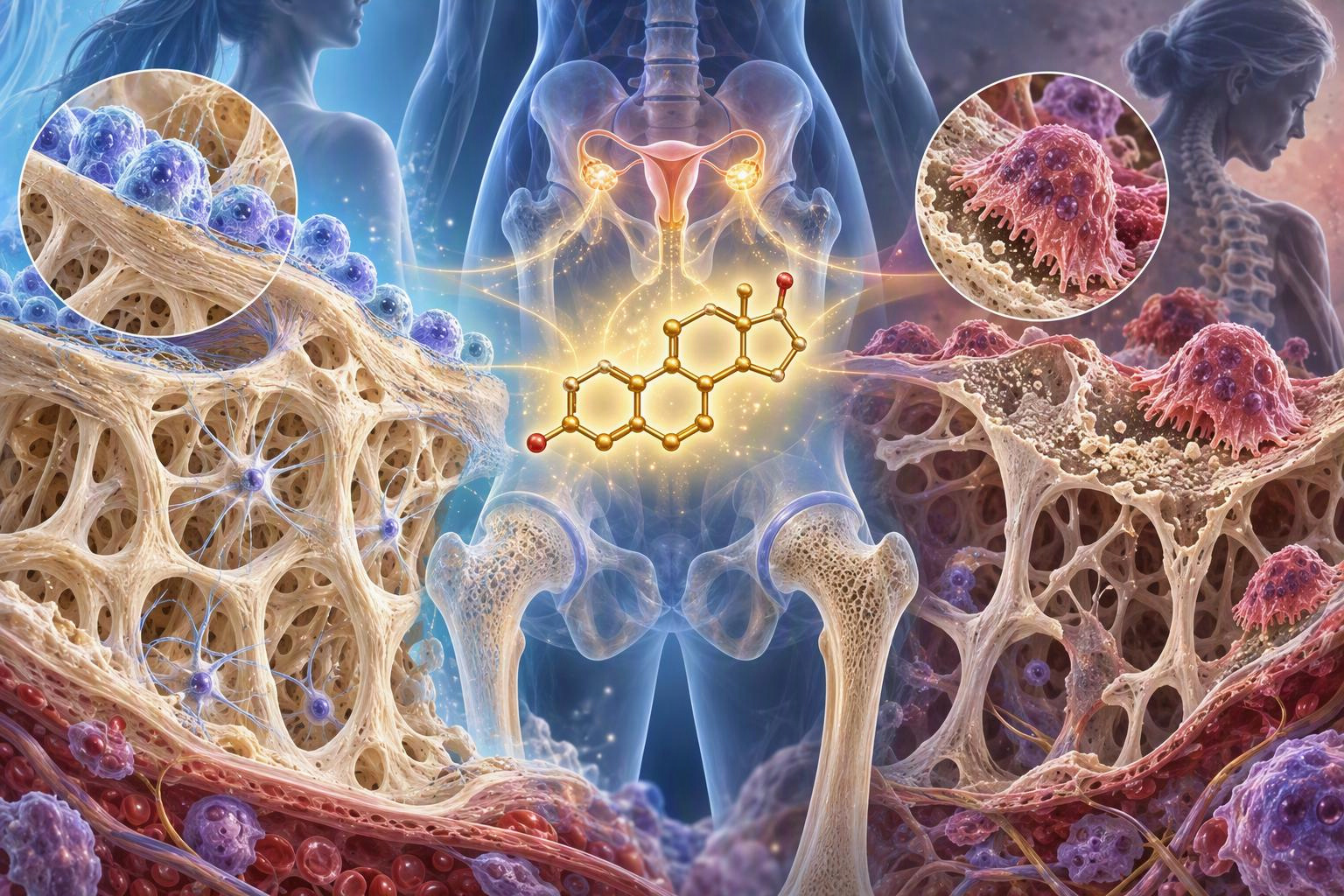
雌激素(estrogen)通常被认为是一类与女性生殖系统密切相关的性激素,但它在骨骼中的作用同样至关重要。尤其是17β-雌二醇(17β-estradiol,E2),不仅参与青春期骨骼生长和峰值骨量形成,而且在成年以后持续抑制过度骨吸收、维持骨重塑平衡。女性进入绝经期后,卵巢雌激素水平快速下降,骨吸收明显增强,骨形成无法完全补偿,由此出现绝经后快速骨丢失,并最终增加骨质疏松和脆性骨折风险。近年来的研究进一步表明,雌激素并不是简单地“让骨骼变强”,而是通过多个细胞类型和分子通路协调骨骼的动态平衡。
Estrogen is commonly recognized as a reproductive hormone, but it is equally important for skeletal physiology. In particular, 17β-estradiol (E2) contributes to pubertal skeletal development and peak bone mass and continues to suppress excessive bone resorption throughout adulthood. When ovarian estrogen production declines during menopause, bone resorption accelerates and is no longer adequately balanced by bone formation. This produces a rapid phase of postmenopausal bone loss and substantially increases the risk of osteoporosis and fragility fractures. Recent research indicates that estrogen does not simply “make bones stronger”; rather, it coordinates a complex network of skeletal cells and molecular pathways to maintain remodeling homeostasis.
1. 雌激素首先作用于“骨细胞网络”
雌激素的作用主要通过**雌激素受体α(ERα)和雌激素受体β(ERβ)介导,其中ERα被认为是骨保护作用的主要受体。ERα不仅存在于成骨细胞和破骨细胞,也存在于骨细胞以及骨髓微环境中的多种细胞。传统观点认为,雌激素主要通过细胞核内的受体调节基因转录;但近年来研究发现,ERα还能够定位于细胞膜,并通过快速的非基因组信号参与骨代谢。2025年发表于 Bone Research 的研究发现,成骨细胞谱系中的膜起始ERα信号(membrane-initiated ERα signaling)**对于女性小鼠正常皮质骨质量和骨力学强度具有重要作用。
Estrogen acts primarily through estrogen receptor alpha (ERα) and estrogen receptor beta (ERβ), with ERα considered the dominant mediator of skeletal protection. ERα is expressed in osteoblasts, osteoclasts, osteocytes, and several cell populations within the bone marrow microenvironment. Traditionally, estrogen signaling was viewed mainly as nuclear receptor-mediated regulation of gene transcription. However, research increasingly shows that ERα can also localize to the cell membrane and initiate rapid non-genomic signaling. A 2025 study in Bone Research demonstrated that membrane-initiated ERα signaling in osteoblast-lineage cells is important for maintaining cortical bone mass and mechanical strength in female mice.
2. 对破骨细胞:雌激素是一道“刹车”
雌激素最经典的骨保护作用之一,是抑制破骨细胞过度活化。破骨细胞负责清除旧骨,但如果其活性持续超过成骨细胞,就会造成骨量下降。雌激素能够影响RANKL–RANK–OPG系统,降低促进破骨细胞形成的信号,同时增强骨组织对破骨活动的抑制。因此,当雌激素下降时,骨重塑系统往往迅速转向“吸收占优势”的状态。绝经后最明显的早期骨丢失正是这一机制的典型表现。
One of the best-established skeletal actions of estrogen is its ability to restrain excessive osteoclast activity. Osteoclasts are essential for removing old bone, but persistent osteoclastic activity in excess of osteoblast-mediated formation leads to net bone loss. Estrogen influences the RANKL–RANK–OPG axis, limiting signals that promote osteoclast differentiation and activity. Consequently, when estrogen levels fall, bone remodeling rapidly shifts toward a resorptive state. The accelerated bone loss observed during the early postmenopausal period is a classic manifestation of this mechanism.
3. 2026年的新发现:雌激素还调节破骨细胞“糖基化”
传统的RANKL机制并不能完全解释雌激素缺乏后破骨细胞为什么会如此活跃。2026年发表在 Bone Research 的研究发现,雌激素还能够通过一种更加精细的机制调节破骨细胞:细胞表面唾液酸化(sialylation)。研究发现,RANKL可以通过c-FOS促进ST3GAL1表达,而ERα结合雌激素后能够干扰这一过程,从而抑制ST3GAL1介导的糖基化程序。单细胞RNA测序进一步显示,绝经后人类骨组织中的破骨细胞群体明显增加,并伴随FOS、CTSK和ST3GAL1等基因表达增强。这提示雌激素缺乏可能通过改变细胞表面糖生物学,促进破骨细胞形成和骨吸收。
The classical RANKL pathway does not fully explain why osteoclast activity becomes so pronounced after estrogen deficiency. A 2026 study published in Bone Research identified a more specialized mechanism involving cellular sialylation. RANKL was shown to stimulate ST3GAL1 expression through c-FOS, whereas estrogen-bound ERα interfered with this pathway and suppressed the ST3GAL1-dependent sialylation program. Single-cell RNA sequencing of human bone further revealed an expansion of osteoclast populations after menopause, accompanied by increased expression of FOS, CTSK, and ST3GAL1. These findings suggest that estrogen deficiency may promote osteoclastogenesis partly by altering the glycosylation biology of bone-resorbing cells.
4. 对成骨细胞:雌激素不仅减少骨吸收,也保护骨形成
如果只把雌激素理解为“抗骨吸收激素”,实际上是不完整的。成骨细胞同样受到雌激素影响。雌激素能够维持成骨细胞分化、胶原合成和骨基质形成,并通过多种信号通路影响RUNX2、Wnt/β-catenin等成骨程序。2026年的一项研究进一步发现,17β-雌二醇能够通过抑制MMP-8并激活Ras信号通路,改善成骨细胞的线粒体稳态,提高ATP产生、线粒体膜电位和氧化代谢能力,从而增强成骨分化。这意味着雌激素的骨保护作用可能不仅发生在细胞核的基因转录层面,也与成骨细胞的能量代谢密切相关。
Estrogen should therefore not be viewed simply as an “anti-resorptive hormone.” Osteoblasts are also strongly influenced by estrogen signaling. Estrogen supports osteoblast differentiation, collagen production, and matrix formation through pathways involving RUNX2 and Wnt/β-catenin signaling. A 2026 study further reported that 17β-estradiol can preserve mitochondrial homeostasis in osteoblasts by inhibiting MMP-8 and activating Ras signaling. This was associated with improved ATP production, mitochondrial membrane potential, oxidative metabolism, and osteogenic differentiation. These findings suggest that estrogenic skeletal protection may involve not only transcriptional regulation but also the metabolic and energetic state of osteoblasts.
5. 雌激素与氧化应激:保护成骨细胞免受“脂质过氧化”
2025年的研究又揭示了另一个重要机制:脂质过氧化(lipid peroxidation)。成骨细胞中的细胞膜含有大量多不饱和脂肪酸,因此容易受到氧化损伤。研究发现,雌激素能够调节谷胱甘肽过氧化物酶4(GPX4)的表达;当雌激素缺乏时,GPX4下降,磷脂过氧化增加,从而损害成骨细胞分化。进一步研究发现,脂质过氧化产物4-HNE能够影响integrin-linked kinase并破坏RUNX2信号。这个发现把“雌激素下降—氧化应激—成骨下降”连接成了一条完整的分子通路。
Another important mechanism involves lipid peroxidation. Osteoblast membranes contain abundant polyunsaturated fatty acids and are therefore susceptible to oxidative damage. Research published in 2025 demonstrated that estrogen regulates expression of glutathione peroxidase 4 (GPX4), an important enzyme that protects cells from phospholipid peroxidation. Estrogen deficiency reduces GPX4 expression and increases lipid peroxidation, impairing osteoblast differentiation. The lipid peroxidation product 4-hydroxynonenal can further disrupt integrin-linked kinase and RUNX2 signaling. This provides a mechanistic link between estrogen deficiency, oxidative stress, and impaired bone formation.
6. 为什么绝经后骨量下降如此迅速?
绝经并不是简单地意味着“年龄增长”。从骨代谢角度看,绝经是一次重要的内分泌转换。卵巢E2水平下降以后,破骨细胞募集和寿命延长,骨吸收表面增加,骨形成虽然也会被激活,但无法完全补偿快速增加的骨吸收。因此,在绝经后的最初几年,松质骨尤其容易发生快速丢失。与此同时,皮质骨也逐渐变薄,骨小梁连接性下降,最终导致骨强度下降。也就是说,骨折风险增加不仅仅来自骨密度下降,还来自骨微结构和材料性质的改变。
Menopause represents a major endocrine transition rather than simply a consequence of chronological ageing. When ovarian E2 levels decline, osteoclast recruitment and survival increase, enlarging the resorptive surface. Bone formation also increases to some extent, but it cannot fully compensate for the accelerated resorption. Trabecular bone is particularly vulnerable during the first several years after menopause. Over time, cortical bone also becomes thinner and trabecular connectivity deteriorates. Thus, increased fracture risk results not only from reduced bone mineral density but also from deterioration of bone microarchitecture and material properties.
7. 为什么男性也需要雌激素?
雌激素与骨健康并不是女性独有的话题。男性体内同样存在雌激素,而且男性骨骼中的一部分雌二醇来自睾酮经芳香化酶(aromatase)转化。研究显示,男性骨骼也需要一定水平的雌激素来抑制骨吸收并维持骨强度。因此,男性严重缺乏芳香化酶或ERα功能异常时,同样可能出现骨量低下和骨骼发育异常。近年来关于雌激素代谢的研究也越来越强调其在男女两性中的共同作用,而不是简单将E2视为“女性激素”。
Estrogen is not exclusively relevant to female skeletal health. Men also produce estrogen, and a proportion of male estradiol is generated by aromatization of testosterone. Adequate estrogen signaling is required in men to restrain bone resorption and maintain skeletal strength. Men with severe aromatase deficiency or impaired ERα signaling can develop low bone mass and abnormal skeletal development. Recent research increasingly emphasizes that estradiol is a metabolic and skeletal hormone in both women and men, rather than simply a “female hormone.”
8. 雌激素治疗:保护骨骼,但并非人人适用
由于雌激素缺乏是绝经后骨丢失的重要驱动因素,**绝经激素治疗(menopausal hormone therapy,MHT)**能够有效减少骨量丢失并降低骨折风险。2025年国际绝经学会(IMS)建议,对于合适的女性,MHT可以作为预防绝经相关骨丢失的重要治疗选择,其获益—风险比通常在绝经后10年以内或60岁以前开始治疗时更有利。2025年新加坡骨质疏松共识也提出,对于适当选择的绝经后女性,尤其是绝经后10年以内者,可以考虑MHT降低骨折风险。
Because estrogen deficiency is a major driver of postmenopausal bone loss, menopausal hormone therapy (MHT) can effectively reduce bone loss and fracture risk in appropriately selected women. The 2025 International Menopause Society recommendations identify MHT as an important option for preventing menopause-related bone loss, with the benefit-risk balance generally more favorable when treatment is initiated within 10 years after menopause or before age 60. The 2025 Singapore osteoporosis consensus similarly states that MHT may be considered for fracture-risk reduction in appropriately selected postmenopausal women, particularly within 10 years of the final menstrual period.
9. 但“补雌激素”并不等于人人都应该使用
雌激素具有明显的组织特异性,因此MHT并不是单纯的“骨质疏松补充剂”。不同年龄、绝经时间、给药途径、剂量以及是否合并孕激素,都可能改变获益与风险。2026年的最新综述再次强调,绝经后骨质疏松治疗需要综合考虑骨折风险、心血管风险、乳腺及子宫内膜相关风险等因素。对于高骨折风险但不适合MHT的人群,还可以根据具体情况选择双膦酸盐、地舒单抗、选择性雌激素受体调节剂或骨形成促进药物等。
However, “replacing estrogen” does not mean that estrogen therapy is appropriate for everyone. Estrogen has tissue-specific effects, and the benefits and risks of MHT depend on age, time since menopause, formulation, dose, route of administration, and whether a progestogen is required. A 2026 review emphasizes that management of postmenopausal osteoporosis should integrate fracture risk with cardiovascular, breast, and endometrial considerations. For women at high fracture risk who are not appropriate candidates for MHT, alternatives include bisphosphonates, denosumab, selective estrogen receptor modulators, and anabolic therapies, depending on individual circumstances.
10. 从“雌激素”走向“选择性骨保护”
未来研究的一个重要方向,是能否只激活雌激素对骨骼有益的信号,而尽量减少其在乳腺、子宫和血管等组织中的潜在风险。这也是**选择性雌激素受体调节剂(SERM)**以及组织选择性ERα调节剂研究的重要基础。2025年的膜ERα研究提示,针对不同细胞、不同亚细胞定位的雌激素信号进行精确调节,可能成为下一代骨代谢药物开发的重要思路。与此同时,2026年关于ST3GAL1、GPX4、MMP-8以及线粒体稳态的研究,也说明未来药物可能不必直接替代雌激素,而可以针对雌激素下游的关键分子进行干预。
An important future direction is to reproduce the beneficial skeletal actions of estrogen while minimizing undesirable effects in tissues such as the breast, endometrium, and cardiovascular system. This concept underlies the development of selective estrogen receptor modulators (SERMs) and tissue-selective estrogen signaling strategies. The 2025 work on membrane ERα suggests that precise targeting of estrogen signaling according to cell type and subcellular localization may become an important strategy for future skeletal therapeutics. Meanwhile, studies involving ST3GAL1, GPX4, MMP-8, and mitochondrial homeostasis suggest that future treatments may not need to replace estrogen directly; instead, they could selectively target key downstream pathways activated or suppressed by estrogen.
结语|Conclusion
雌激素在骨代谢中的作用远比“防止绝经后骨质疏松”更加复杂。它通过ERα/ERβ调节破骨细胞和成骨细胞,同时影响RANKL–OPG系统、Wnt信号、细胞氧化应激、线粒体功能以及近年来发现的细胞糖基化等过程。绝经后E2下降所造成的,并不是单一指标的改变,而是整个骨重塑网络的重新平衡。
Estrogen's role in bone metabolism is far more complex than simply “preventing postmenopausal osteoporosis.” Through ERα and ERβ, estrogen regulates both osteoclasts and osteoblasts and influences the RANKL–OPG axis, Wnt signaling, oxidative stress, mitochondrial function, and, more recently, cellular glycosylation. The decline in E2 during menopause therefore does not produce a single abnormality; it causes a broad reorganization of the bone-remodeling network.
未来的骨健康研究可能会从“补充多少雌激素”逐渐转向“如何精确控制雌激素信号”。如果能够选择性激活骨细胞中的保护性ERα信号、抑制异常的破骨细胞程序,同时恢复成骨细胞的抗氧化和线粒体功能,就有可能在不完全复制传统激素治疗风险的情况下获得骨保护效果。这种从**激素替代(hormone replacement)走向信号精准调控(precision estrogen signaling)**的转变,可能成为未来骨代谢研究的重要方向。
Future skeletal research may therefore shift from asking simply “how much estrogen should be replaced?” to asking “how can estrogen signaling be precisely controlled?” Selectively activating protective ERα pathways in skeletal cells, suppressing pathological osteoclast programs, and restoring antioxidant and mitochondrial function in osteoblasts may eventually provide skeletal benefits without fully reproducing the risks associated with systemic hormone exposure. The transition from hormone replacement to precision estrogen signaling may become an important direction in the future of bone-metabolism research.
参考文献|References
- Dou C, Dan Y, Zhang Z, et al. Estradiol regulates osteoclast sialylation via ST3Gal1 in postmenopausal osteoporosis. Bone Research. 2026;14:22.
- Min H, Li Y, Chen G, et al. 17β-Estradiol Maintains Mitochondrial Homeostasis in Osteoblasts by Inhibiting MMP-8 and Activating the Ras Signaling Pathway in Postmenopausal Osteoporosis. FASEB Journal. 2026;40(14):e72139.
- Jiang Y, Horkeby K, Henning P, et al. Membrane-initiated estrogen receptor-α signaling in osteoblasts is crucial for normal regulation of the cortical bone in female mice. Bone Research. 2025;13:65.
- Regulation of enzymatic lipid peroxidation in osteoblasts protects against postmenopausal osteoporosis. Nature Communications. 2025;16:758.
- Hevener AL, Correa SM. Metabolic Messengers: oestradiol. Nature Metabolism. 2025;7:1114–1122.
- Reid IR, Bolland MJ. Management of postmenopausal osteoporosis. Endocrine Reviews. 2026;47(4):468–495.
- International Menopause Society (IMS) recommendations and key messages on women's midlife health and menopause. 2025.
- 2025 Singapore consensus statements on the management of osteoporosis. Annals, Academy of Medicine, Singapore. 2025.
- Stanczyk FZ, Winer S, Sriprasert I, et al. Efficacy and safety of estrogen therapy for prevention of osteoporosis in postmenopausal women. Women's Health. 2026.