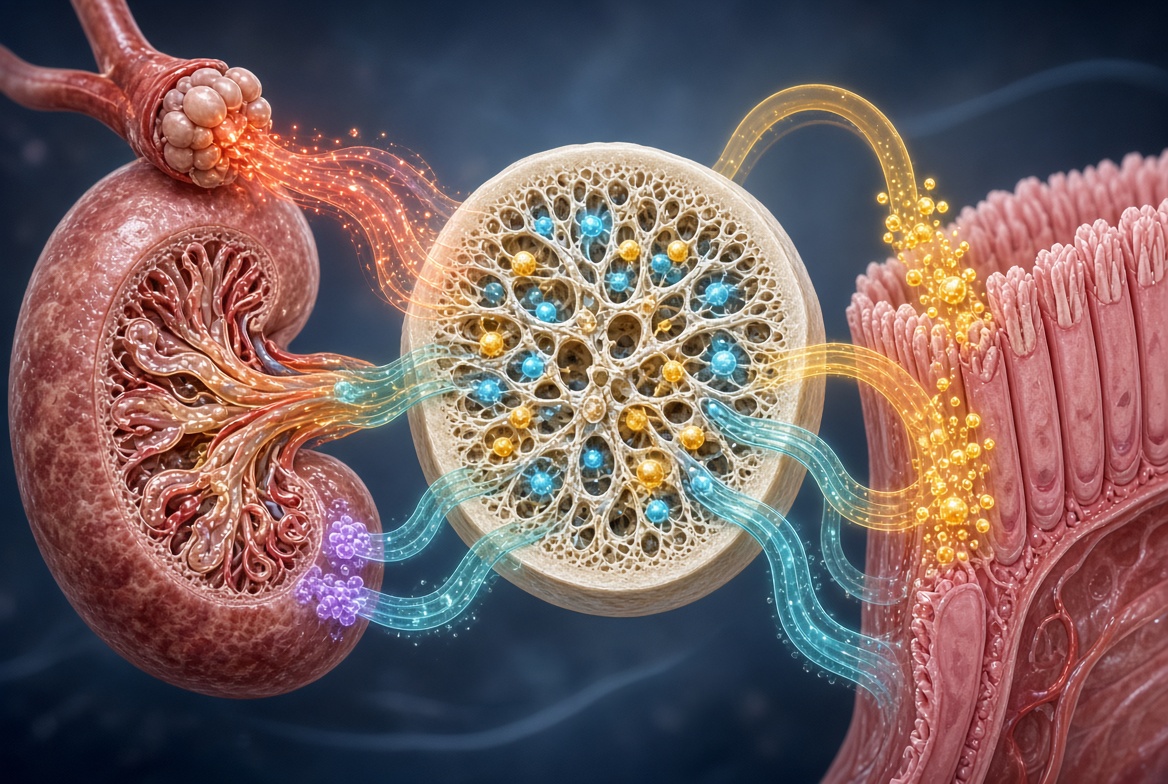
钙(calcium)和磷(phosphate)是人体最重要的两种矿物质之一。人体约99%的钙和85%左右的磷储存在骨骼和牙齿中,以羟基磷灰石〔Ca₁₀(PO₄)₆(OH)₂〕等形式构成骨组织的主要无机成分。然而,钙和磷并不仅仅是“骨骼材料”:钙参与肌肉收缩、神经传导、凝血以及细胞信号传递;磷则是ATP、核酸、细胞膜磷脂以及多种磷酸化反应的重要组成部分。因此,人体必须在“储存矿物质”和“维持血液中稳定浓度”之间建立精细的动态平衡。
Calcium and phosphate are two of the most important minerals in human physiology. Approximately 99% of body calcium and about 85% of body phosphorus are stored in bones and teeth, largely as hydroxyapatite [Ca₁₀(PO₄)₆(OH)₂]. Yet their functions extend far beyond the skeleton. Calcium is essential for muscle contraction, neurotransmission, coagulation, and intracellular signaling, whereas phosphate is a fundamental component of ATP, nucleic acids, phospholipids, and protein phosphorylation. The body must therefore maintain a highly regulated balance between mineral storage and stable circulating concentrations.
1. 三大器官:肠道、肾脏与骨骼
钙磷平衡并不是由单一器官控制的,而是由肠道、肾脏和骨骼共同完成。肠道决定膳食钙磷有多少能够进入体内;骨骼既是最大的储存库,也是一个动态的矿物质交换器官;肾脏则通过滤过、重吸收和排泄精确调节血液中的磷和钙。2026年的综述进一步指出,磷稳态涉及肠道吸收、细胞内外磷转运、骨基质储存以及肾小管重吸收等多个层面,而钠依赖性磷转运蛋白NPT2a、NPT2c以及肠道NPT2b等是这一系统的重要组成部分。
Calcium-phosphate homeostasis is controlled by an integrated system involving the intestine, kidney, and skeleton. The intestine determines how much dietary calcium and phosphate enters the body; bone serves as the largest mineral reservoir and a dynamic exchange compartment; and the kidney finely regulates circulating phosphate and calcium through filtration, reabsorption, and excretion. A 2026 review emphasized that phosphate homeostasis involves intestinal uptake, intracellular and extracellular phosphate transport, skeletal storage, and renal tubular reclamation, with transporters such as NPT2a, NPT2c, and intestinal NPT2b playing central roles.
2. PTH:钙稳态的重要“报警器”
当血液中的离子化钙下降时,甲状旁腺能够迅速感知这一变化,并增加**甲状旁腺激素(PTH)**分泌。PTH首先作用于肾脏,增加远端肾单位的钙重吸收,同时促进肾脏产生具有生物活性的1,25-二羟维生素D〔1,25(OH)₂D,calcitriol〕。此外,PTH还能够通过骨重塑间接增加钙从骨组织进入循环。与此同时,PTH会降低肾脏对磷的重吸收,使磷通过尿液排出,从而防止血钙升高后形成过量的钙磷沉积。
When circulating ionized calcium falls, the parathyroid glands rapidly sense the change and increase secretion of parathyroid hormone (PTH). PTH acts on the kidney to enhance calcium reabsorption and stimulate production of biologically active 1,25-dihydroxyvitamin D [1,25(OH)₂D, or calcitriol]. It can also promote calcium mobilization from bone through its effects on remodeling. At the same time, PTH reduces renal phosphate reabsorption, increasing urinary phosphate excretion and helping prevent excessive calcium-phosphate precipitation.
3. 维生素D:连接肠道与矿物质吸收的桥梁
维生素D在钙磷代谢中的核心作用,是促进肠道对矿物质的吸收。维生素D经过肝脏羟化形成25-羟维生素D〔25(OH)D〕,随后主要在肾脏经CYP27B1转化为活性形式calcitriol。Calcitriol通过维生素D受体(VDR)调节TRPV6、calbindin等蛋白,使肠道能够更加有效地吸收钙,同时促进磷的吸收。值得注意的是,calcitriol并不是一个单向“升高钙”的激素,其合成受到PTH、FGF23以及血磷等多重反馈调控。2025年的综述也进一步强调了维生素D、PTH和FGF23之间的相互调节关系。
Vitamin D provides a critical link between the intestine and mineral availability. Vitamin D is hydroxylated in the liver to form 25-hydroxyvitamin D [25(OH)D] and is then converted mainly in the kidney by CYP27B1 into active calcitriol. Through the vitamin D receptor (VDR), calcitriol increases expression of proteins such as TRPV6 and calbindin, enhancing intestinal calcium absorption and also promoting phosphate absorption. Importantly, calcitriol is not simply a “calcium-raising hormone”; its synthesis is tightly controlled by PTH, FGF23, and phosphate availability. Recent reviews continue to emphasize the interconnected regulation among vitamin D, PTH, and FGF23.
4. FGF23:骨骼发出的“磷酸盐调节信号”
过去,人们主要用PTH和维生素D解释钙磷代谢,而现在,**FGF23(成纤维细胞生长因子23)**已经成为理解这一系统不可缺少的第三个核心调节因子。FGF23主要由骨细胞和成骨细胞产生,当机体需要降低磷负荷时,骨组织可以释放FGF23作用于肾脏。FGF23通过FGFR和α-Klotho受体复合物降低近端肾小管NPT2a/NPT2c介导的磷重吸收,同时抑制calcitriol生成,从而减少肠道磷吸收。换句话说,**骨骼不仅是矿物质仓库,同时也是内分泌器官。**
Historically, calcium-phosphate physiology was largely explained by PTH and vitamin D. Today, fibroblast growth factor 23 (FGF23) is recognized as a third major regulator. Produced predominantly by osteocytes and osteoblasts, FGF23 acts as an endocrine signal when phosphate balance needs to be adjusted. Through FGFR–α-Klotho receptor complexes, FGF23 decreases renal phosphate reabsorption by suppressing NPT2a/NPT2c activity and reduces calcitriol production, thereby limiting intestinal phosphate uptake. In this sense, bone is not merely a mineral reservoir; it is also an endocrine organ.
5. α-Klotho:FGF23系统的关键“辅助受体”
FGF23的作用还揭示了肾脏在矿物质代谢中的另一层复杂性:α-Klotho。Klotho是FGF23发挥经典内分泌作用的重要辅助受体。2026年的最新研究进一步提出,肾小管不同区域的Klotho可能承担不同功能:近端肾小管Klotho更密切参与磷和维生素D代谢,而远端肾单位的Klotho可能更多参与钙重吸收、骨重塑以及可溶性Klotho水平调节。这一发现正在改变传统的“肾脏Klotho功能完全一致”的认识。
The FGF23 system also reveals another layer of complexity involving α-Klotho, an essential co-receptor for canonical FGF23 signaling. Recent 2026 research suggests that Klotho may have distinct functions along different nephron segments. Proximal tubular Klotho appears particularly important for phosphate and vitamin D metabolism, whereas distal nephron Klotho may contribute more directly to calcium reabsorption, bone remodeling, and circulating soluble Klotho levels. These findings are reshaping the traditional view that renal Klotho has a uniform function throughout the nephron.
6. 真正的核心:PTH–Vitamin D–FGF23三角调控
因此,现代钙磷代谢可以被理解为一个动态的PTH–Vitamin D–FGF23调控网络。低血钙倾向于刺激PTH;PTH促进calcitriol形成;calcitriol增加肠道钙磷吸收,同时促进FGF23产生;而FGF23反过来抑制calcitriol并增加肾脏磷排泄。磷本身也不再被认为只是“被动代谢物”。最新研究表明,磷可能直接参与细胞信号,并影响PTH和FGF23分泌,形成更加复杂的反馈回路。
Modern calcium-phosphate physiology can therefore be viewed as a dynamic PTH–vitamin D–FGF23 regulatory network. Low calcium tends to stimulate PTH, which promotes calcitriol production. Calcitriol increases intestinal calcium and phosphate absorption and can stimulate FGF23 production. FGF23 then suppresses calcitriol synthesis and increases renal phosphate excretion. Importantly, phosphate itself is increasingly recognized as an active signaling molecule rather than merely a metabolic substrate. Recent work indicates that intracellular and extracellular phosphate can influence signaling pathways and modify PTH and FGF23 secretion, adding another layer of feedback regulation.
7. 为什么肾脏疾病会打破钙磷平衡?
慢性肾脏病(CKD)是理解钙磷代谢失衡最典型的例子。随着肾功能下降,磷排泄能力逐渐下降,FGF23和PTH往往较早升高,而calcitriol和Klotho下降;在疾病进一步发展后,出现明显的高磷血症、继发性甲状旁腺功能亢进以及骨矿化和骨重塑异常。这种疾病谱被称为CKD-MBD(慢性肾脏病—矿物质和骨代谢紊乱)。2026年的综述指出,CKD早期甚至在血钙和血磷仍处于正常范围时,FGF23、PTH、Klotho和维生素D代谢已经可能发生明显变化。
Chronic kidney disease (CKD) provides one of the clearest examples of disrupted mineral metabolism. As renal function declines, phosphate excretion becomes progressively impaired. FGF23 and PTH often rise early, while calcitriol and Klotho decline. With further progression, hyperphosphatemia, secondary hyperparathyroidism, and abnormalities of bone mineralization and remodeling may develop. This spectrum is known as chronic kidney disease–mineral and bone disorder (CKD-MBD). A 2026 review emphasized that substantial abnormalities in FGF23, PTH, Klotho, and vitamin D metabolism may occur even while serum calcium and phosphate remain apparently normal during early CKD.
8. 最新研究:骨骼可能主动“计算”磷需求
2026年的研究正在进一步改变我们对钙磷代谢的认识。例如,最新实验研究发现,CKD状态下成骨细胞的脂肪酸代谢可能影响骨组织对磷的利用,并进一步影响FGF23产生。研究者发现,骨组织中的GPAT2代谢途径发生改变时,可能减少磷向骨基质的正常整合,同时增加FGF23水平;针对这一代谢途径的干预在动物和细胞模型中降低了循环FGF23和磷水平,并减轻血管钙化。这提示骨细胞的能量代谢本身可能成为全身矿物质稳态的重要调节节点。
Recent research is pushing this concept even further. A 2026 study found that altered fatty-acid metabolism in osteoblasts may influence skeletal phosphate incorporation and FGF23 production in CKD. Manipulation of the bone GPAT2 metabolic pathway reduced circulating FGF23 and phosphate and attenuated vascular calcification in experimental models. These findings suggest that osteoblast metabolism itself may function as an important control node in systemic mineral homeostasis, linking skeletal metabolism with cardiovascular complications of CKD.
9. 急性肾损伤也会迅速改变这一系统
值得注意的是,钙磷调控并不是慢性疾病才会发生变化。2026年发表的一项研究发现,急性肾损伤后FGF23可以在短时间内明显升高,并伴随尿磷排泄增加、calcitriol下降和PTH升高;随着肾功能恢复,这些变化又可以部分逆转。这提示FGF23升高并不一定意味着单纯的“病理状态”,在某些情况下,它可能首先是一种适应性反应,帮助机体快速限制磷潴留。
Importantly, disturbances in mineral metabolism are not restricted to chronic disease. A 2026 experimental study showed that acute kidney injury can rapidly increase FGF23, accompanied by increased urinary phosphate excretion, reduced calcitriol, and elevated PTH. As renal function recovered, these abnormalities also improved. This suggests that an acute rise in FGF23 may sometimes represent an adaptive response designed to limit phosphate accumulation rather than simply a marker of pathological mineral imbalance.
10. 从“钙补充”走向“矿物质网络管理”
因此,未来的骨健康管理不能简单理解为“缺钙就补钙”。真正决定骨骼健康的,是钙、磷、维生素D、PTH、FGF23、Klotho、骨重塑以及肾功能之间的动态关系。2025—2026年的研究正在推动一个新的认识:骨骼、肾脏和内分泌系统实际上构成了一个连续的“骨—肾—矿物质轴”。未来,随着多组学、单细胞技术和人工智能模型的发展,我们可能不仅能够测量血钙和血磷,还能够根据FGF23、PTH、Klotho、骨转换标志物以及肾功能等数据,动态判断一个人的矿物质代谢状态。
The future of skeletal health management therefore cannot simply be reduced to “taking more calcium.” Bone health depends on the dynamic interaction among calcium, phosphate, vitamin D, PTH, FGF23, Klotho, bone remodeling, and kidney function. Research in 2025–2026 increasingly supports the concept of an integrated bone–kidney–mineral axis. With advances in multi-omics, single-cell technologies, and artificial intelligence, future assessment may move beyond measuring serum calcium and phosphate toward dynamic characterization of mineral metabolism using FGF23, PTH, Klotho, bone-turnover markers, and renal function.
结语|Conclusion
钙磷代谢是人体最精密的生理调控系统之一。骨骼既是钙磷最大的储存库,也是能够感知并主动调节矿物质平衡的内分泌器官;肾脏负责精细控制磷排泄和钙重吸收;肠道负责矿物质输入;而PTH、维生素D、FGF23和Klotho则构成连接这些器官的核心信号网络。今天的研究正在告诉我们:骨健康不是单纯的“骨密度问题”,而是一个全身性矿物质代谢问题。
Calcium-phosphate metabolism is one of the most sophisticated regulatory systems in human physiology. Bone is not merely the largest reservoir of calcium and phosphate; it is also an endocrine organ capable of sensing and actively regulating mineral balance. The kidney controls phosphate excretion and calcium conservation, the intestine determines mineral input, and PTH, vitamin D, FGF23, and Klotho form the central signaling network connecting these organs. Modern research increasingly suggests that skeletal health is not simply a matter of bone density—it is fundamentally a problem of systemic mineral metabolism.
参考文献|References
- Bergwitz C. Phosphate homeostasis and endocrine regulators. Pediatric Nephrology. 2026. doi:10.1007/s00467-026-07399-z.
- Solis E, White KE, Meyer MB. The genetics and outcomes of an altered FGF23-1,25D-PTH axis in diseases of mineral metabolism. Journal of Bone and Mineral Research. 2026;41(6):598–608. doi:10.1093/jbmr/zjag057.
- Fibroblast growth factor 23 (FGF23): From synthesis to cleavage. 2026 review.
- Klotho revisited: tubular heterogeneity reshapes mineral metabolism, aging, and CKD. 2026 review.
- Komaba H, Nakagawa Y, Ito M, et al. FGF23 regulates phosphate and vitamin D metabolism during acute kidney injury and recovery. American Journal of Physiology-Renal Physiology. 2026;331(4):F622–F631. doi:10.1152/ajprenal.00139.2026.
- Moustaki M, Paschou SA, Palioura E, et al. Chronic kidney disease: from mineral dysregulation to bone and cardiovascular disease. 2026. doi:10.1007/s40618-026-02955-8.
- Targeting osteoblast fatty acid metabolism attenuates skeletal and cardiovascular complications in chronic kidney disease models. Journal of Clinical Investigation. 2026.
- Phosphate-Mediated Regulation of Intracellular Calcium Dynamics. 2026.
- Clinical practice recommendations for the diagnosis and management of X-linked hypophosphataemia. Nature Reviews Nephrology. 2025;21:330–354.
- Vitamin D and chronic kidney disease: mechanisms, clinical implications, and future perspectives. Frontiers in Medicine. 2025.