骨骼并不是“静止的结构”
我们通常把骨骼想象成坚硬、固定不变的支架,支撑身体、保护内脏。但实际上,骨组织始终处于动态变化之中。旧骨不断被清除,新骨不断形成,这个过程被称为骨重塑(bone remodeling)。其中最重要的两类细胞,就是成骨细胞和破骨细胞。它们一个负责“建造”,一个负责“拆除”,共同维持骨骼的强度和稳定。
We often think of bones as hard, static structures that simply support the body and protect internal organs. In reality, bone tissue is constantly changing. Old bone is continuously removed and new bone is formed through a process called bone remodeling. Two major cell types control this process: osteoblasts and osteoclasts. One builds bone, while the other removes it, and together they maintain skeletal strength and integrity.
成骨细胞:骨骼的“建筑师”
成骨细胞(osteoblasts)主要负责形成新的骨组织。它们来源于间充质干细胞谱系,能够合成大量骨基质蛋白,尤其是Ⅰ型胶原蛋白。成骨细胞首先制造一种柔软的有机骨基质,随后促进其中的矿物质沉积,使骨基质逐渐硬化。骨形成过程中,一部分成骨细胞最终会被包埋在自己制造的骨组织中,并转变为骨细胞(osteocytes)。
Osteoblasts are the primary bone-forming cells. They arise from the mesenchymal stem cell lineage and produce large amounts of bone matrix proteins, especially type I collagen. Osteoblasts first create a relatively flexible organic matrix and then promote mineral deposition, gradually making the matrix harder. Some osteoblasts eventually become trapped within the bone they have produced and differentiate into osteocytes, the long-lived cells embedded throughout mature bone.
破骨细胞:骨骼的“拆除工”
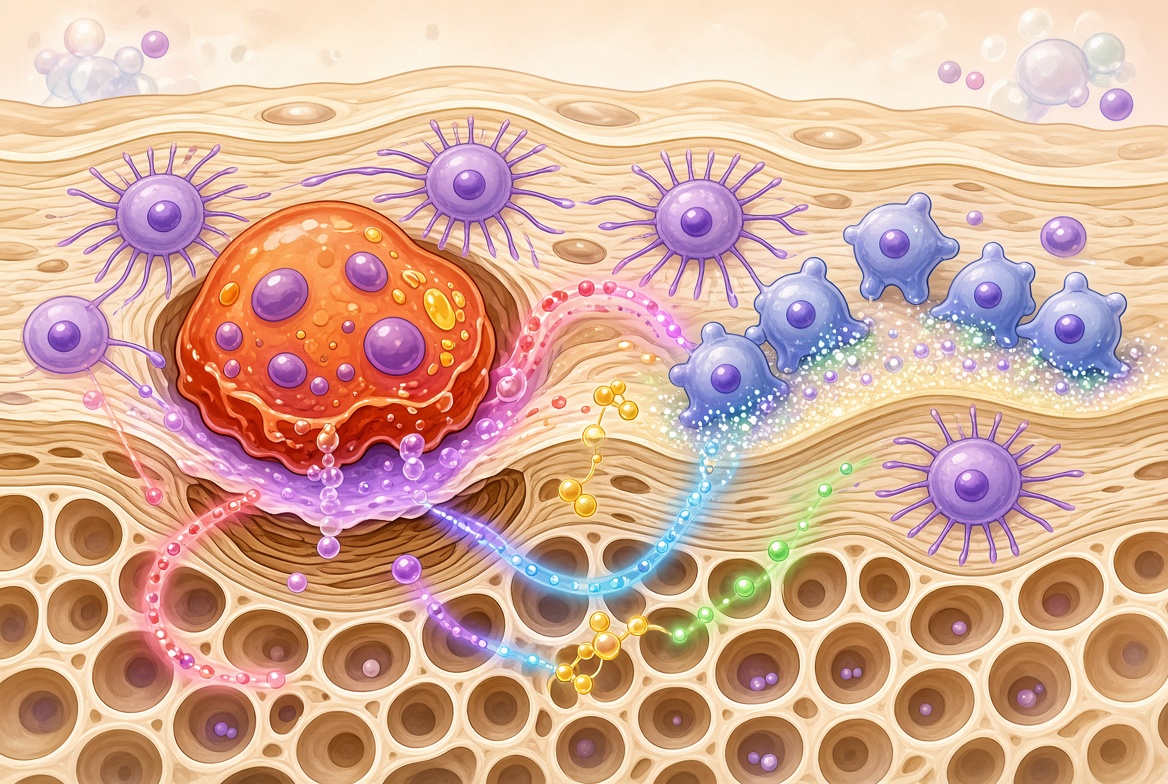
如果只有成骨而没有骨吸收,骨骼同样无法正常更新。**破骨细胞(osteoclasts)**负责吸收和清除旧骨。它们是一种体积较大的多核细胞,来源于造血系统中的单核细胞/巨噬细胞谱系。破骨细胞能够附着在骨表面,并形成特殊的封闭区域,在其中释放酸和蛋白水解酶,将矿物质和有机骨基质分解。
Osteoclasts are essential because bone cannot remain healthy through bone formation alone. These large, multinucleated cells arise from the monocyte/macrophage lineage of the hematopoietic system. They attach tightly to the bone surface and create a specialized resorption compartment. Within this compartment, acids dissolve the mineral component of bone while proteolytic enzymes break down the organic matrix.
两种细胞如何“合作”?
成骨细胞和破骨细胞并不是各自独立工作的。它们之间存在复杂的细胞信号交流。例如,成骨细胞及其前体细胞可以产生RANKL,促进破骨细胞前体成熟;同时,**OPG(osteoprotegerin)**可以结合RANKL,从而抑制破骨细胞形成。因此,RANKL/OPG系统是调节骨吸收的重要分子开关。
Osteoblasts and osteoclasts do not work independently. They communicate through a sophisticated network of molecular signals. For example, osteoblast-lineage cells can produce RANKL, which promotes osteoclast differentiation, while osteoprotegerin (OPG) binds RANKL and limits osteoclast formation. The RANKL/OPG system therefore acts as a major molecular regulator of bone resorption.
为什么骨骼需要不断“拆了再建”?
骨重塑并不是简单地把旧骨换成新骨。它能够修复日常活动产生的微小损伤,调整骨骼结构,使骨骼适应机械负荷,同时参与钙、磷等矿物质的调节。正常情况下,骨形成和骨吸收处于动态平衡。如果破骨细胞长期过度活跃,骨吸收超过骨形成,就可能导致骨量下降和骨强度降低,例如骨质疏松症(osteoporosis)。
Bone remodeling is more than simply replacing old bone with new bone. It helps repair microscopic damage caused by daily mechanical stress, adapts bone architecture to changing loads, and contributes to the regulation of minerals such as calcium and phosphate. Under normal conditions, bone formation and resorption remain in dynamic balance. If osteoclast activity becomes excessive for a prolonged period, bone resorption can exceed formation, contributing to reduced bone mass and weaker bones, as seen in osteoporosis.
成骨细胞和破骨细胞:不是简单的“对立关系”
有趣的是,成骨细胞和破骨细胞并不是简单的“敌对双方”。破骨细胞清除旧骨之后,会释放骨基质中储存的生长因子,并通过细胞信号影响后续的骨形成。换句话说,“拆除”本身也可以为“重建”创造条件。这种高度协调的耦合关系,是骨重塑能够持续进行的重要基础。
Interestingly, osteoblasts and osteoclasts are not simply opposing forces. When osteoclasts remove old bone, they can release growth factors stored within the bone matrix and influence subsequent bone formation through cellular signaling. In other words, resorption can help create the conditions for rebuilding. This tightly coupled relationship is fundamental to continuous bone remodeling.
激素也在调节这场“建筑工程”
骨细胞活动还受到多种激素和全身因素调节。甲状旁腺激素、维生素D、雌激素以及其他代谢信号,都能够影响成骨细胞和破骨细胞的行为。尤其是雌激素水平下降后,破骨细胞活性可能增强,因此绝经后女性骨量下降的风险明显增加。这也是理解女性绝经期骨健康的重要生物学基础。
Bone cell activity is also regulated by hormones and systemic signals. Parathyroid hormone, vitamin D, estrogen, and other metabolic factors can influence both osteoblasts and osteoclasts. In particular, declining estrogen levels can increase osteoclast activity, which helps explain why bone loss becomes more common after menopause. This biological mechanism is central to understanding skeletal health during and after the menopausal transition.
骨骼健康的核心:保持动态平衡
因此,骨骼健康并不是“骨头越硬越好”,而是要维持一个恰当的动态平衡。成骨细胞负责建造,破骨细胞负责清除,骨细胞负责感知机械环境并协调局部反应。三者共同构成一个精密的骨骼调控网络。运动、营养、激素状态、年龄以及疾病等因素,都可能改变这个系统的平衡。
Healthy bones are therefore not simply about having the hardest possible skeleton. What matters is maintaining an appropriate dynamic balance. Osteoblasts build bone, osteoclasts remove it, and osteocytes sense the mechanical environment and help coordinate local responses. Together, these cells form an intricate regulatory network. Physical activity, nutrition, hormonal status, aging, and disease can all influence this balance.
从“骨头”到“活的器官”
今天的骨科学已经不再把骨骼看成一种单纯的机械材料。骨组织具有细胞、血管、神经和复杂的分子信号网络,是一个真正意义上的活组织(living tissue)。理解成骨细胞与破骨细胞之间的相互作用,不仅能够帮助我们认识骨骼如何生长、修复和衰老,也为骨质疏松症等骨骼疾病的治疗提供了重要基础。
Modern bone biology no longer views the skeleton as merely a mechanical material. Bone is a living tissue, containing cells, blood vessels, nerves, and complex molecular signaling networks. Understanding the interaction between osteoblasts and osteoclasts helps explain how bones grow, repair themselves, and age—and provides an important foundation for developing treatments for skeletal diseases such as osteoporosis.
总结:成骨细胞负责“建”,破骨细胞负责“拆”,而骨骼健康的关键,就在于让这场“拆建工程”始终保持平衡。
In one sentence: osteoblasts build, osteoclasts resorb, and skeletal health depends on keeping this continuous process of demolition and reconstruction in balance.
参考文献|References
- Kim JM, Lin C, Stavre Z, et al. Osteoblast-Osteoclast Communication and Bone Homeostasis. Cells. 2020;9(9):2073. doi:10.3390/cells9092073.
- Chen X, Wang Z, Duan N, et al. Osteoblast-osteoclast interactions. Connective Tissue Research. 2018;59(2):99–107.
- Boyle WJ, Simonet WS, Lacey DL. Osteoclast differentiation and activation. Nature. 2003;423:337–342.
- Sims NA, Martin TJ. Coupling the activities of bone formation and resorption during bone remodeling. Bone. 2012;50(6):1337–1345.
- Stegen S, Carmeliet G. Metabolic regulation of skeletal cell fate and function. Nature Reviews Endocrinology. 2024;20:399–413. doi:10.1038/s41574-024-00969-x.
- Stegen S, Moermans K, Stockmans I, et al. The serine synthesis pathway drives osteoclast differentiation through epigenetic regulation of NFATc1 expression. Nature Metabolism. 2024;6:141–152.