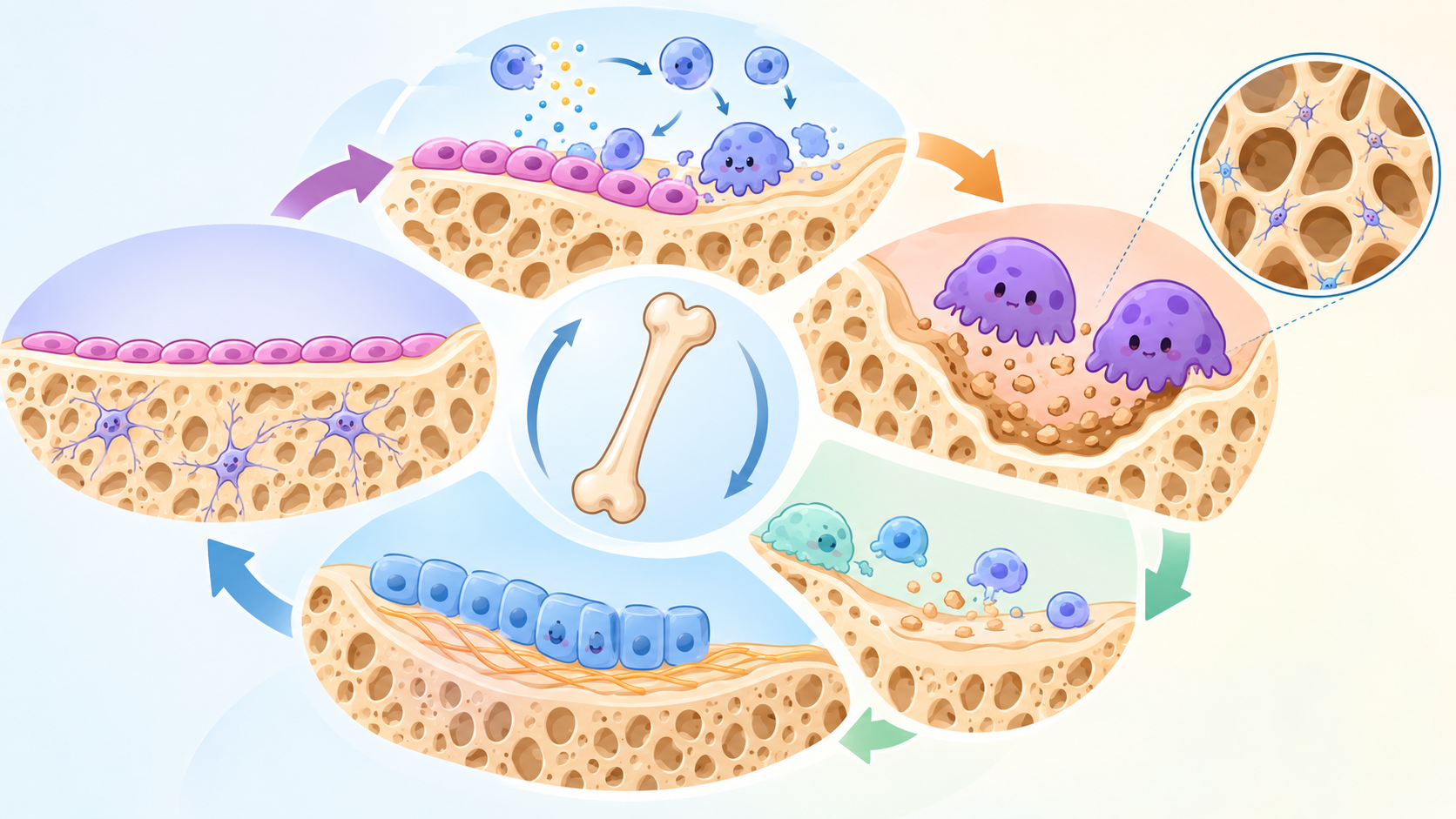
骨并不是一种“静止”的组织。即使成年以后,人体骨骼仍然持续经历旧骨清除、新骨形成以及矿物质重新沉积的动态过程,这一过程被称为骨重塑(bone remodeling)。骨重塑不仅决定骨量,还影响骨的微结构、力学性能、钙磷稳态以及损伤修复。传统上,人们常将骨重塑理解为“破骨细胞拆除旧骨、成骨细胞补上新骨”的循环;而近年来的研究表明,骨细胞(osteocyte)、免疫细胞、血管、神经以及骨髓微环境共同构成了一个高度复杂的调控网络。
Bone is not a static tissue. Even after skeletal maturity, our bones continuously undergo bone remodeling, a dynamic process involving the removal of old or damaged bone and the formation of new bone. Remodeling is essential not only for maintaining bone mass, but also for preserving microarchitecture, mechanical strength, mineral homeostasis, and skeletal repair. Traditionally, remodeling has been simplified as a process in which osteoclasts remove old bone and osteoblasts replace it. Recent research, however, shows that osteocytes, immune cells, blood vessels, nerves, and the bone-marrow microenvironment form an intricate regulatory network controlling this cycle.
1. Activation|启动:骨骼首先“感知”变化
骨重塑通常始于局部骨组织受到机械负荷变化、微损伤、激素变化或代谢信号刺激。此时,埋藏在骨基质中的**骨细胞(osteocytes)**发挥关键作用。骨细胞约占成熟骨细胞群体的主要部分,它们通过复杂的骨小管—骨陷窝网络感受机械刺激,并释放包括RANKL、硬化蛋白(sclerostin)等在内的信号分子。骨细胞因此可以被视为骨骼的“传感器”和调度中心。2025年的综述进一步强调,Piezo1、integrin、YAP/TAZ和Wnt/β-catenin等机械转导通路,是连接机械刺激与骨重塑的重要桥梁。
Bone remodeling often begins when a region of bone experiences altered mechanical loading, microdamage, hormonal signals, or metabolic stress. Osteocytes, which are embedded within the mineralized matrix, play a central role in detecting these changes. Through their extensive lacunar-canalicular network, osteocytes sense mechanical stimuli and release signaling molecules such as RANKL and sclerostin. They can therefore be regarded as the “sensor and coordinator” of the skeletal system. Recent research has highlighted mechanotransduction pathways involving Piezo1, integrins, YAP/TAZ, and Wnt/β-catenin as important links between mechanical forces and remodeling responses.
2. Resorption|骨吸收:破骨细胞清除旧骨
启动信号随后会促进**破骨细胞(osteoclasts)**募集和活化。破骨细胞来源于单核—巨噬细胞谱系,通过RANK–RANKL信号轴获得成熟和活化信号,而OPG(osteoprotegerin)则可以作为“诱饵受体”结合RANKL,从而抑制破骨细胞形成。因此,RANKL/OPG比例是调节骨吸收的重要分子开关。成熟破骨细胞附着于骨表面后形成密闭的骨吸收区,通过酸化以及蛋白酶等机制溶解矿物质和降解骨基质,形成骨吸收陷窝。
The activation signals recruit and stimulate osteoclasts, multinucleated cells derived from the monocyte–macrophage lineage. Osteoclast differentiation and activation are strongly regulated by the RANK–RANKL pathway, while osteoprotegerin (OPG) acts as a decoy receptor that binds RANKL and suppresses osteoclastogenesis. The balance between RANKL and OPG therefore functions as an important molecular switch controlling bone resorption. Mature osteoclasts attach to the bone surface and create a sealed resorption compartment, where acidification dissolves the mineral phase and proteolytic enzymes degrade the organic matrix.
3. Reversal|反转阶段:从“拆除”转向“重建”
骨吸收并不会无限持续。破骨细胞完成任务后逐渐离开或凋亡,骨重塑进入一个非常重要但过去研究相对不足的反转阶段(reversal phase)。在这一阶段,骨吸收表面逐渐转变为适合成骨细胞工作的微环境。近年来研究发现,骨吸收过程中释放的基质成分、生长因子以及骨细胞和免疫细胞产生的信号,都可能参与这一“拆除—重建”转换。因此,骨重塑并不是两个完全独立的过程,而是存在明显的骨吸收—骨形成偶联(coupling)。
Bone resorption does not continue indefinitely. After completing their task, osteoclasts become inactive or undergo apoptosis, and remodeling enters the less well-understood reversal phase. During this transition, the resorbed surface is transformed into a microenvironment suitable for osteoblast activity. Matrix-derived growth factors, signals released by osteocytes, and immune-cell mediators may all contribute to this transition. Thus, bone resorption and bone formation are not independent processes; they are tightly coupled both spatially and temporally.
4. Formation|骨形成:成骨细胞重新建造骨组织
随后,**成骨细胞(osteoblasts)**进入骨吸收区域。它们来源于间充质谱系细胞,并通过Wnt/β-catenin等信号通路促进增殖、分化以及骨基质合成。成骨细胞首先产生富含Ⅰ型胶原的有机骨基质,即类骨质(osteoid),随后通过碱性磷酸酶等机制促进矿化。当部分成骨细胞最终被包埋在自身形成的骨基质中,它们会分化为新的骨细胞;另一些则进入静息状态或发生凋亡。
Osteoblasts subsequently populate the resorption cavity. Derived from mesenchymal-lineage cells, osteoblasts promote proliferation, differentiation, and matrix production through pathways including Wnt/β-catenin signaling. They first synthesize an organic matrix rich in type I collagen, known as osteoid, which is subsequently mineralized through processes involving alkaline phosphatase and other factors. Some osteoblasts eventually become embedded within the matrix they produced and differentiate into new osteocytes, while others become bone-lining cells or undergo apoptosis.
5. Mineralization|矿化:让新骨获得强度
新形成的类骨质还不是成熟骨组织。随后发生的**矿化过程(mineralization)**使羟基磷灰石晶体沉积于胶原基质中,从而赋予骨骼硬度和承重能力。这个阶段受到钙、磷、维生素D、甲状旁腺激素(PTH)以及FGF23等因素共同调控。值得注意的是,这些因素不仅调节全身钙磷代谢,也直接影响骨细胞和骨重塑过程。近年来,对骨转换标志物的研究也从传统的骨形成和骨吸收指标逐渐扩展至sclerostin、DKK-1、RANKL/OPG、periostin以及miRNA等更加复杂的分子指标。
Newly produced osteoid is not yet mature bone. During mineralization, hydroxyapatite crystals are deposited within the collagen-rich matrix, giving bone its characteristic stiffness and load-bearing capacity. This process is regulated by calcium, phosphate, vitamin D, parathyroid hormone (PTH), fibroblast growth factor 23 (FGF23), and other factors. Importantly, these regulators influence not only systemic mineral metabolism but also bone-cell activity and remodeling. Recent research has expanded the concept of bone turnover biomarkers beyond conventional formation and resorption markers to include sclerostin, DKK-1, RANKL/OPG, periostin, sphingosine-1-phosphate, and microRNAs.
6. The Cycle Continues|循环继续:骨骼进入下一轮更新
当新的骨组织成熟后,一部分成骨细胞转化为骨细胞,重新进入骨骼内部的骨陷窝—骨小管网络。新的骨细胞又能够感知机械负荷,并根据身体运动、年龄、激素水平和代谢状态调整下一轮骨重塑。由此形成一个连续循环:
Activation → Resorption → Reversal → Formation → Mineralization → Activation
这种循环并不是简单的“旧骨换新骨”。它实际上是骨骼不断进行损伤修复、结构优化和力学适应的过程。2026年的数学建模研究甚至提示,骨细胞网络本身可能形成类似动态控制系统的结构,并能够解释卸载后重新负重所产生的部分骨适应现象。
Once new bone matures, some osteoblasts become osteocytes and return to the lacunar-canalicular network. These newly formed osteocytes can again sense mechanical loading and modify subsequent remodeling according to physical activity, age, hormonal status, and metabolic conditions. The cycle can therefore be summarized as:
Activation → Resorption → Reversal → Formation → Mineralization → Activation
This cycle is not simply a mechanism for replacing “old bone with new bone.” It represents a continuous process of damage repair, structural optimization, and mechanical adaptation. A mathematical model published in 2026 further suggested that the osteocyte network may behave as a dynamic control system capable of generating complex skeletal adaptation responses, including partial recovery after unloading followed by reloading.
7. Why Does Remodeling Become Unbalanced?|为什么骨重塑会失衡?
健康状态下,骨吸收与骨形成基本保持动态平衡。然而,随着衰老、绝经、长期缺乏运动、慢性炎症或某些疾病的发展,这种耦联关系可能发生改变。当破骨细胞活性长期超过成骨细胞,新骨形成无法弥补骨吸收造成的损失,骨量和骨微结构便会逐渐下降,最终增加骨质疏松和脆性骨折风险。最新研究尤其关注细胞衰老、SASP(衰老相关分泌表型)、免疫衰老以及骨髓微环境改变。2026年的研究认为,衰老细胞产生的炎症因子、趋化因子以及Wnt拮抗因子等,可能共同推动年龄相关的骨重塑失衡。
Under healthy conditions, bone resorption and formation remain dynamically coupled. With ageing, menopause, prolonged physical inactivity, chronic inflammation, or certain diseases, this coupling may become disrupted. When osteoclastic resorption persistently exceeds osteoblastic formation, bone mass and microarchitecture gradually deteriorate, increasing the risk of osteoporosis and fragility fractures. Current research is increasingly focused on cellular senescence, the senescence-associated secretory phenotype (SASP), immunosenescence, and alterations in the bone-marrow microenvironment. Research published in 2026 suggests that inflammatory cytokines, chemokines, and Wnt antagonists released by senescent cells may contribute to age-related disruption of bone remodeling.
8. From a “Cycle” to a “Network”|从“周期”走向“网络”
因此,今天我们对骨重塑的理解已经发生改变。它不再只是“破骨细胞—成骨细胞”的二元循环,而更接近一个由骨细胞、破骨细胞、成骨细胞、免疫细胞、血管、神经和骨髓基质细胞共同组成的多细胞网络。2025—2026年的研究进一步推动了骨免疫学、机械生物学、骨衰老以及精准骨代谢研究的发展。与此同时,CCN3等新的骨合成代谢调节因子、衰老细胞清除策略以及基于多组学和人工智能的骨重塑预测,都可能成为未来骨健康研究的重要方向。
Our understanding of bone remodeling has therefore shifted from a simple “cycle” toward a sophisticated multicellular network involving osteocytes, osteoclasts, osteoblasts, immune cells, vascular cells, nerves, and bone-marrow stromal cells. Research during 2025–2026 has further expanded the fields of osteoimmunology, mechanobiology, skeletal ageing, and precision bone metabolism. Emerging osteoanabolic regulators such as CCN3, approaches targeting cellular senescence, and multi-omics or artificial-intelligence-based prediction of remodeling states may become important directions for future skeletal research.
结语|Conclusion
骨重塑周期是人体维持骨骼生命力的核心机制之一。它让骨骼能够不断清除微损伤、适应机械负荷并维持钙磷平衡。真正值得关注的未来方向,不只是“如何增加骨密度”,而是如何精确调节骨吸收与骨形成之间的耦联关系,恢复骨细胞的机械感知能力,并重建健康的骨髓—免疫—血管微环境。这也意味着,未来的骨健康管理可能逐渐从单纯关注骨密度,走向对整个骨重塑网络的动态监测和精准干预。
The bone remodeling cycle is one of the fundamental mechanisms sustaining skeletal vitality. It enables the skeleton to remove microdamage, adapt to mechanical loading, and maintain calcium–phosphate homeostasis. The future of skeletal medicine may therefore extend beyond simply “increasing bone mineral density.” A more precise goal is to restore the coupling between resorption and formation, preserve osteocyte mechanosensing, and rebuild a healthy bone-marrow, immune, and vascular microenvironment. This perspective may ultimately move bone-health management from static assessment toward dynamic monitoring and precision intervention of the entire remodeling network.
参考文献|Selected References
- Wu Y, Gan D, Liu Z, et al. Osteocytes: master orchestrators of skeletal homeostasis, remodeling, and osteoporosis pathogenesis. Front Cell Dev Biol. 2025;13:1670716.
- Liu H, Lei B. Cellular senescence and the SASP in skeletal ageing: convergent mechanisms of progressive bone loss in osteoporosis. Biogerontology. 2026;27(5).
- Novel aspects of biochemical assessment of bone remodeling and mineralization. 2025/2026 review.
- Chen Y, Wang S, Chen X, et al. Unraveling the mechanisms of bone diseases: targeting dendritic cells in osteoimmunology for internal homeostasis balance. Bone Research. 2025;13:81.
- Wang J, Xin Y, Dong Z, et al. The interplay between the immune microenvironment and bone aging: From molecular mechanisms to therapeutic interventions. Experimental Gerontology. 2025;212:112974.
- Ambrosi TH. Surveying the landscape of emerging osteoanabolic therapies. Nature Reviews Endocrinology. 2025;21:75–76.
- A mathematical model of osteocyte network control of bone mechanical adaptation. 2026.
- 2025 Singapore consensus statements on the management of osteoporosis. Annals, Academy of Medicine, Singapore. 2025.